
College Basketball Roster Hierarchy: A Recruit's Guide
Learn what is college basketball roster hierarchy and how understanding it can help recruits choose the right program for their future.

DepthChartIQ
Athletic Intelligence

College Basketball Roster Hierarchy: A Recruit’s Guide

College basketball roster hierarchy is defined as the structured distribution of roles and playing time among returning players, freshmen, and transfers within a program’s roster. Understanding this structure is the single most useful thing a high school recruit or college athlete can do before choosing a program. The NCAA caps rosters at 15 players, but meaningful playing time typically spreads across 10–12 active spots. Elite programs allocate those minutes with clear purpose, and the data shows exactly how. DepthchartIQ tracks these patterns across thousands of rosters to give athletes a real picture of where they fit.
What is college basketball roster hierarchy?
College basketball roster hierarchy is the formal term coaches and analysts use to describe how a program ranks and distributes roles across its roster. The structure is not random. It reflects a deliberate system built around three player categories: returners, freshmen, and transfers. Each group carries a different weight in the rotation, and each serves a different function in the team’s short-term and long-term goals.
The hierarchy matters because playing time is finite. With only 40 minutes per game split across a rotation, every minute given to one player is a minute taken from another. Programs that define roles clearly tend to perform better than those that leave the rotation open-ended. Understanding roster positions before you commit to a school gives you a realistic view of your opportunity.
Role clarity also shapes player development. A freshman buried at the bottom of a deep rotation develops differently than one who earns 20 minutes a night. Knowing where you land in a program’s hierarchy before you sign tells you more about your next four years than any recruiting pitch will.
How do returning players shape the core of the roster hierarchy?
Returning players are the foundation of any roster structure. Elite teams allocate about 57.5% of playing minutes to returners, compared to 55.5% across all programs. That gap is small in percentage terms, but it reflects a meaningful commitment to continuity at the top of the sport.
Returners anchor defense first. Defensive systems require repetition, trust, and shared memory of schemes. A player in his third year knows where his teammates will be. That knowledge cannot be transferred quickly to a freshman or a transfer arriving in the fall. Programs that invest in multi-year players build defenses that hold up in March.
Maintaining at least 50% of playing minutes for returning players is the accepted benchmark for team success. Falling below that threshold typically signals a roster in transition, which creates instability in both performance and player development.
Here is what returner dominance means for you as a recruit or current athlete:
- Starter lock-in: If a program returns four or five experienced players at your position, your path to meaningful minutes is narrow in year one.
- Leadership pipeline: Returners set the culture. Incoming players learn the system from them, not just from coaches.
- Defensive continuity: Programs with high returner minutes consistently rank better in defensive efficiency metrics.
- Transfer pressure: A roster heavy with returners has less need to add transfers, which means more room for freshmen who commit early.
Pro Tip: Before you commit, ask the coaching staff what percentage of their rotation minutes are returning next season. That single number tells you more about your opportunity than any verbal promise.
Investing in players expected to stay multiple seasons produces better team continuity than cycling through one-year contributors. Programs that prioritize retention build rosters where roles are earned over time, which rewards athletes who commit to development.
What role do freshmen play in roster hierarchy and development?
Freshmen occupy the bottom tier of most roster structures, but that does not mean they are irrelevant. Freshmen minutes average about 11% across all programs, while elite teams push that figure to roughly 14%. The difference reflects a willingness at top programs to absorb short-term growing pains for long-term payoff.
The challenge with freshmen minutes is real. Freshmen minutes often carry short-term offensive costs, meaning teams that play freshmen heavily can see dips in offensive efficiency early in the season. Talented programs absorb this inefficiency because their overall roster depth covers for it. Weaker programs cannot afford the same risk.
How freshmen earn their way up the hierarchy follows a recognizable pattern:
- Prove defensive value first. Coaches trust freshmen on defense before they trust them with offensive responsibility. Showing you can guard at the college level opens the door to more minutes.
- Master one role completely. Freshmen who try to do everything rarely do anything well. Owning a specific role, whether that is floor spacing, rim running, or ball pressure, gets you on the court faster.
- Compete in practice. Modern roster construction builds intra-squad competition across 10–12 players. Practice performance directly influences game rotation decisions.
- Stay ready for opportunity. Injuries and foul trouble create minutes. Freshmen who are prepared when the moment comes move up the hierarchy quickly.
Pro Tip: If you are a high school recruit evaluating a program, look at how many freshmen played meaningful minutes in the last two seasons. That pattern tells you whether the coaching staff trusts young players or prefers experience at all costs.
Understanding player development benchmarks at the college level helps freshmen set realistic expectations for their first year and plan their growth arc through the program.
How do transfers fit into the roster hierarchy and team building?
Transfers fill gaps. That is their primary function in the modern college basketball roster structure. Transfers account for about 28.3% of minutes on elite teams, which is actually lower than the 33.3% average across all programs. Elite teams use transfers selectively. They do not rebuild through the portal. They patch specific holes.
This distinction matters enormously if you are a transfer considering your options. A program that relies heavily on transfers for the majority of its rotation is a program in constant flux. Stability is lower, chemistry takes longer to build, and your role can shift dramatically from one season to the next.
The tradeoffs of transfer-heavy rosters are worth understanding clearly:
- Immediate impact vs. long-term fit: Transfers arrive ready to contribute, but they have less time to build chemistry with returners. That gap shows up in late-game execution.
- Portal dependency: Programs that cycle through transfers annually rarely develop a consistent identity. That makes it harder for any individual player to build a multi-year legacy.
- Competition for minutes: When a program adds multiple transfers at the same position, someone loses minutes. Know who else is in the portal before you commit.
- Role clarity: The best transfer situations are ones where the need is specific. If a program needs a shooter and you are a shooter, your role is defined before you arrive.
Why transfer destination matters goes beyond the school’s name. The roster composition you are entering determines your playing time, your development, and your visibility to the next level.
Roster construction is not one-size-fits-all. Elite teams tailor minute allocation among freshmen, transfers, and returners based on their specific talent profile and team context. A transfer who thrives in one system may struggle in another.
What is the modern approach to roster depth and role clarity?
The old model of college basketball rosters centered on a fixed starting five and a short bench. The modern model distributes minutes and roles across a broader group. Programs now build intra-squad competition by recruiting across 10–12 players rather than focusing purely on a starting lineup.
This shift changes how hierarchy works in practice. Roles are more fluid, and players move up or down the rotation based on performance rather than class year alone. A sophomore can lose minutes to a freshman if the freshman outperforms him in practice. A transfer can lose his starting spot to a returner who improves over the summer.
Teams with better roster depth and balanced talent distributions improve their performance metrics compared to teams built around a single star. The depth spectrum concept captures this: programs that spread talent across the roster are more resilient to injury, foul trouble, and opponent-specific game plans.
| Roster tier | Typical minute share | Primary function |
|---|---|---|
| Returners | 55%–58% | Continuity, defense, leadership |
| Transfers | 28%–33% | Immediate gap-filling, position depth |
| Freshmen | 11%–14% | Long-term development, energy minutes |
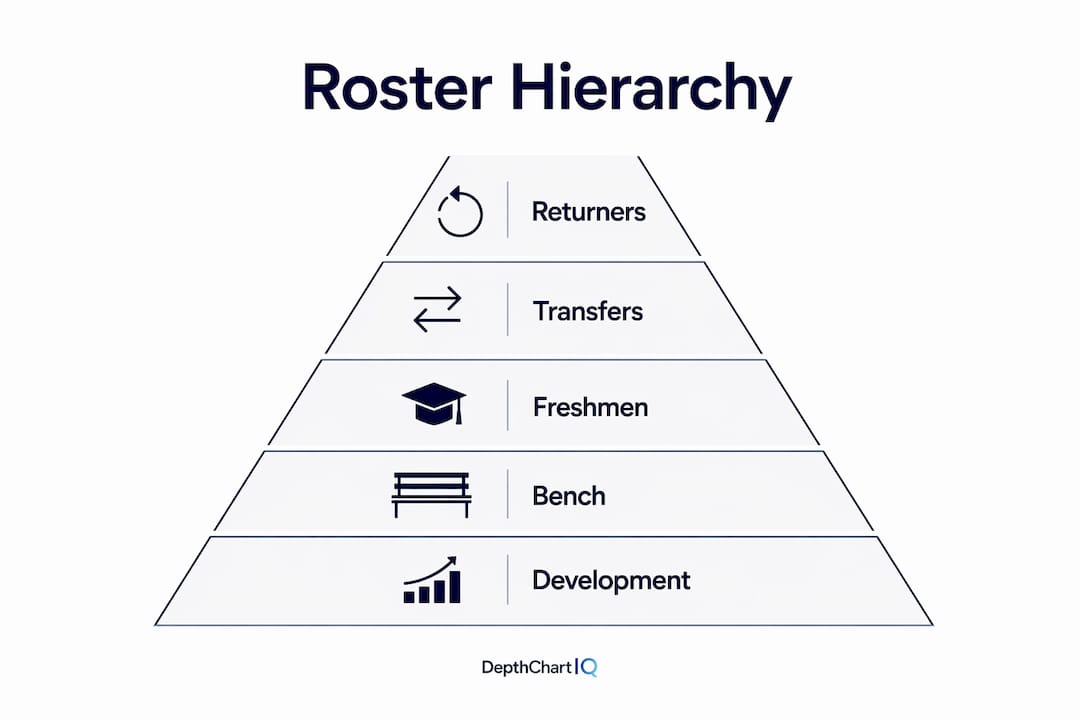
Role clarity is the output of good roster construction. When every player knows his job, the team executes faster and with less hesitation. Programs that leave roles undefined create internal competition that hurts performance rather than helping it.
How does understanding roster hierarchy help recruits and athletes?
Knowing how rosters are organized in college basketball gives you a concrete framework for evaluating every program you consider. It moves the conversation beyond “they offered me” to “here is where I actually fit.”
How roster changes affect athlete opportunities is one of the most underanalyzed factors in recruiting decisions. A program that loses three starters to graduation or the portal next spring looks very different from one that returns everyone. That context changes your opportunity completely.
Here is how to apply roster hierarchy knowledge to your own career planning:
- Map the current roster at your position. Count how many players ahead of you are returners, how many are transfers, and how many are freshmen. That map tells you your realistic timeline.
- Ask about multi-year projections. A coach who can tell you where you fit in year two and year three is a coach who has thought seriously about your development.
- Evaluate early playing time potential at each program. Some programs develop players slowly. Others put freshmen in the fire immediately. Know which environment fits your game.
- Consider the transfer portal risk. If a program adds two or three transfers at your position every year, your minutes are never secure. Factor that instability into your decision.
Comparing college basketball program fit requires more than watching highlight reels. It requires understanding the roster structure you are entering and where you realistically land within it.
Key Takeaways
College basketball roster hierarchy is defined by how programs distribute roles and minutes among returners, freshmen, and transfers, with elite teams consistently prioritizing returner continuity above all other factors.
| Point | Details |
|---|---|
| Returners anchor the hierarchy | Elite teams give returners about 57.5% of minutes, setting the floor for stability and defense. |
| Freshmen minutes signal program philosophy | Programs allocating 14% or more to freshmen are willing to develop talent over time. |
| Transfers fill gaps, not foundations | Elite teams use transfers for about 28.3% of minutes, targeting specific roster needs. |
| Depth beats star power | Teams with balanced talent across 10–12 players outperform single-star rosters in performance metrics. |
| Role clarity drives development | Athletes who understand their place in the hierarchy develop faster and contribute more consistently. |
What I’ve learned watching roster hierarchies evolve
The conventional wisdom used to be simple: returners start, freshmen wait, transfers plug holes. That model still exists, but the best programs have moved well past it.
What I have seen over years of watching roster data is that the most dangerous assumption a recruit can make is that class year determines opportunity. It does not. Role clarity and talent fit determine opportunity. A freshman who arrives with a specific skill the team needs will play ahead of a sophomore who does not. A transfer who fits the defensive system will start over a returner who does not.
The other misconception I keep seeing is that transfer-heavy rosters are a sign of program strength. They are often the opposite. Programs that cycle through the portal every year are programs that cannot retain talent. Retention is the real signal. When players choose to stay, it means the development environment works.
The data point that changed how I think about this: defense and stability rely on roster continuity, regardless of whether the players are returners, freshmen, or transfers. Continuity is the variable. The class label is secondary. If you are evaluating a program, count how many players from last year’s rotation are coming back. That number is more predictive than any ranking or reputation.
— John
DepthchartIQ gives you the roster picture before you decide
Choosing a program without knowing its roster structure is like accepting a job without knowing your role. DepthchartIQ changes that.

The platform uses advanced metrics and prediction algorithms to show you exactly how minutes are distributed across a program’s roster, where openings exist, and how your profile fits within the current hierarchy. Its roster analysis tools include Success Probability Scores and Roster Pressure insights built specifically for recruits and college athletes making high-stakes decisions. DepthchartIQ reports a 76% accuracy rate in predicting player outcomes, which means the picture it gives you is grounded in real performance patterns, not guesswork. See where you fit at depthchartiq.ai.
FAQ
What is the NCAA roster limit for college basketball?
The NCAA sets a 15-player roster limit for Division I college basketball programs. Meaningful playing time typically spreads across 10–12 active spots per game.
How much playing time do returners typically get?
Returning players receive about 55.5% of minutes across all programs, with elite teams allocating closer to 57.5%. That majority share reflects the value programs place on experience and continuity.
Do freshmen get significant playing time in college basketball?
Freshmen average about 11% of minutes across all programs. Elite programs push that figure to roughly 14%, typically when the freshman brings a specific skill the roster needs immediately.
How do transfers affect a player’s opportunity on a roster?
Transfers fill specific gaps and account for about 28.3% of minutes on elite teams. A high volume of transfers at your position signals direct competition for your minutes and warrants careful evaluation before committing.
How can a recruit use roster hierarchy to choose a program?
Map the current roster at your position, count returners ahead of you, and ask coaches about your projected role in year two. Programs with clear role definitions and strong retention rates offer the most predictable development paths.