
Why Transfer Destination Matters in Basketball
Discover why transfer destination matters in basketball. Make informed choices for career growth, playing time, and NIL opportunities.

DepthChartIQ
Athletic Intelligence

Why Transfer Destination Matters in Basketball

Transfer destination is the single most consequential decision a college basketball player makes after signing a letter of intent. The right program accelerates your development, puts you in front of scouts, and opens NIL opportunities. The wrong one costs you a year of eligibility and sets your career back. Research from Georgetown’s McDonough School of Business confirms that college basketball transfers follow a predictable labor market, driven by optimization for exposure, professional pathways, and role fit, not random dissatisfaction. Understanding why transfer destination matters in basketball means looking past the logo on the jersey and asking harder questions about playing time, coaching philosophy, and system fit.
Why transfer destination matters in basketball more than most players realize
The transfer portal is not a reset button. It is a labor market, and like any labor market, the outcome depends on where you land, not just that you moved. Research from the Journal of Intercollegiate Sport identifies the athlete-coach relationship as the most critical factor driving transfer decisions in Division I men’s basketball. That finding matters because most players enter the portal focused on program prestige or NIL dollar amounts, not on whether the coach’s system actually fits how they play.
Playing time and role clarity follow directly from coaching fit. A player who transfers to a higher-profile program but sits behind two McDonald’s All-Americans has not improved his situation. He has traded one problem for a more visible one. The impact of transfer choices in basketball compounds over time. One wasted season at the wrong destination can push a player out of professional consideration entirely.

NIL opportunities also vary sharply by destination. Larger media markets and Power Four programs carry bigger brand partnerships, but those deals go to players with defined roles and consistent minutes. A player buried on the depth chart at a brand-name school earns less NIL income than a starter at a well-run mid-major with strong regional media coverage.
What factors make a transfer destination critical for athlete success?
Four factors separate good transfer destinations from bad ones. Coaching fit sits at the top of the list, followed by system compatibility, role clarity, and NIL market access.
- Coaching fit: The coach-athlete relationship drives transfer satisfaction more than any other variable, including teammates and facilities. A coach who communicates clearly, develops your specific skill set, and gives you a defined role is worth more than a famous name on a staff roster.
- System compatibility: A stretch four who transfers to a program running a physical post-heavy offense will struggle regardless of his talent. The system has to match your game, not the other way around.
- Role clarity: Vague promises about “competing for minutes” are a warning sign. The best transfer destinations offer a clear, specific role before you sign.
- NIL market access: Program size and media footprint determine your earning ceiling. A starting guard at a mid-major in a top-20 media market can out-earn a backup at a Power Four school in a smaller city.
Pro Tip: Before committing to any program, ask the coaching staff to show you film of how they used a player at your position last season. Their answer tells you more than any recruiting pitch.
The importance of transfer location also shows up in player development infrastructure. Programs with dedicated skill development coaches, advanced analytics staff, and strong alumni networks in professional basketball give you resources that directly improve your draft stock.
How does the transfer portal function as a labor market?
Georgetown Business research by Brooks Holtom frames transfer portal dynamics through the same push-pull model used to explain corporate employee mobility. Push factors are the conditions that drive a player out of a program: limited playing time, a coaching change, or a system that does not fit. Pull factors are the conditions that attract a player to a new destination: a defined role, better NIL access, or a coach with a track record of developing players at your position.
Understanding this framework changes how you should approach the portal. Players who enter purely on push factors, meaning they are running away from a bad situation, often make reactive decisions. They pick the first program that shows serious interest rather than the one that fits best. Players who enter with pull factors clearly defined make better decisions because they know what they are looking for before the calls start coming in.
| Factor type | Example | Decision quality |
|---|---|---|
| Push only | Left due to coaching change, no target program | Often reactive, higher re-entry risk |
| Pull only | Targeted specific role at specific program | Deliberate, lower re-entry risk |
| Push and pull | Left bad fit, had clear destination criteria | Most informed, best outcomes |
Winning at smaller programs also creates an unexpected transfer risk. A player who dominates at a mid-major becomes visible to larger schools with bigger NIL budgets. That visibility is good for the player’s career, but it means mid-major programs face constant roster churn even when they develop talent well. As a recruit evaluating a mid-major destination, factor in whether the program has a history of keeping its best players or losing them after one breakout season.
Why coaching fit matters more than NIL offers or program prestige
The phrase “failed negotiations” appears frequently in transfer portal coverage, but industry observers note that it usually masks a deeper issue: poor tactical or system fit rather than a purely financial disagreement. A player and a program can agree on money and still produce a failed transfer if the coach’s scheme does not use the player’s strengths.
Alabama transfer Aiden Sherrell made this point directly. He stated publicly that he has never made a decision over money, emphasizing role and fit as his primary criteria. His experience reflects a broader pattern. Players who chase the highest NIL offer without evaluating system fit frequently re-enter the portal within a year.
- Prestige without role clarity: A brand-name program that cannot tell you exactly how you fit their rotation is a risk, not an opportunity.
- High NIL, wrong system: A player who thrives in a motion offense will not produce in a set-play heavy system, regardless of what he earns off the court.
- Fit with moderate NIL: A player in the right system with a defined role builds the on-court résumé that drives NIL value upward over time.
Pro Tip: Ask every coaching staff you speak with: “What does your starting lineup look like next season, and where do I fit?” If they cannot answer specifically, keep looking.
High NIL offers do not guarantee transfer success. Fit and system compatibility are the variables that actually predict performance and satisfaction. The players who thrive after transferring are often under-the-radar athletes with strong efficiency metrics who found a system that uses their skills, not marquee names who chased the biggest check.
How can athletes evaluate and choose the best transfer destination?
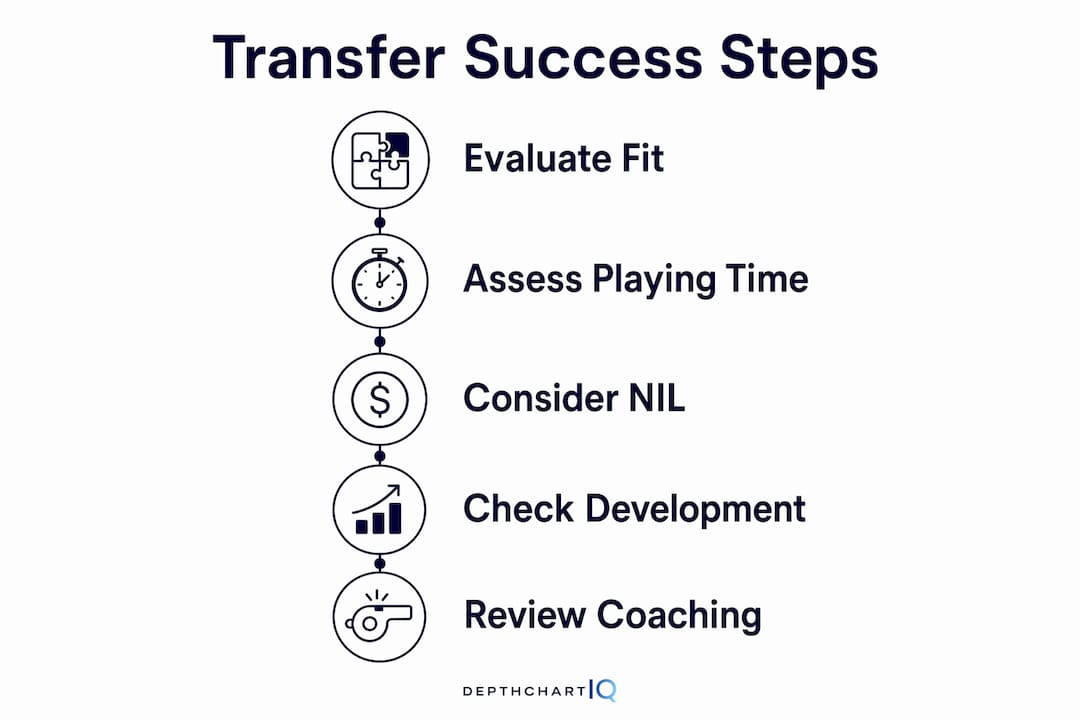
Evaluating transfer destinations requires a structured process, not a gut feeling. Use this checklist before committing to any program.
- Map the depth chart. Request the current roster and identify how many players at your position are returning, graduating, or also in the portal. DepthchartIQ’s Roster Pressure insights give you a data-driven view of where you actually fit before you commit.
- Audit the coaching staff’s track record. Look at how the coach developed players at your position over the last three seasons. Did those players improve statistically? Did any reach professional levels?
- Clarify your role in writing. A verbal promise about playing time is not a commitment. Ask for specifics about your expected role and get it documented in your scholarship agreement where possible.
- Research the NIL market realistically. Talk to current players about actual NIL income, not projected figures. Programs often advertise top-end deals that only one or two players receive.
- Evaluate team culture directly. Speak with current players without coaching staff present. Ask about practice environment, communication style, and how the coach handles adversity.
- Check roster stability. A program that loses multiple players to the portal every year signals internal problems. Use a transfer decision checklist to track these patterns across every school you consider.
- Assess proximity and support systems. Geographic location affects your mental health, family access, and recovery resources. Do not underestimate this factor.
Warning signs to avoid include vague language about “competing for a spot,” coaching staffs that cannot explain their offensive or defensive system clearly, and programs with three or more players at your position already on scholarship. A mismatch between your expected role and the system the coach actually runs is the leading cause of early portal re-entry and dissatisfaction.
Many mid-major programs lose top players to bigger schools due to NIL and exposure gaps. That reality cuts both ways. If you are a high-efficiency player who needs minutes and development, a mid-major destination with a clear role may serve your career better than a Power Four bench spot.
Key takeaways
Transfer destination shapes every dimension of a college basketball career, from playing time and development to NIL income and professional exposure, making it the most consequential decision a player makes in the portal.
| Point | Details |
|---|---|
| Coaching fit is the top factor | The athlete-coach relationship drives transfer satisfaction more than NIL, prestige, or facilities. |
| System compatibility beats prestige | A player in the right scheme outperforms a mismatched player at a bigger school every time. |
| Role clarity before signing | Vague promises about minutes are a warning sign; demand specifics before committing. |
| NIL follows performance | Defined roles and consistent minutes generate more NIL value than a backup spot at a brand-name program. |
| Use data to evaluate destinations | Tools like DepthchartIQ’s Roster Pressure insights remove guesswork from depth chart analysis. |
The transfer conversation most players get wrong
The transfer decision gets most of the attention, but the transfer conversation with your current coach is where careers quietly get damaged. Players’ transfer conversations demand tact to protect current relationships and future reputation in the sport. College basketball is a small world. The coach you leave today may be the assistant at your next program’s rival, or the scout who calls your agent in three years.
What I have seen repeatedly is players treating the transfer as a purely logistical move, when it is also a professional relationship decision. The athletes who handle it with maturity, who communicate directly and honestly with their current staff, almost always land in better situations. The ones who ghost their coaches or leak their portal entry to the media before having a direct conversation tend to carry that reputation into their next stop.
The deeper issue is that most players focus entirely on the destination and almost nothing on the process of getting there. Fit evaluation, role research, and honest self-assessment about what went wrong at the current program are the real work. Skipping that work and picking the first program that offers a scholarship is how players end up re-entering the portal a second time.
Approach your transfer as a professional growth decision. You are not just changing schools. You are choosing the environment where you will develop the skills, relationships, and reputation that determine your career ceiling. That deserves more than a week of phone calls and a social media announcement.
— John
How DepthchartIQ helps athletes choose the right destination
Choosing a transfer destination without data is like signing a contract without reading it.
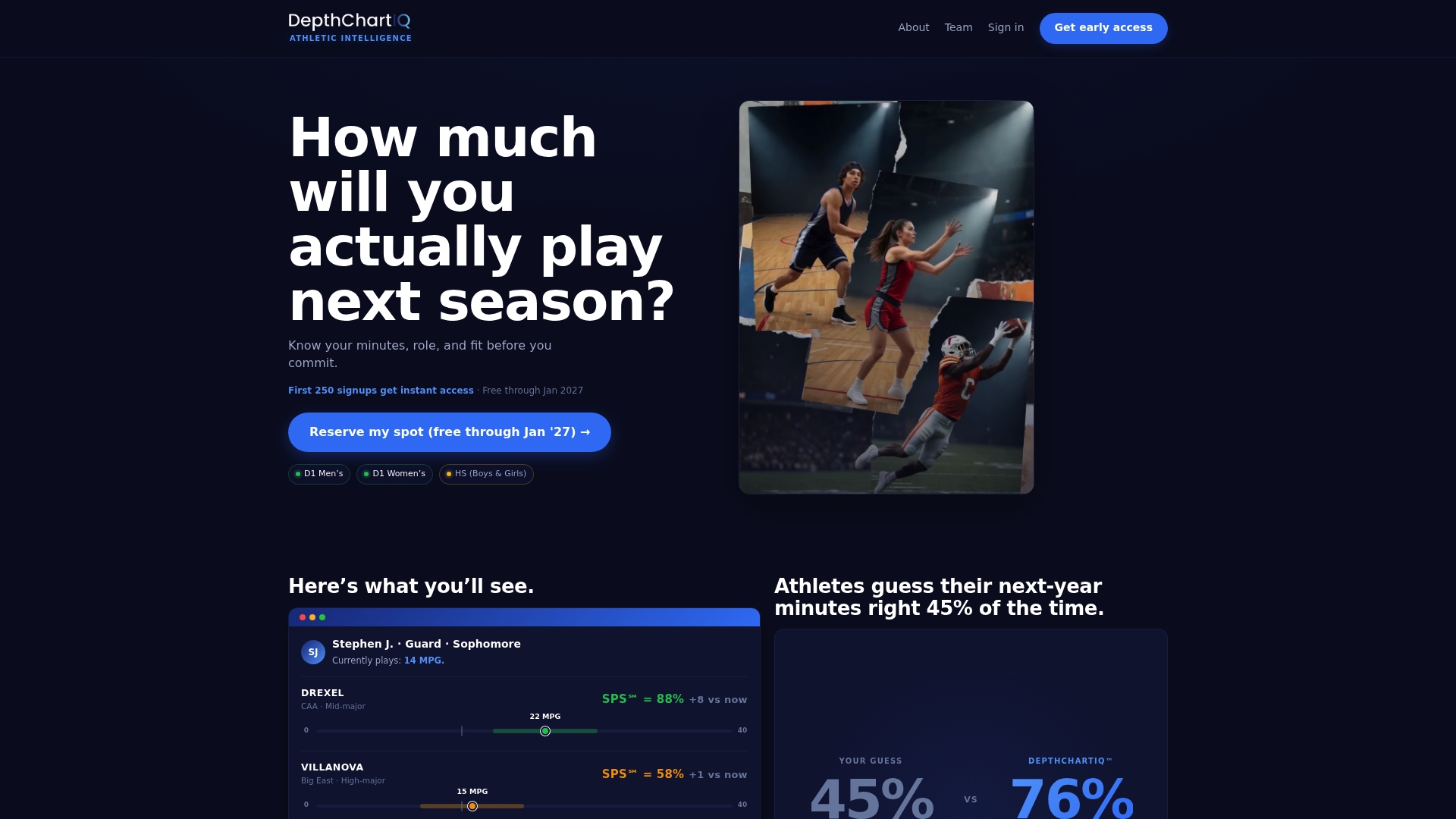
DepthchartIQ gives college athletes and high school recruits a clear picture of where they actually fit before they commit. The platform’s Success Probability Scores and Roster Pressure insights show you how roster changes at any program affect your projected playing time, with a 76% accuracy rate in predicting player outcomes. You can evaluate multiple programs side by side, identify depth chart openings, and make a decision grounded in real data rather than recruiting pitches. Visit DepthchartIQ to see how the platform supports your transfer evaluation from the first portal entry to the final commitment.
FAQ
Why does transfer destination matter so much in basketball?
Transfer destination directly determines your playing time, development environment, NIL earning potential, and exposure to professional scouts. The wrong destination can cost you a full season of eligibility and set your career back significantly.
What is the most important factor when choosing a transfer destination?
Research from the Journal of Intercollegiate Sport identifies the athlete-coach relationship as the top factor. System compatibility and role clarity follow closely behind NIL and program prestige.
Should I prioritize NIL money when picking a transfer destination?
NIL offers should not be your primary criterion. Players who prioritize role fit and coaching connection over NIL income consistently outperform those who chase the highest offer without evaluating system fit.
How do I evaluate program fit before committing?
Audit the depth chart at your position, speak with current players without staff present, and ask the coaching staff specifically how you fit their rotation next season. A program fit comparison framework helps you assess multiple schools against the same criteria.
What are the warning signs of a bad transfer destination?
Vague promises about playing time, coaching staffs that cannot explain their system clearly, and high roster turnover year over year are the clearest warning signs. A mismatch between expected and actual role is the leading cause of players re-entering the portal within a single season.