
Find a College Program with Early Playing Time
Discover how to find a college program with early playing time. Learn to target schools with a history of starting freshmen and transfers.

DepthChartIQ
Athletic Intelligence

Find a College Program with Early Playing Time

Early playing time is defined as consistent, meaningful court minutes earned by freshmen or transfer athletes within their first season at a program. For basketball players, securing those minutes depends less on talent alone and more on choosing the right program. The best way to find a college program with early playing time is to target schools with a documented history of starting underclassmen or transfers, then verify that history with hard evidence rather than coach promises. Roster turnover, division level, and the transfer portal all shape how quickly you can step into a real role. This guide gives you the exact framework to identify those programs and position yourself to get recruited by them.
How to find college programs with early playing time
The most reliable way to identify genuine early playing time opportunities is to analyze a program’s roster history, not just listen to what coaches say during recruiting visits. Coaches at every level will tell you that you have a real shot at starting. The ones worth believing are backed by receipts from past lineups, meaning actual box scores and depth charts showing true freshmen or first-year transfers logging significant minutes.
Start by pulling the last two or three seasons of rosters for any program you are considering. Look for patterns: Did freshmen appear in the starting five? Did transfers contribute immediately? Programs that consistently integrate new players are structurally built to do it again. Programs that rely on upperclassmen year after year are telling you something just as clearly.

The transfer portal has shifted this calculus. Transfer portal dynamics now push coaches to seek ready-to-play athletes, which means depth chart turnover is often a stronger signal of opportunity than freshman start history alone. A program that loses two or three starters to the portal every spring is a program with open spots.
Key criteria to evaluate when researching programs:
- Roster turnover rate: Programs that lose multiple upperclassmen annually create recurring openings.
- Freshman and transfer start history: Check box scores from the past two seasons for evidence of early contributors.
- Coaching philosophy: Some coaches publicly commit to playing the best player regardless of class year. Find those coaches.
- Depth at your position: A team with three returning guards and no departures is not your opportunity. A team with one returning guard is.
- Program level and division: Lower-enrollment D2, D3, NAIA, and JUCO programs statistically carry fewer players at each position.
DepthchartIQ provides athletes with Success Probability Scores and Roster Pressure insights built from real roster data, which removes the guesswork from this analysis entirely.
Pro Tip: Search a program’s name plus “true freshman minutes” or “transfer impact” on sports news sites. Beat writers cover this better than any recruiting database.
What recruiting timelines mean for your playing time search
Timing your outreach correctly is the second major variable in securing early playing time opportunities. Recruiting rules differ sharply by division: D1 programs operate under strict NCAA contact windows, while D3, NAIA, and JUCO programs can communicate with athletes at any time. That flexibility at lower divisions is a real advantage for athletes who want to move fast.
The recruiting process for college athletic programs works best when you treat it like a job search with a deadline. Here is a practical sequence:
- Build your target list first. Effective recruiting requires a realistic list of 30–50 programs across all division levels. Include D1, D2, D3, NAIA, and JUCO schools. Casting a wide net is not settling. It is math.
- Research each program’s depth chart before you email. Personalized outreach that references a specific roster need gets responses. Generic emails do not.
- Send your first email in the spring of your sophomore or junior year. Families who start outreach in 8th or 9th grade fare better overall, but late starters in 11th and 12th grade can still secure spots with urgency and focused effort.
- Attach a highlight film under four minutes. Coaches watch the first 60 seconds. Put your best plays there.
- Follow up every two to three weeks. Persistence signals coachability. One email is not a recruiting campaign.
- Attend showcases and college camps. In-person evaluation accelerates decisions. Coaches who see you live move faster than those who only watch film.
- Ask directly about your position’s depth chart. The question “Who is returning at my position next year?” is not rude. It is the right question.
Pro Tip: Email the position coach, not just the head coach. Position coaches drive playing time decisions and often manage their own recruiting pipelines.
Seniors should not assume the window has closed. Coaches across all divisions fill roster spots through spring and actively seek late additions. The urgency is real, but so is the opportunity.
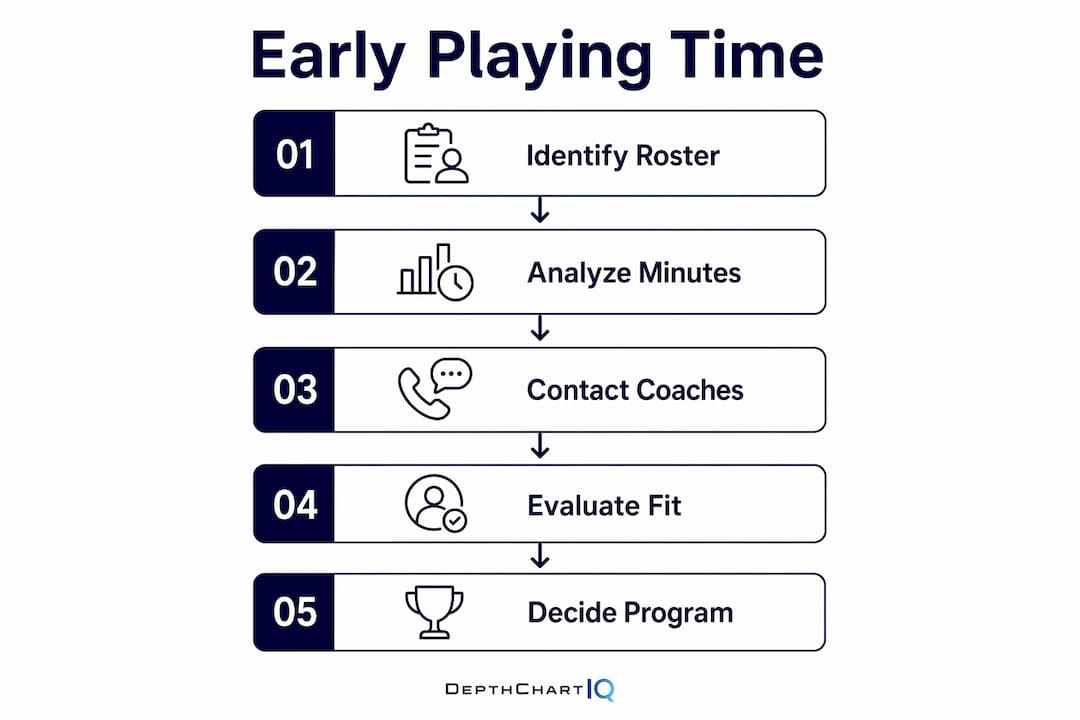
Why division level and the transfer portal change your odds
Most athletes fixate on D1 programs. That instinct is understandable and almost always counterproductive for athletes who want to play right away. 94% of college football players compete outside FBS, and the same principle applies in basketball: the vast majority of college athletes find their best development environment outside the top tier. The playing time math simply works better at D2, D3, NAIA, and JUCO levels.
Junior college as a fast track
The NJCAA is the most direct path to immediate playing time for many athletes. Over 60,000 student-athletes compete across 525 NJCAA colleges, and junior college programs typically carry smaller rosters with more open positions per player. The two-year window forces coaches to play their best available athletes. There is no redshirting a roster spot when your program only lasts two seasons.
Junior college also functions as a bridge to four-year programs. Athletes who develop and produce at the JUCO level regularly transfer to D1, D2, or D3 schools with a track record that makes them attractive recruits. The path is longer in calendar years but often shorter in terms of actual playing time earned.
Transfer portal opportunities at four-year programs
The transfer portal has fundamentally changed roster management at every NCAA division. Coaches now expect turnover and plan for it. That planning creates predictable openings, especially at programs that lose multiple contributors each spring. Athletes who prioritize rep equity over school name recognition are making a rational career decision. Getting 25 minutes per game at a D2 program builds more film, more confidence, and more options than sitting on a D1 bench for two years.
The shift toward rep equity is not just a trend among overlooked athletes. Top recruits increasingly choose mid-tier programs specifically because they want to play immediately. That shift validates the strategy.
| Division level | Typical roster size | Contact rules | Transfer portal activity |
|---|---|---|---|
| NCAA D1 | 13 scholarship players | Restricted windows | Very high |
| NCAA D2 | 10 scholarship players | Fewer restrictions | Moderate to high |
| NCAA D3 | No scholarships, open rosters | No restrictions | Moderate |
| NAIA | Smaller scholarships | No restrictions | Lower |
| NJCAA (JUCO) | Smaller rosters, 2-year cycle | No restrictions | High outbound |
When you evaluate current school fit against these variables, the right level becomes clearer quickly.
Common mistakes that cost athletes early playing time
The most expensive mistake in college basketball recruiting is taking a coach’s verbal promise as a guarantee. Coaches are optimistic by nature and competitive by profession. They will tell you what they believe in the moment. That belief does not survive roster changes, portal additions, or a coaching staff turnover. Verify every claim with box scores, not conversations.
“The best way to measure true early playing opportunity is detailed roster history and turnover analysis, not just coach promises or recruit rankings. Evidence from past lineups is the only reliable signal.”
Other patterns that consistently derail athletes seeking early playing time:
- Ignoring academic eligibility: Missing NCAA or NJCAA eligibility requirements ends your playing career before it starts. Confirm your GPA and test score requirements for each division early.
- Starting outreach too late: Athletes who begin contacting coaches in the fall of their senior year are competing for the last available spots, not the best ones.
- Targeting only D1 programs: Narrowing your search to the top tier without evidence that you fit those rosters wastes months of recruiting time.
- Skipping the position-specific depth chart analysis: A school might look great on paper but have three returning players at your exact position. That is not an opportunity.
- Overlooking coaching stability: A coach who recruited you may not be there when you arrive. Check a staff’s tenure before committing.
Parents play a real role here. The 2026 guide to evaluating college athletic programs outlines exactly what families should verify before a commitment is made.
Key Takeaways
The most reliable path to early college basketball playing time runs through programs with documented roster turnover, a history of starting underclassmen or transfers, and a division level that matches your current readiness.
| Point | Details |
|---|---|
| Verify with receipts | Check actual box scores for freshmen and transfer minutes, not just coach promises. |
| Target roster turnover | Programs losing multiple starters annually create the most predictable openings. |
| Expand your division search | D2, D3, NAIA, and JUCO programs offer more playing time access than D1 for most athletes. |
| Start outreach early and wide | Build a list of 30–50 programs and contact coaches in your sophomore or junior year. |
| Use the transfer portal strategically | Portal-driven roster gaps at four-year programs create immediate impact opportunities for transfers. |
What I’ve learned watching athletes chase the wrong programs
I have watched talented players spend two years on a D1 bench when they could have been averaging 20 points a game one division lower. The prestige trap is real, and it costs athletes their best developmental years. The athletes who come out ahead are the ones who treat the recruiting process like a research project, not a popularity contest.
The data-driven approach matters more than most families realize. Knowing that a program has started three true freshmen in the past two seasons tells you more about your actual opportunity than any campus visit conversation. DepthchartIQ’s 76% accuracy rate in predicting player outcomes reflects exactly this kind of roster-level analysis. That number is not marketing. It is what happens when you replace gut instinct with verified depth chart data.
My honest advice: be flexible about the name on the jersey and inflexible about the minutes on the court. A player who gets 30 minutes per game at a D2 program for four years builds a career. A player who gets 8 minutes per game at a D1 program for two years before transferring builds frustration. The program comparison framework I recommend starts with playing time evidence and works backward to everything else.
Recruiting is not passive. The athletes who find early playing time opportunities are the ones who research 40 programs, email 30 coaches, and visit 10 schools. They treat every contact as a data point. They ask hard questions. They do not wait to be discovered.
— John
DepthchartIQ gives you the data to find the right program
Choosing a program based on roster history and depth chart analysis is the right approach. Doing that research manually across dozens of programs takes weeks.
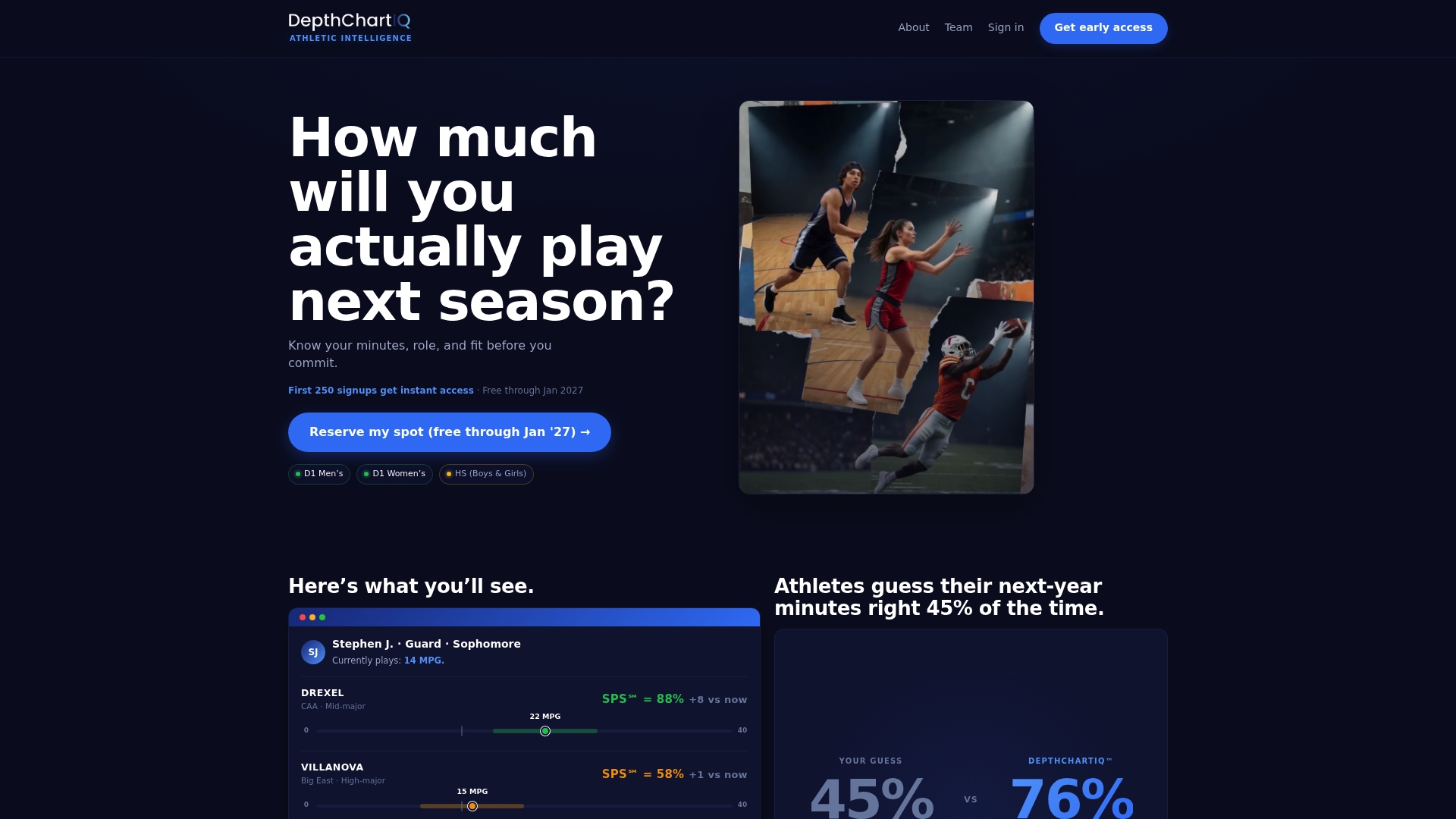
DepthchartIQ pulls real roster data, tracks depth chart changes, and generates Success Probability Scores so you can see exactly where your chances of early playing time are highest. The platform’s Roster Pressure insights flag programs with open positions at your spot before those openings become public knowledge. Athletes using DepthchartIQ enter recruiting conversations with verified data, not assumptions. Explore the DepthchartIQ methodology to see how the platform builds its predictions, or go directly to DepthchartIQ to start your program search today.
FAQ
What does “early playing time” mean in college basketball?
Early playing time refers to meaningful court minutes earned by a freshman or first-year transfer during their initial season. Programs with a history of starting underclassmen offer the strongest evidence of this opportunity.
How do I know if a program will actually give me playing time?
Check the program’s box scores and rosters from the past two seasons. Look for freshmen and transfers who started or played significant minutes. Coach promises without this evidence are not reliable indicators.
Is junior college a good path to early playing time?
Yes. The NJCAA’s 525 colleges offer smaller rosters and a two-year structure that pushes coaches to play their best available athletes immediately. JUCO is one of the most direct routes to consistent early minutes.
When should I start contacting college coaches?
Starting in 8th or 9th grade produces the best outcomes, but seniors can still secure spots with focused, urgent outreach through spring. Contact coaches at D3, NAIA, and JUCO programs first, since those divisions have no contact restrictions.
Does the transfer portal help athletes get early playing time?
The transfer portal creates predictable roster gaps at programs that lose multiple contributors each spring. Athletes who predict minutes at a new school by analyzing depth chart turnover can identify and target those openings before the competition does.