
High School Recruit Program Comparison Guide 2026
Discover the high school recruit program comparison guide to find the best path for your athlete. Make informed decisions today!

DepthChartIQ
Athletic Intelligence

High School Recruit Program Comparison Guide 2026

A high school recruit program comparison guide is a decision framework that separates three distinct categories: eligibility clearance, recruiting calendars, and recruiting platforms. Most families collapse all three into one vague concept called “the recruiting process,” and that confusion costs athletes real opportunities. The NCAA Eligibility Center, NCSA, and FieldLevel each solve different problems. Knowing which problem you actually have determines which program deserves your time and money. This guide breaks each category down so you can match your athlete’s specific needs to the right path.
What does a high school recruit program comparison guide actually cover?
A recruit program comparison guide covers three separate decision areas: academic eligibility clearance, recruiting calendar rules, and recruiting platform services. These three areas are distinct and require different actions at different times. Treating them as one process is the most common mistake families make. Getting clarity on each category before spending money on any service is the fastest way to avoid wasted effort.
Eligibility clearance happens through the NCAA Eligibility Center or the NAIA Eligibility Center. Recruiting calendars govern when coaches can legally contact athletes. Recruiting platforms like NCSA, FieldLevel, SportsRecruits, and Hudl help athletes build profiles and connect with coaches. Each tool solves a specific bottleneck, not all of them at once.

How do NCAA and NAIA eligibility centers compare?
NCAA and NAIA eligibility centers set the academic and amateur standards an athlete must meet before any college program can officially recruit them. Division requirements differ significantly: NCAA Division I requires a minimum core GPA of 2.3 with a sliding scale for test scores, Division II requires a 2.2 GPA with fixed ACT or SAT scores, and Division III sets its own independent standards. The NAIA uses a different model entirely, requiring athletes to meet two of three criteria: GPA, test scores, or class rank.
The NCAA Eligibility Center reviews only approved core courses. Grades earned in non-approved courses do not count toward eligibility, regardless of how strong those grades are. Early course auditing is the single most effective way to protect an athlete’s eligibility timeline. Changing a course in sophomore year is manageable. Discovering a problem in senior year is not.
International athletes face an additional layer. Document submission must go through the recruiting school’s admissions or registrar’s office, not directly from the student. Translations must be line-by-line and certified. The NCAA rejects unofficial translations and any documents submitted directly by the athlete.
Pro Tip: Register with the NCAA Eligibility Center no later than the start of junior year. Log in to the student portal and cross-check every course on your transcript against the approved course list for your high school. One unapproved course can shift your entire eligibility calculation.
Key differences at a glance:
- NCAA Division I: Core GPA 2.3 minimum, sliding scale test scores, 16 core courses required
- NCAA Division II: Core GPA 2.2 minimum, fixed ACT/SAT benchmarks, 16 core courses required
- NCAA Division III: No NCAA Eligibility Center registration required; schools set their own standards
- NAIA: Two of three criteria: GPA, standardized test score, or class rank in top 50% of graduating class
What are recruiting calendars and contact windows?
Recruiting calendars define the specific periods during which college coaches can legally contact, evaluate, or visit with a high school athlete. The four main periods are contact, quiet, dead, and evaluation. Each period restricts what coaches and athletes can do, and violations carry real consequences for programs.
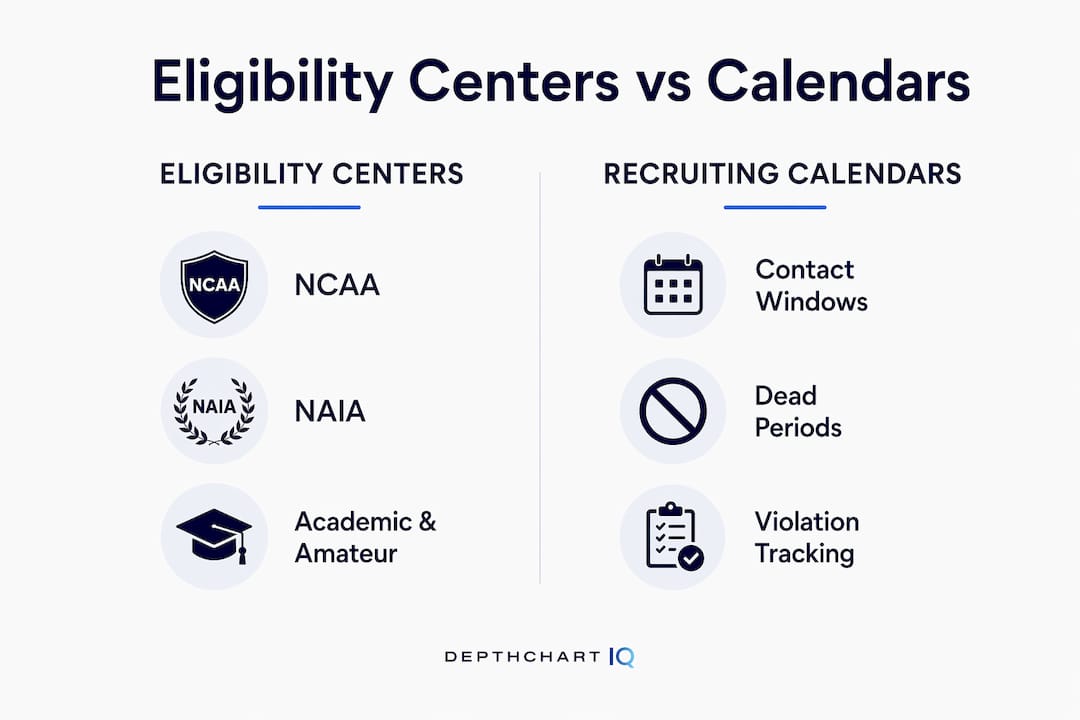
The contact period allows face-to-face communication between coaches and athletes off campus. The quiet period limits contact to on-campus visits only. The dead period prohibits all in-person contact, including unofficial visits. The evaluation period allows coaches to watch athletes compete but prohibits verbal communication off campus.
These windows vary by sport and by NCAA division level. A football recruit operates on a completely different calendar than a tennis recruit. Division I basketball has stricter contact windows than Division II. Families who understand these rules can time their outreach, campus visits, and highlight film submissions to land when coaches are actually permitted to respond.
- Identify your sport’s specific calendar. NCAA.org publishes division-specific recruiting calendars updated each year.
- Mark contact periods in advance. These are the windows when coaches can call, text, and meet off campus.
- Schedule unofficial visits during quiet periods. Coaches can still meet with athletes on campus during quiet periods.
- Send film and profile updates before evaluation periods. Coaches review materials before they travel to watch athletes compete.
- Avoid cold outreach during dead periods. Coaches cannot respond, and repeated contact during dead periods reflects poorly on the athlete.
Recruiting calendar violations are tracked at the program level, not the athlete level. Coaches who break contact rules face NCAA sanctions. That means coaches are highly aware of these windows, and athletes who demonstrate the same awareness stand out immediately.
Which recruiting platforms are worth comparing?
Recruiting platforms solve the exposure problem, not the eligibility problem. Choosing the right platform means identifying your athlete’s specific bottleneck first: film visibility, coach outreach, profile credibility, or expert guidance. Paying for a full-service platform when you only need film hosting wastes money.
The major platforms differ in price, feature depth, and the type of athlete they serve best:
| Platform | Pricing | Best for |
|---|---|---|
| NCSA | $1,500–$4,200+ | Athletes wanting full-service guidance and coach matching |
| FieldLevel | $29–$79 per month | Athletes who want direct coach outreach at lower cost |
| SportsRecruits | Varies by school | Athletes whose high school subscribes to the platform |
| Hudl | Subscription based | Athletes prioritizing film hosting and video quality |
NCSA provides the broadest feature set, including expert counselors, coach databases, and profile tools. That breadth comes at a price. FieldLevel’s monthly model works well for athletes who are self-directed and want to contact coaches directly without a long-term contract. SportsRecruits operates largely through high school athletic departments, so access depends on whether your school already uses it. Hudl is the gold standard for film quality and is widely used by college coaches for evaluation.
Pro Tip: Before signing up for any platform, write down the one thing currently blocking your recruitment. If coaches don’t know you exist, prioritize coach network access. If you have interest but no film, prioritize Hudl. Matching the tool to the problem saves hundreds or thousands of dollars.
Common pitfalls families hit when selecting platforms:
- Paying for expert guidance when the athlete already has coach interest and just needs a profile
- Choosing the most expensive option assuming it delivers the best results
- Ignoring free tools like the NCAA Eligibility Center portal before spending on paid services
- Signing long-term contracts before confirming the platform has coaches in the target division
For a direct comparison of platform alternatives, the DepthchartIQ recruiting platform guide breaks down feature sets and pricing tiers across the major services.
How do prep programs and academies compare?
Prep programs and post-grad academies serve a different purpose than recruiting platforms. They provide athletic development, academic support, and direct exposure to college coaches through competition schedules. The decision to attend one requires comparing cost, level targeting, roster size, and placement outcomes.
IMG Academy is the most recognized name in this space, with costs ranging from $75,000 to $90,000 or more per year. That price covers housing, coaching, academic instruction, and a national competition schedule. Not every family can or should spend at that level. Smaller regional prep programs offer similar exposure at a fraction of the cost, particularly for athletes targeting Division II or Division III programs.
Post-grad programs differ from standard high school programs in one key way: they give athletes an additional year of development after completing high school eligibility. This extra year is most valuable for athletes who are academically borderline, physically underdeveloped for their target division level, or who received late interest from college programs. Comparing prep programs requires looking at roster size alongside placement claims. A program that places 20 athletes per year at Division I schools means little if the roster carries 80 athletes competing for those spots.
Key criteria for comparing prep programs:
- Level focus: Does the program target Division I, Division II, or a mix? Does it offer post-grad options?
- Roster size: Smaller rosters mean more individual attention and more playing time visibility for coaches
- Cost and what it covers: Confirm whether tuition includes housing, meals, and travel for competitions
- Placement track record: Ask for specific college placements by division level over the past three years
- Academic support: Programs that combine NCAA core course compliance with athletic development protect eligibility while building exposure
For families evaluating the full range of development options, the athlete development program guide from DepthchartIQ provides a structured framework for comparing options by division target and athlete profile.
Key takeaways
A recruit program comparison requires separating eligibility clearance, recruiting calendar rules, and platform selection into three distinct decisions, each solved by different tools at different times.
| Point | Details |
|---|---|
| Separate the three categories | Eligibility, calendars, and platforms are distinct problems requiring different solutions. |
| Audit courses early | NCAA-approved courses are the only ones that count; check your transcript in sophomore year. |
| Match platform to bottleneck | Identify whether your gap is visibility, film, or coach access before paying for any service. |
| Understand contact windows | Timing outreach to contact periods dramatically increases the chance coaches can respond. |
| Evaluate prep programs by placement rate | Roster size and division-specific placements matter more than a program’s brand name. |
What I’ve learned after watching families get this wrong
The families who struggle most in recruiting are not the ones with the least talented athletes. They are the ones who treat recruiting as a single process instead of three separate problems running on different timelines. I have seen athletes lose eligibility over one unapproved elective that nobody caught until senior year. I have seen families spend over $3,000 on a full-service recruiting platform when the athlete already had coach interest and just needed a Hudl account.
The recruiting calendar piece surprises me most. Parents spend months crafting emails to coaches, then send them during a dead period and wonder why nobody responds. Coaches are not ignoring those emails out of disinterest. They are legally prohibited from replying. Understanding that one rule changes the entire communication strategy.
My honest advice: start with the academic eligibility checklist before touching any platform or prep program. If your courses are not approved, no amount of exposure fixes the problem. Once eligibility is confirmed, map the recruiting calendar for your sport and division target. Only then does it make sense to evaluate platforms or prep programs. That sequence saves time, money, and a lot of unnecessary stress.
— John
DepthchartIQ: data-driven tools for recruit program decisions
Families who want more than a general framework benefit from tools that connect athlete-specific data to real program outcomes. DepthchartIQ uses advanced metrics and prediction algorithms to give high school recruits a clear picture of where they fit across college programs.
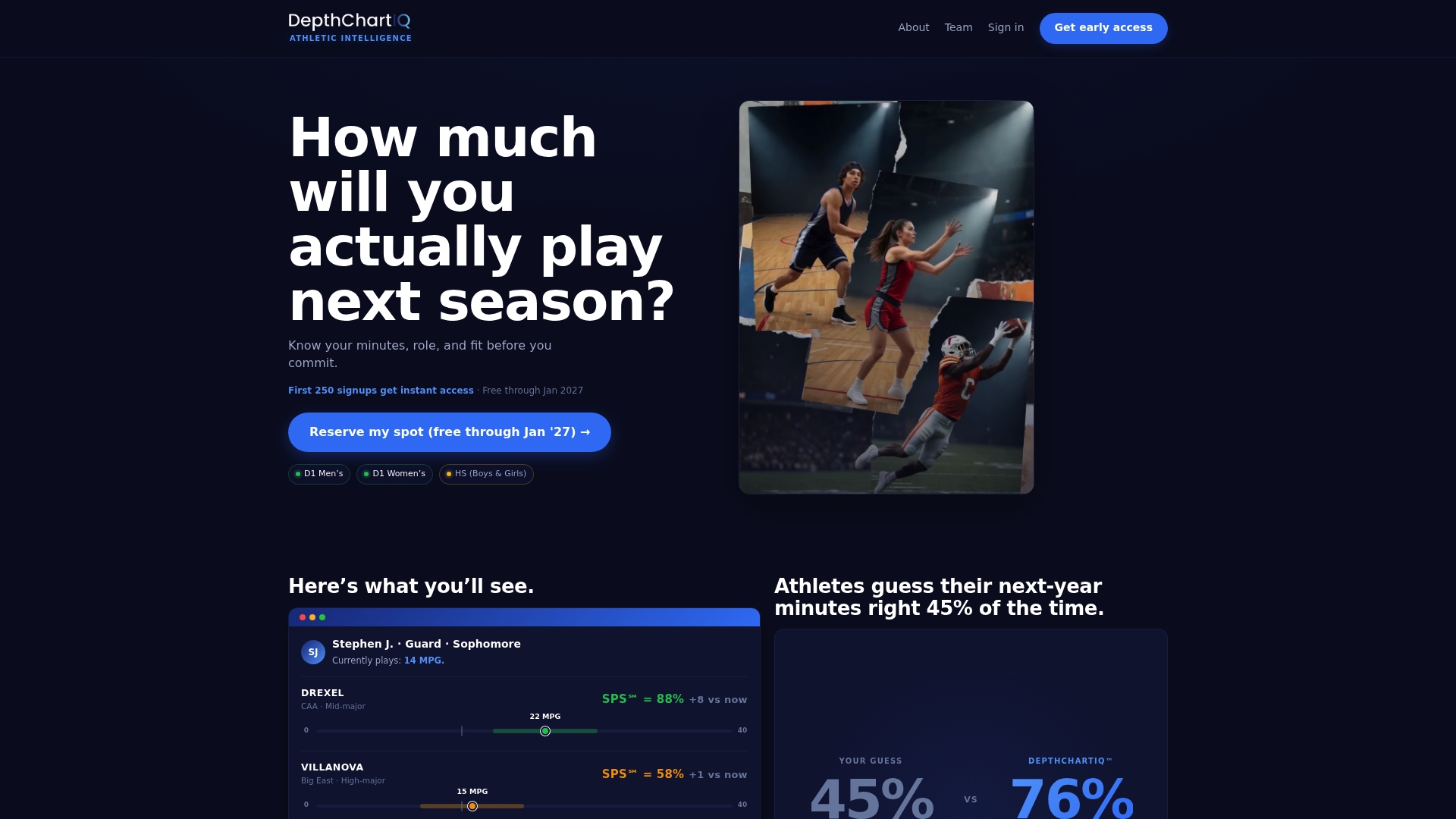
The platform’s Success Probability Scores and Roster Pressure insights show athletes which programs offer the best realistic fit, not just which ones are most prestigious. DepthchartIQ reports a 76% accuracy rate in predicting player outcomes. That level of precision changes how families evaluate options. Learn how the platform works at the DepthchartIQ methodology page, or explore the full suite of tools at DepthchartIQ.
FAQ
What is the NCAA Eligibility Center?
The NCAA Eligibility Center is the organization that certifies whether high school athletes meet the academic and amateur requirements to compete at NCAA Division I or Division II programs. Athletes must register and submit transcripts, test scores, and amateur status information.
When should a high school athlete start the recruiting process?
Most college coaches recommend beginning eligibility registration and profile building no later than the start of junior year. Earlier preparation in sophomore year gives athletes time to correct course approval issues before they affect eligibility.
What is a recruiting dead period?
A dead period is a time defined by NCAA rules during which coaches cannot have any in-person contact with recruits or their families, on or off campus. Athletes can still contact coaches, but coaches cannot respond in person.
How much do recruiting platforms cost?
Recruiting platform costs range from roughly $29 per month for services like FieldLevel to $1,500–$4,200 or more for full-service programs like NCSA. The right price point depends on what specific gap the athlete needs to fill.
Do prep schools guarantee college placement?
No prep school guarantees college placement. Families should request specific placement data by division level over the past three years and compare roster size to placement numbers to assess realistic outcomes.