
How to Compare College Basketball Program Fit in 2026
Learn how to compare college basketball program fit in 2026. Find programs that match your skills, goals, and growth potential for success.

DepthChartIQ
Athletic Intelligence

How to Compare College Basketball Program Fit in 2026

Program fit is defined as the alignment between a player’s skills, goals, and circumstances and what a specific college basketball program actually offers. Most players focus on brand names and rankings. The ones who make smart decisions focus on playing time, coaching philosophy, roster stability, and academic support. NCAA Division I men’s basketball includes 310 programs across 32 conferences, which means the range of opportunity is enormous. When you learn to compare college basketball program fit across these dimensions, you stop chasing prestige and start finding programs where you can actually grow.
How to evaluate playing time opportunities across programs
Playing time is the most concrete measure of fit. A scholarship offer means nothing if you sit on the bench for three years behind players with more experience and a clearer path to the pros.

Start with roster structure. NCAA D1 programs carry up to 13 scholarship players. Power Four rosters often run deep at every position, which compresses available minutes for newcomers. Mid-major programs typically carry fewer five-star recruits, which creates more visible paths to early playing time. Top-tier resources do not guarantee minutes because stacked rosters limit spots compared to mid-majors with clearer paths to the court.
Roster turnover is your best signal for open minutes. Programs with high transfer portal activity or heavy senior classes leave significant gaps. High turnover programs can lose over 84% of scoring production and 78% of minutes played in a single season. That kind of vacancy creates real opportunity for incoming players who fit the position need.
- Check how many minutes and points graduated or transferred players accounted for last season
- Identify your position group specifically, not just the overall roster
- Look at how many players at your position return versus how many are gone
- Compare scholarship availability by class year, not just total roster count
Pro Tip: Pull the box scores from a program’s last 10 games. Add up minutes played by players who are leaving. That number tells you exactly how much court time is up for grabs next season.
Comparing coaching styles and program culture
Coaching style shapes your daily experience, your development arc, and your long-term career. Two programs in the same conference can feel completely different based on who runs the practice floor.
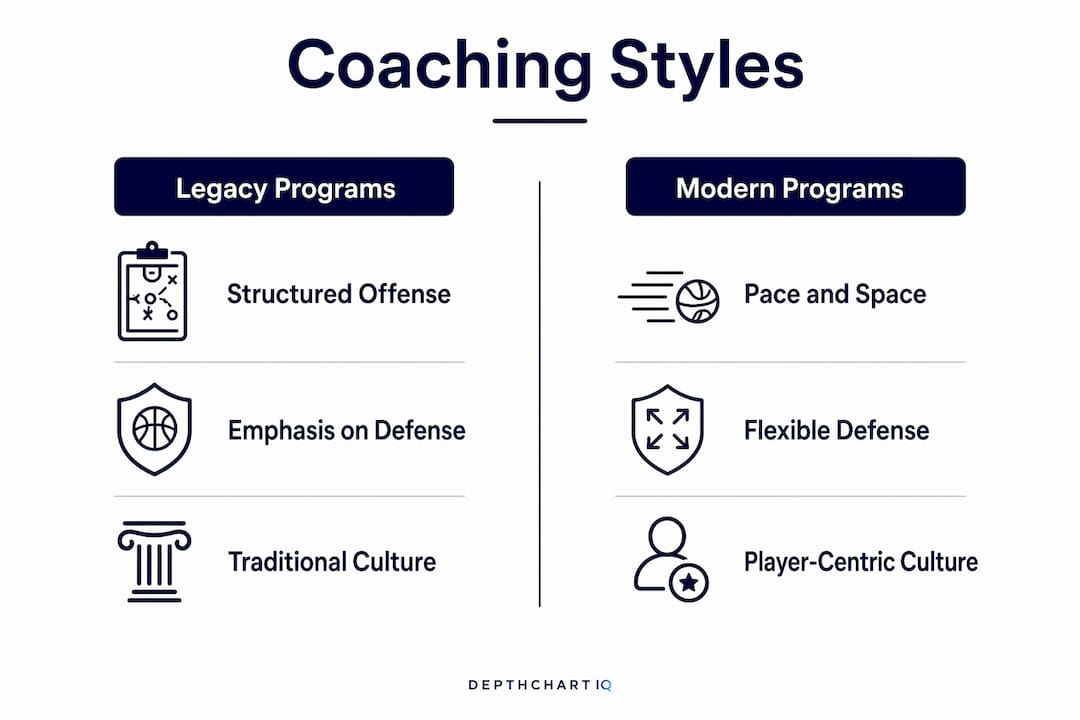
Legacy programs carry deep identity. Jon Scheyer at Duke has adapted Coach K’s winning foundation to a more modern, pace-and-space style rather than simply replicating the old system. That kind of adaptation signals a coach who prioritizes current player development over nostalgia. Programs that cling to outdated systems without adjusting tend to struggle recruiting players whose games were built in modern AAU and high school environments.
Program identity varies sharply by style. UNLV runs a fast-paced offense built on transition and athleticism. Syracuse has used a structured 2-3 zone for decades. Neither is better in the abstract. The question is which system fits how you play and how you want to develop. A guard who thrives in open court situations will have a very different experience in a half-court, possession-based system.
Evaluate these factors when reviewing a coaching staff:
- Coaching tenure at the current program (stability signals commitment to a system)
- Win-loss record over the past three to five seasons
- Number of players who reached professional leagues under that coach
- How often the coach’s system changes versus stays consistent
“The best coach for your career is the one whose system fits your skills today and develops the gaps in your game for tomorrow.”
Pro Tip: Search for interviews where the head coach describes their offensive and defensive philosophy. If their language matches how you describe your own game, that is a strong cultural signal.
Assessing team dynamics and roster stability
Roster stability directly affects team chemistry, player development, and your personal timeline for earning minutes. A program that rebuilds its entire roster every year through the transfer portal may offer fast opportunity, but it rarely builds the kind of trust and chemistry that produces consistent winning.
The transfer portal increases roster turnover significantly. Programs with frequent roster reboots may offer instant chances but risk lacking development stability and culture. For a player who needs two years to develop physically and technically, landing in a revolving-door program can mean competing against new transfers every single offseason.
| Roster type | Playing time timeline | Development environment |
|---|---|---|
| Stable, returning core | Longer wait, clearer role | Strong chemistry, consistent system |
| High turnover, portal-heavy | Faster opportunity | Unpredictable culture, variable coaching focus |
| Mixed (some returns, some transfers) | Moderate competition | Balanced development with some flexibility |
Use this framework to match your own timeline. If you are ready to contribute immediately, a high-turnover program may fit. If you need a year to develop, a stable roster with a clear depth chart gives you a better environment.
Pro Tip: Check the transfer portal activity for your target programs over the past two seasons. A program that loses five or more players per year to the portal signals internal issues beyond just roster management.
Balancing academic, financial, and athletic factors
Athletic fit is only one dimension of a good program decision. Fit requires weighing academics, financial cost, and coaching track record rather than relying on reputation alone. Players who ignore these factors often find themselves at programs that look great on paper but fail them off the court.
Academic outcomes matter beyond eligibility. Graduation rates and post-college earnings vary significantly across programs. A school with strong academic support for athletes protects your future if a professional career does not materialize. The academic balance checklist for college athletes covers the specific questions worth asking during campus visits.
Financial fit is equally concrete. Scholarship offers rarely cover full cost of attendance at every school. Net cost after aid, room, board, and fees can differ by tens of thousands of dollars per year between programs. A partial scholarship at a high-resource program may cost more out of pocket than a full ride at a mid-major.
| Factor | What to measure | Why it matters |
|---|---|---|
| Graduation rate | Four-year athlete graduation percentage | Protects your future beyond basketball |
| Net cost after aid | Total cost minus scholarship and grants | Determines real financial burden |
| Academic support staff | Tutors, advisors dedicated to athletes | Affects eligibility and long-term success |
| Coaching development record | Players reaching pro level or graduating | Signals investment in player futures |
How to compare multiple basketball programs step by step
A structured comparison process prevents you from making decisions based on emotion or incomplete information. Recruiting experts advise using conference tiers and personal priorities to narrow program lists rather than generic division labels. That approach gives you a realistic pool of programs where you can compete and contribute.
Follow this process:
- Define your non-negotiables. List your minimum requirements for playing time opportunity, academic quality, location, and financial aid before you look at any specific program.
- Sort by conference tier, not just division. Power Four, high-major, mid-major, and low-major programs offer very different competitive environments and visibility.
- Pull roster data for each program. Identify minutes and scoring lost from last season, returning players at your position, and incoming transfers.
- Research the coaching staff. Review win-loss records, player development history, and system consistency over the past five years.
- Compare academic and financial packages side by side. Use net cost, graduation rates, and academic support resources as equal criteria alongside athletic fit.
- Rank programs using a weighted decision matrix. Assign weights to each factor based on your personal priorities, then score each program honestly.
The most common mistake players make is skipping step one. Without defined priorities, every program looks appealing and none of them gets a fair evaluation. Evaluating programs for athlete development requires a clear personal baseline before any external comparison makes sense.
Key Takeaways
Comparing college basketball program fit requires evaluating playing time data, coaching philosophy, roster stability, and academic-financial factors together, not in isolation.
| Point | Details |
|---|---|
| Playing time over prestige | Track minutes and scoring lost by departing players to find real open opportunities. |
| Coaching style alignment | Match the coach’s system to your current skills and your development needs. |
| Roster stability signals culture | High portal turnover can mean fast minutes but unstable development environments. |
| Academic and financial fit | Net cost after aid and graduation rates are equal criteria to athletic opportunity. |
| Use conference tiers | Sort programs by conference tier, not just division, for realistic fit comparisons. |
What I’ve learned about fit that most recruiting guides miss
Most recruiting content tells you to “find the right fit” without explaining what that actually means in practice. After years of watching players make program decisions, the pattern is consistent. Players who thrive are the ones who matched their current skill level to a program’s actual need, not their projected ceiling to a program’s reputation.
The prestige trap is real. Players consistently overvalue school name recognition and undervalue realistic playing pathways. A mid-major program where you start as a sophomore builds your resume faster than three years of DNPs at a Power Four school. Coaches at every level notice players who produce, not players who sat behind five-star recruits.
Coaching changes deserve more weight than most players give them. A program that built its identity under one coach for 15 years can shift dramatically in two seasons under new leadership. Tommy Lloyd’s 148-36 record in five seasons at Arizona shows what a well-supported first-time head coach can build. But that same transition risk cuts the other way when a new coach inherits a roster that does not fit their system.
Honest self-assessment is the hardest part. Most players rate themselves higher than their current film supports. The players who make the best decisions are the ones who watch their own tape with the same critical eye they use on opponents.
— John
DepthchartIQ gives you the data to decide with confidence
Choosing the right basketball program is a high-stakes decision. DepthchartIQ gives you the data to make it clearly.
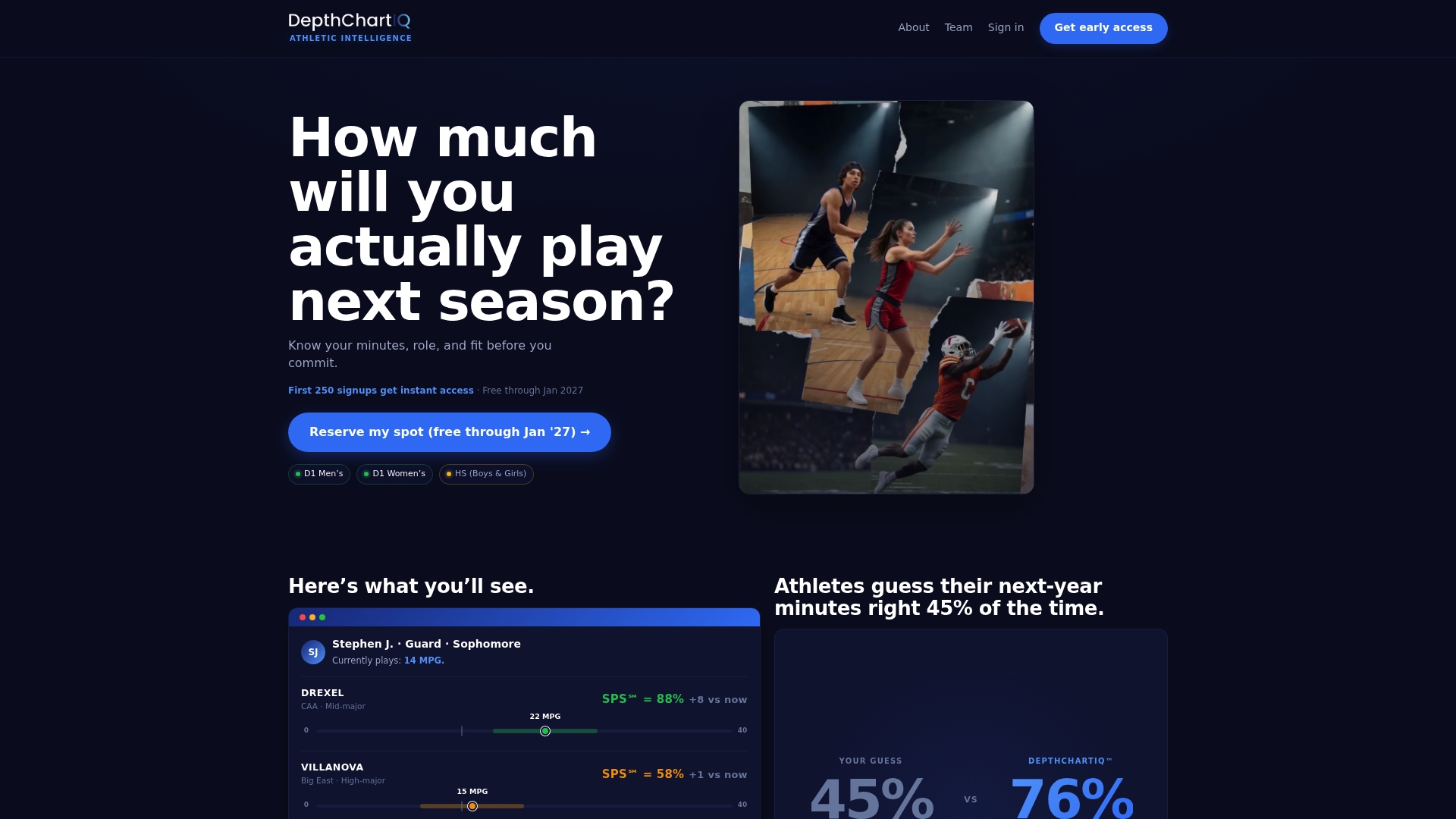
DepthchartIQ uses advanced metrics and prediction algorithms to show you exactly where you fit on a program’s depth chart before you commit. The platform’s Success Probability Scores and Roster Pressure insights are built on real roster data, transfer portal activity, and coaching history. DepthchartIQ reports a 76% accuracy rate in predicting player outcomes, which means you get a grounded picture of your playing time potential, not a guess. Whether you are a high school recruit narrowing your list or a college player evaluating a transfer, the DepthchartIQ platform gives you a clear, data-backed starting point.
FAQ
How do I compare college basketball program fit effectively?
Compare playing time opportunity, coaching style, roster stability, and academic-financial factors together using real roster data. Conference tiers give more practical fit signals than division labels alone.
What is the best division level for playing time?
No single division guarantees playing time. Mid-major programs often offer clearer paths to the court than Power Four programs with stacked rosters and limited scholarship openings.
How does the transfer portal affect program fit?
High transfer portal activity increases roster turnover, which can create immediate opportunity but reduces development stability and team chemistry over time.
Should academics factor into my basketball program choice?
Academics are a direct fit factor. Graduation rates, net cost after aid, and dedicated academic support for athletes affect both your eligibility and your life after basketball.
How many programs should I compare at once?
Narrow your list to 8–12 programs using conference tier and position need first. A focused comparison of a smaller group produces better decisions than a surface-level review of 30 schools.