
Basketball Scholarship Equivalency Explained for Recruits
Discover what scholarship equivalency means in basketball. Learn how to evaluate offers and avoid costly mistakes in college recruiting.

DepthChartIQ
Athletic Intelligence

Basketball Scholarship Equivalency Explained for Recruits

Basketball scholarship equivalency is defined as a system where a program receives a fixed pool of scholarship funds that coaches divide among multiple players as partial awards rather than giving each athlete a full ride. Understanding this model is the single most important financial concept in college basketball recruiting. The NCAA, NAIA, and their respective divisions each apply equivalency rules differently, and the differences directly affect how much money you actually receive. Recruits who treat every scholarship offer as a full ride make costly financial mistakes. This article breaks down what scholarship equivalency means across every level of college basketball and how to evaluate what any offer is truly worth.
How does scholarship equivalency differ from headcount scholarships in basketball?
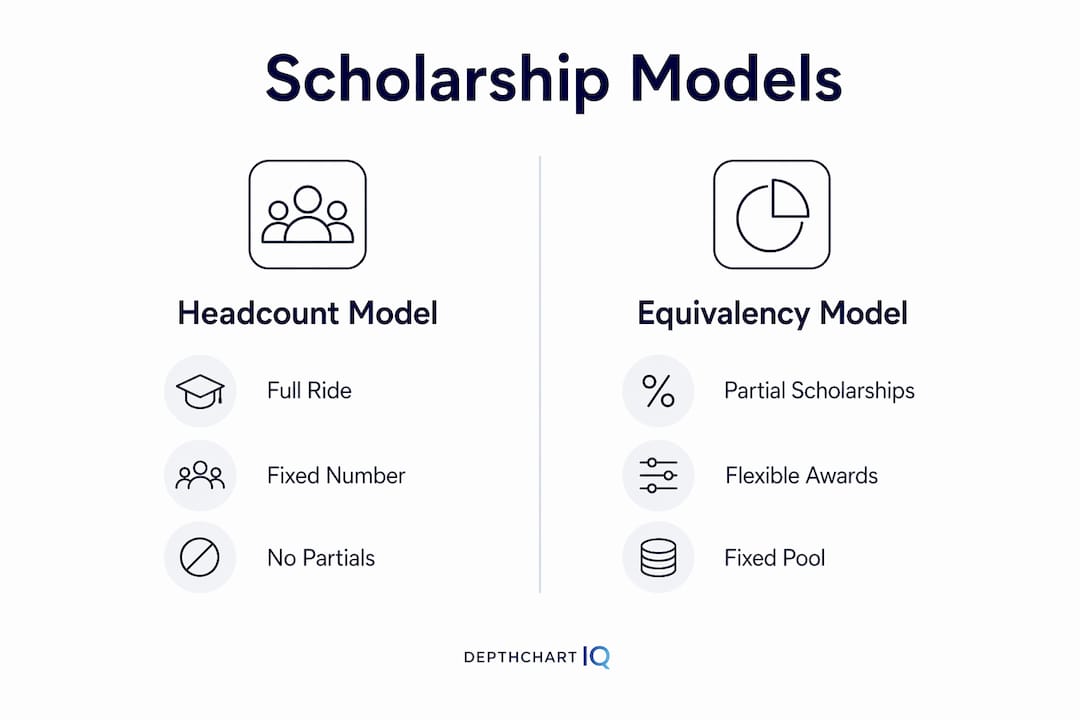
Scholarship equivalency and headcount scholarships are two fundamentally different systems for distributing athletic aid. In a headcount sport, every scholarship is a full ride. Each scholarship counts as exactly one, and no splitting is allowed. In an equivalency sport, coaches receive a set number of scholarship equivalents and can divide that pool into as many partial awards as they choose.
Historically, NCAA Division I men’s basketball operated as a headcount sport, meaning every scholarship athlete received a full ride. That changed significantly on July 1, 2025. Under the new NCAA framework tied to the House v. NCAA settlement, D1 basketball programs now operate with a 15-player roster limit and can distribute scholarship dollars flexibly between full and partial awards. That shift moved D1 men’s basketball closer to the equivalency model used at lower divisions.

Women’s basketball at the D1 level has long operated under a headcount model with 15 full scholarships. The 2025 changes introduced more flexibility there as well, though the full-ride standard remains more common in women’s programs than in men’s.
The practical difference is significant. Under a headcount model, you either have a full scholarship or you do not. Under an equivalency model, partial scholarships can range from as low as 5% to full coverage depending on how a coach chooses to allocate the pool. A coach with 10 equivalency scholarships might give two players 50% each, five players 80% each, and still have funds left for walk-ons who receive small awards.
| Feature | Headcount model | Equivalency model |
|---|---|---|
| Scholarship type | Full ride only | Full or partial |
| Splitting allowed | No | Yes |
| Typical D1 women’s basketball | Yes (historically) | Shifting post-2025 |
| Typical D2 men’s and women’s | No | Yes |
| NAIA basketball | No | Yes |
| Scholarship pool size | Fixed per athlete | Fixed total equivalents |
Pro Tip: Ask every coach directly whether their program uses a headcount or equivalency model. The answer changes how you interpret every number they give you.
What does scholarship equivalency mean across NCAA divisions and NAIA basketball?
The meaning of scholarship equivalency shifts depending on which division you are targeting. Each level sets its own rules on how many equivalents a program can award and how those funds are distributed.
NCAA Division I
Since the 2025 rule changes, D1 men’s basketball programs work within a 15-player roster limit and distribute scholarship dollars with far more flexibility than before. Programs can now offer a mix of full and partial scholarships to fill their rosters. This is a significant departure from the prior model where every scholarship athlete received a full ride. Recruits targeting D1 programs need to ask specifically what percentage of a full scholarship they are being offered, not just whether they have a scholarship.
NCAA Division II
Division II basketball programs use a pure equivalency model. D2 programs typically offer around 10 equivalency scholarships per team, which coaches divide among their full roster. A D2 team might carry 15 players but spread 10 scholarship equivalents across all of them. That means the average award is well below a full ride, and many players receive 50% to 70% coverage.
NCAA Division III
Division III programs do not offer athletic scholarships at any level. Athletes at D3 schools may still qualify for academic or need-based financial aid, but no money is tied to athletic performance or participation. Families targeting D3 schools should focus entirely on the school’s financial aid office rather than the coaching staff when discussing funding.
NAIA basketball
NAIA programs use an equivalency model similar to D2. NAIA basketball programs generally work with around 11 scholarship equivalents per team, which coaches split among players. The NAIA also allows stacking of athletic and academic aid, which makes it a strong option for recruits who qualify for both.
| Division | Scholarship model | Typical equivalents | Athletic scholarships offered |
|---|---|---|---|
| NCAA D1 (post-2025) | Equivalency (flexible) | Up to 15 roster spots | Yes, full or partial |
| NCAA D2 | Equivalency | ~10 | Yes, partial common |
| NCAA D3 | None | 0 | No |
| NAIA | Equivalency | ~11 | Yes, partial common |
How to interpret and evaluate partial scholarship offers
A scholarship percentage means nothing until you convert it into dollars. Converting percentage offers to dollar amounts based on a school’s total cost of attendance is the critical step most families skip. A 60% scholarship at a school with a $55,000 annual cost of attendance is worth $33,000 per year. That same 60% at a school with a $30,000 cost of attendance is worth only $18,000. The percentage is identical. The financial reality is not.
Families often mistakenly assume that an athletic scholarship means a full ride. In equivalency sports, partial scholarships are the norm, not the exception. The exact dollar value depends entirely on the school’s cost of attendance, which includes tuition, fees, room, board, and books.
Stacking multiple forms of aid is a common and effective way to reduce total college costs. Combining a partial athletic scholarship with academic merit aid and need-based grants can bring your actual out-of-pocket cost close to zero at some programs. Equivalency programs at the D2 and NAIA levels rely on this approach regularly.
Here are the steps every family should take when evaluating a partial scholarship offer:
- Get the dollar amount in writing. Ask the coach to convert the percentage into an annual dollar figure based on the current cost of attendance.
- Request the school’s full cost of attendance breakdown. Tuition alone does not tell the full story. Room, board, and fees add thousands.
- Contact the financial aid office independently. Ask what academic or need-based aid you qualify for separate from the athletic award.
- Ask about renewal conditions. Find out what GPA, playing time, or conduct standards must be maintained for the scholarship to continue.
- Compare net costs across schools. A smaller scholarship at a lower-cost school may leave you with less debt than a larger scholarship at an expensive private university.
Pro Tip: Written confirmation of scholarship terms is non-negotiable. Verbal promises are not binding. Get the duration, renewal conditions, and dollar amount documented before signing anything.
What factors do coaches consider when distributing equivalency scholarships?
Coaches do not distribute equivalency scholarships based purely on talent. Scholarship amounts vary based on roster strategy and not only on athletic merit. A coach might offer a highly recruited point guard 40% while offering a less-recruited big man 80% simply because the program desperately needs a center and has multiple point guard options.
Several factors shape how a coach splits the scholarship pool:
- Positional scarcity. A program with no quality post players will pay a premium for a center, even if that player is not the most talented recruit in the class.
- Recruiting class balance. Coaches spread scholarships across multiple classes to avoid having too many players at the same position graduating in the same year.
- Budget constraints. Athletic department budgets vary widely. A program with a tight budget may offer more players smaller awards to stay within its financial limits.
- Negotiation history. Recruits who express strong interest early often receive smaller initial offers. Coaches save larger offers for recruits who are harder to close.
- Academic profile. A recruit who qualifies for significant academic aid may receive a smaller athletic scholarship because the total package still looks attractive.
Understanding this dynamic changes how you approach recruiting conversations. The initial offer is rarely the final offer. Coaches expect families to ask questions and, in many cases, to negotiate. Knowing that a low offer may reflect positional depth rather than your talent level helps you respond without taking it personally. Comparing scholarship offers across programs is the most effective way to understand where you stand. A program comparison guide can help you evaluate fit beyond just the financial numbers.
Families who understand how coaches evaluate athletic programs are better positioned to ask the right questions and interpret the answers accurately.
Key Takeaways
Basketball scholarship equivalency means coaches divide a fixed pool of scholarship funds into partial awards, making full rides the exception rather than the rule at most levels.
| Point | Details |
|---|---|
| Equivalency vs. headcount | Equivalency sports allow partial scholarships; headcount sports require full rides for every scholarship athlete. |
| D1 changed in 2025 | NCAA D1 basketball now uses flexible scholarship distribution within a 15-player roster limit. |
| D3 offers no athletic aid | Division III programs award zero athletic scholarships; only academic and need-based aid applies. |
| Convert percentages to dollars | Always calculate the dollar value of any percentage offer using the school’s full cost of attendance. |
| Get terms in writing | Scholarship renewals are not guaranteed; written confirmation of conditions protects your family financially. |
What families consistently get wrong about scholarship equivalency
Most families I work with arrive at the recruiting process with one assumption baked in: a scholarship means a full ride. That assumption costs them. They compare a 70% offer from a D2 school against a 100% offer from a D1 school and assume the D1 offer is better without doing the math. When you factor in cost of attendance, the D2 offer sometimes leaves the family paying less out of pocket.
The second mistake is treating the initial offer as fixed. Coaches expect conversations. A family that accepts the first number without asking questions leaves money on the table. I have seen recruits increase their initial offer by asking one simple question: “Is there any flexibility given our financial situation?” That question alone has changed outcomes.
The third mistake is ignoring renewal risk. Athletic scholarships are typically renewable annually and not guaranteed for four years. A coaching change, an injury, or a performance dip can all affect whether your scholarship continues. Families who plan their finances around a four-year guarantee without written confirmation are taking a real risk.
My strongest advice is to focus every conversation with a coach on three numbers: the dollar amount of the offer, the total cost of attendance, and the net cost after all aid is stacked. Everything else is noise until those three numbers are clear.
— John
How DepthchartIQ helps recruits evaluate basketball scholarship offers
Evaluating scholarship equivalency offers requires more than a calculator. You need to understand how a program uses its roster, how many players compete at your position, and how likely you are to see meaningful playing time.
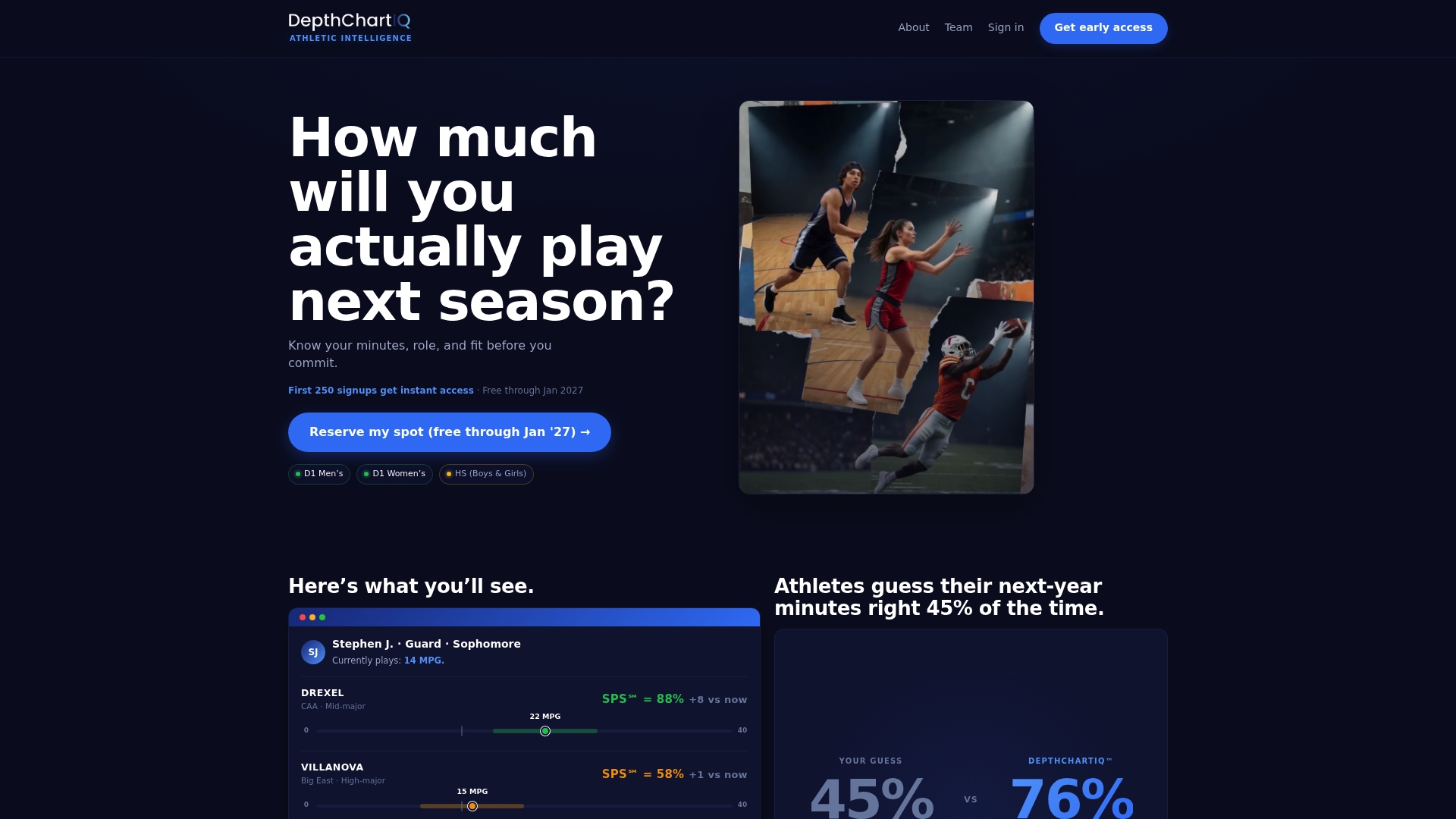
DepthchartIQ analyzes roster data and depth charts to give recruits a clear picture of where they fit within a program. The platform’s methodology for analyzing program fit includes Success Probability Scores and Roster Pressure insights that show you how a scholarship offer connects to your actual opportunity on the court. A 60% scholarship at a program where you are likely to start is a different proposition than a 60% scholarship where you sit behind three players at your position for two years. DepthchartIQ gives you that context before you commit. Visit depthchartiq.ai to see how the platform helps recruits and families make smarter decisions about scholarship offers and program fit.
FAQ
What does scholarship equivalency mean in basketball?
Scholarship equivalency in basketball means a program has a fixed number of full scholarship equivalents that coaches can divide among players as partial awards. Partial scholarships can range from a small percentage to a full ride depending on how the coach allocates the pool.
Is a basketball scholarship always a full ride?
No. In equivalency sports, most scholarships are partial awards. Only headcount sports require every scholarship to be a full ride, and D1 men’s basketball shifted away from the strict headcount model after July 1, 2025.
How many equivalency scholarships does a D2 basketball program have?
NCAA Division II basketball programs typically work with around 10 scholarship equivalents per team. Coaches divide that pool among their full roster, so most players receive partial awards rather than full rides.
Can I combine an athletic scholarship with other financial aid?
Yes. Stacking a partial athletic scholarship with academic merit aid and need-based grants is a common strategy at D2 and NAIA programs. The combined package can significantly reduce your actual out-of-pocket cost.
Are basketball scholarships guaranteed for four years?
No. Athletic scholarships are typically renewed annually and are not guaranteed for the full duration of your college career. Always get written confirmation of renewal conditions, including GPA requirements and any performance-related terms, before committing to a program.