
How Parents Evaluate College Athletic Programs: 2026 Guide
Explore how parents evaluate college athletic programs with structured insights for 2026. Make informed decisions for your child's future!

DepthChartIQ
Athletic Intelligence

How Parents Evaluate College Athletic Programs: 2026 Guide

Evaluating a college athletic program means measuring academic outcomes, financial health, recruiting authenticity, and team culture together, not just a coach’s win record. How parents evaluate college athletic programs has grown more structured since the NCAA introduced measurable benchmarks like the Academic Progress Rate (APR) and Graduation Success Rate (GSR), giving families real data to work with. The most common mistake parents make is treating a campus visit as a sales pitch to absorb rather than an interview to conduct. Your child’s athletic career lasts four years. Their degree and professional network last a lifetime.
How parents evaluate college athletic programs: starting with academics
Academic evaluation is the most skipped step in the college athletic selection process, and it is also the most consequential. The NCAA’s APR measures team retention and eligibility in real time, assigning two points per athlete per semester. Teams scoring below 930 face strategic penalties designed to push programs toward academic accountability. That 930 threshold is your first filter when assessing college sports programs.
The APR is publicly searchable through the NCAA’s database, which means you can pull any Division I team’s score before you ever speak to a coach. The GSR goes further by tracking athletes who transfer in and out, giving a more complete picture than traditional graduation rates. APR provides a more immediate snapshot of academic health than graduation data alone, which can lag by four to six years. A program with a GSR significantly below the school’s overall graduation average is telling you something important about how it treats athletes as students.
When you sit down with a coaching staff, ask these specific questions about academic support:
- Is tutoring mandatory or optional, and who pays for it?
- Does the program offer priority class registration for athletes?
- What is the team’s current APR score, and how has it trended over three years?
- How does the program handle conflicts between travel schedules and exams?
- What academic majors are realistically accessible given practice and travel demands?
A coach unable to discuss team academic outcomes with confidence is signaling that academics are not a program priority. That is not a red flag to dismiss. It is a defining characteristic of the program’s culture.
Pro Tip: Ask the academic support staff directly, not just the coach. Programs with strong academic cultures will connect you with their tutoring and advising teams without hesitation. Programs that deflect this request are worth scrutinizing.
| Academic Metric | What to Look For |
|---|---|
| APR Score | 930 minimum; 950+ indicates strong academic culture |
| Graduation Success Rate | Compare to school-wide average; gap above 10 points warrants questions |
| Academic Support Structure | Mandatory tutoring and proactive advising signal genuine investment |
| Major Accessibility | Confirm target major is feasible given practice and travel schedule |
What indicators reveal if a program’s recruiting approach is genuine?
Genuine recruiting interest and database maintenance look identical from the outside until you know what to test for. Real recruiting interest involves coaches asking specific questions about your child’s academic goals, intended major, family situation, and decision timeline. Generic praise and mass camp invitations mean your athlete is in a roster database, not on a serious offer list.
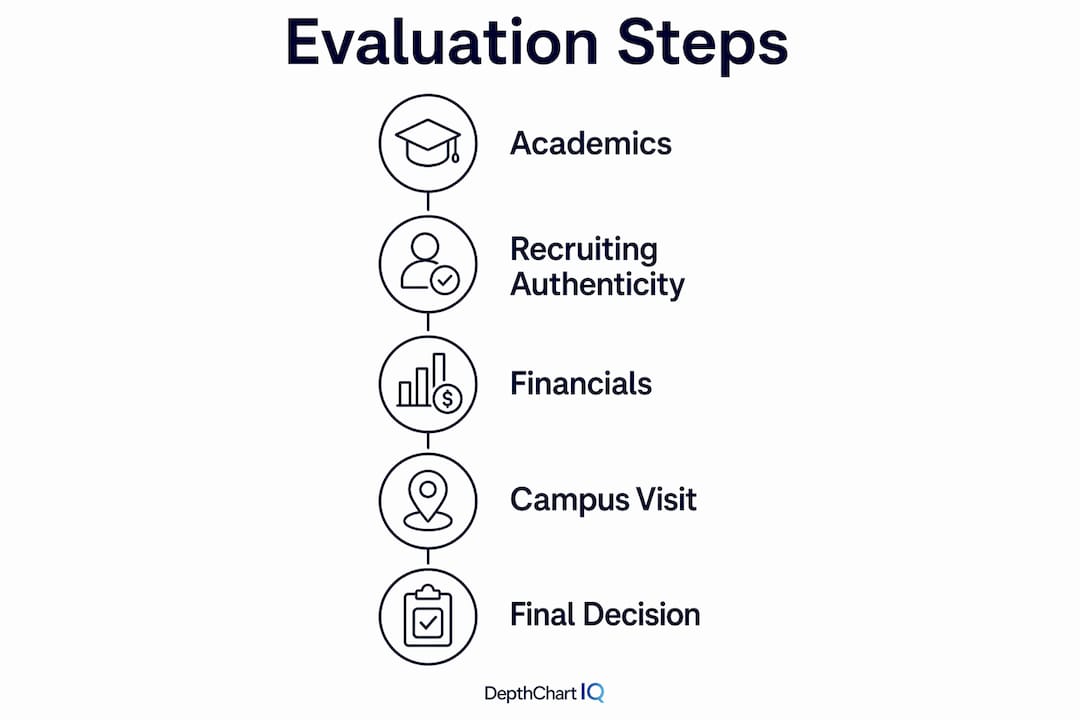
Use what recruiting professionals call a specificity test. When a coach contacts your child, note whether the conversation includes questions like: “What are you thinking about studying?” or “What is your timeline for making a decision?” A coach who tailors communication to your athlete’s individual fit is demonstrating genuine interest. A coach who sends the same enthusiastic email to 200 prospects is managing volume.
Here is a practical sequence for testing recruiting authenticity:
- Ask the coach directly what they know about your child’s academic interests. A prepared coach will have reviewed transcripts and test scores.
- Request a specific conversation about how your athlete fits the current roster and what playing time looks like realistically in year one and year two.
- Ask about the program’s timeline for extending offers and what the next steps are. Vague answers indicate your child is not a priority recruit.
- Verify that the coach is referencing academic eligibility verification through the NCAA Eligibility Center. Coaches serious about an athlete confirm eligibility status early.
- Cross-check the coach’s claims about playing time against current roster depth and graduation timelines.
Pro Tip: Register with the NCAA Eligibility Center as early as freshman or sophomore year. Most families delay registration until senior year, which creates eligibility bottlenecks that slow scholarship offers. Early registration also signals to coaches that your family is organized and serious.
Recruiting authenticity directly connects to scholarship sustainability. A program that recruits carelessly tends to manage scholarships carelessly. Understanding the contact periods in recruiting helps you interpret when a coach’s outreach is permissible and meaningful versus procedural.
How do financial realities of college athletic programs affect families?
The financial structure of college athletics is one of the least discussed and most consequential factors in a parents guide to athletic evaluations. Fewer than 30 of 363 Division I programs generate revenue that exceeds expenses without institutional subsidies or mandatory student fees. That means the program recruiting your child is almost certainly running a deficit, and understanding how that deficit is covered matters to your family.
Mandatory student fees are the most common subsidy mechanism. At many schools, every enrolled student pays fees that fund athletic department operations, regardless of whether they attend a single game. These fees inflate the apparent cost of attendance and are rarely highlighted during recruiting visits. When you are doing a college sports program comparison, ask the financial aid office, not the athletic department, what the total mandatory fee burden is per year.
“Athletic department finances directly affect scholarship sustainability, facility investment, and the academic support resources available to your child. A program under financial stress cuts support staff first.”
Ask these financial questions during your evaluation:
- What percentage of the athletic budget comes from student fees versus ticket revenue and media rights?
- Has the program reduced scholarship counts or support staff in the last three years?
- Is the athletic scholarship renewable annually, and what are the conditions for renewal?
- How does the program handle scholarship continuity if the head coach leaves?
Separating scholarship negotiation from academic support discussions is worth doing deliberately. Families who conflate the two often accept scholarship offers without fully understanding what academic resources are actually funded. A partial scholarship at a program with strong academic infrastructure can outperform a full scholarship at a program with thin support.
| Financial Factor | Question to Ask |
|---|---|
| Student fee subsidy | What percentage of the athletic budget comes from mandatory student fees? |
| Scholarship renewal | What are the annual conditions for scholarship renewal? |
| Budget stability | Has the program cut support staff or scholarships in the past three years? |
| Coach departure clause | Does scholarship continuity depend on the current coaching staff? |
What practical steps help parents assess program culture and fit?
Program culture is the factor most parents feel least equipped to evaluate, yet it predicts athlete satisfaction and academic performance more reliably than any single statistic. Team culture is best assessed through direct conversations with current athletes, away from coaches and official visit schedules. Ask the athletic department to connect you with two or three current athletes for an informal conversation, and pay attention if that request is declined or heavily managed.
During those conversations, ask current athletes about:
- How the coaching staff responds to losing streaks and adversity
- Whether academic scheduling conflicts are handled with flexibility or friction
- How the program supports athletes through injuries, including access to medical staff and academic accommodations
- Whether the team culture is one where athletes feel comfortable raising concerns with coaches
- What a typical week looks like in terms of practice hours, travel, and study time
Scheduling conflicts between classes and practices are a daily reality in college athletics, and how a program handles them reveals its actual priorities. Ask whether athletes in your child’s intended major have successfully completed that program while competing. If the coaching staff cannot name current or recent athletes who graduated in that field, the major may be incompatible with the sport’s demands at that school.
Pro Tip: Distinguish between athletic opportunity and career opportunity. A program at a smaller school with a strong alumni network in your child’s field of interest can deliver more long-term value than a high-profile program where athletes are academically marginalized. The degree and the network outlast the jersey.

Academic support structures that are proactive, meaning advisors reach out to athletes before grades slip rather than after, indicate a program that treats academic success as a shared responsibility. Reactive support, where athletes must seek help themselves, places the burden entirely on 18-year-olds managing full athletic and academic loads simultaneously.
Key takeaways
Evaluating college athletic programs requires parents to assess academics, recruiting authenticity, financial transparency, and team culture with the same rigor they apply to athletic fit.
| Point | Details |
|---|---|
| Use NCAA APR as your baseline | Programs scoring below 930 face penalties; scores above 950 signal genuine academic investment. |
| Test recruiting authenticity | Coaches who ask specific questions about academics and timelines are genuinely interested; generic outreach is not. |
| Investigate financial structure | Ask how the program covers its deficit and whether student fees inflate your cost of attendance. |
| Talk to current athletes directly | Unscripted conversations with current athletes reveal program culture more accurately than any official visit. |
| Register for NCAA Eligibility Center early | Early registration prevents scholarship delays and signals organizational seriousness to coaching staffs. |
What I’ve learned about what parents actually get wrong
Parents consistently enter the recruiting process focused on the wrong variable. They optimize for the biggest program name or the most enthusiastic coach, and they underweight the question of whether their child will thrive academically and personally in that environment for four years.
I have seen families commit to programs where the coach knew nothing about the athlete’s academic interests, where the scholarship renewal conditions were buried in fine print, and where the team’s APR score had been declining for three consecutive years. Every one of those families had a campus visit that felt exciting. None of them had asked the hard questions.
The recruiting process is designed to sell. Coaches are skilled at creating urgency and excitement. Your job as a parent is to slow that process down and treat each program as a business decision with a four-year contract attached. Ask the same questions of every program. Compare the answers in writing. If a coach pressures you to commit before you have completed your evaluation, that pressure itself is data.
The families who navigate this process best are the ones who understand that coach recruitment signals are readable and testable, not just felt. They treat a campus visit as a structured interview, not a social event. They leave with answers, not just impressions.
— John
How Depthchartiq helps families make smarter program decisions
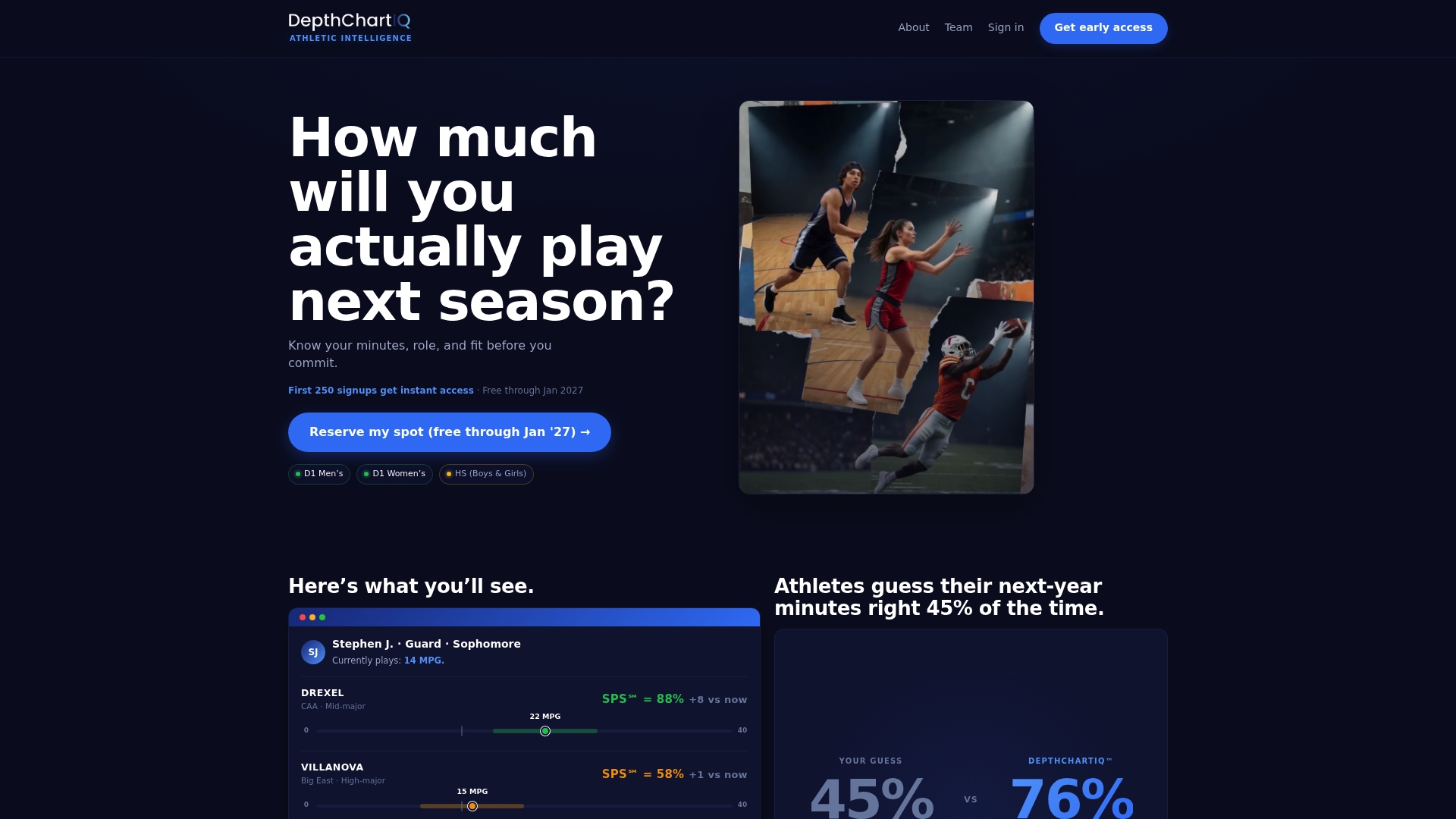
Depthchartiq gives families a data-driven foundation for evaluating college athletic programs that goes beyond what any campus visit or coach conversation can provide. The platform’s prediction methodology analyzes roster depth, playing time projections, and program dynamics to show exactly where a recruit fits within a program’s current and future structure. For basketball families specifically, Depthchartiq’s 76% accuracy rate in predicting player outcomes means you are comparing programs with real numbers, not recruiting promises. Pair those insights with the academic and financial questions in this guide, and you have a complete evaluation framework. Visit Depthchartiq to explore how the platform supports your family’s decision.
FAQ
What is the NCAA APR and why does it matter to parents?
The NCAA Academic Progress Rate (APR) measures team retention and eligibility in real time, with a score of 930 as the minimum threshold before penalties apply. Parents can search any Division I team’s APR score publicly through the NCAA database to assess academic culture before a campus visit.
How do I know if a coach is genuinely recruiting my child?
Genuine recruiting interest involves coaches asking specific questions about your child’s academic goals, intended major, and decision timeline. Generic praise and mass camp invitations indicate roster database management, not serious recruitment.
What financial questions should parents ask athletic programs?
Ask what percentage of the athletic budget comes from mandatory student fees, whether scholarships are renewed annually and under what conditions, and whether the program has reduced support staff or scholarship counts in recent years. These answers reveal financial stability and scholarship sustainability.
When should my child register with the NCAA Eligibility Center?
Register with the NCAA Eligibility Center during freshman or sophomore year of high school, not senior year. Early registration identifies eligibility issues early and prevents delays in scholarship offers.
How do I assess team culture during a campus visit?
Request direct, unscripted conversations with current athletes away from coaches and official programming. Ask them about scheduling conflicts, injury support, how the staff handles adversity, and what a typical week looks like academically and athletically.