
Compare Programs for Athlete Development: 2026 Guide
Discover how to effectively compare programs for athlete development opportunities. Evaluate coaching quality, costs, and more to enhance your future!

DepthChartIQ
Athletic Intelligence

Compare Programs for Athlete Development: 2026 Guide

Athlete development programs are structured training and academic environments designed to build competitive performance, technical skill, and long-term career readiness. When you compare programs for athlete development opportunities, the difference between a good choice and a great one comes down to specifics: coaching ratios, training volume, academic compatibility, and total cost. Most athletes pick programs based on reputation alone. That approach leaves real development potential on the table. This guide gives you a practical framework to evaluate programs on the factors that actually move the needle on your career.
What are the key factors to compare in athlete development programs?
Evaluating sports training options requires a clear set of criteria before you ever visit a campus or attend an open day. Without a framework, you default to gut feeling, which is almost always influenced by marketing.
Coaching quality is the single most important variable. Small-group coaching with low coach-to-athlete ratios produces better performance improvement than large-group training at brand-name facilities. Ask every program for their ratio and how many individual feedback sessions you receive per week.

Training volume and match-play must match your age and sport. For tennis, recommended match-play targets run 90–120 minutes per week for athletes under 10, scaling to 180–240 minutes per week for athletes 16 and older. That same logic applies across sports: volume without structured competition does not produce development.
Academic program compatibility is non-negotiable for collegiate athletes. Programs that offer flexible scheduling, tutoring, and credit transfer support give you a real advantage when balancing study and training. Check the academic balance checklist before committing to any program.
Total cost of participation varies dramatically. Annual costs range from $2,500 for club soccer leagues to over $70,000 for elite boarding school programs. That gap is not just tuition. Travel, equipment, boarding, and hidden administrative fees all add up fast.
Key factors to evaluate:
- Coach-to-athlete ratio and individual feedback frequency
- Weekly training hours and structured match-play volume
- Academic scheduling flexibility and support services
- Full cost breakdown including travel and boarding
- Program structure: boarding, local, or hybrid
- Competitive calendar alignment with your target outcome (college placement or professional track)
Pro Tip: Ask each program for their last three years of college placement data. Programs that track and share outcomes are the ones actually accountable for athlete growth.
How do scorecards and trial weeks help you objectively compare programs?
The best athlete training opportunities are not always the loudest ones. A weighted scorecard assigns percentages to each evaluation criterion so your final score reflects what matters most to you, not what the program’s brochure emphasizes.
Here is how to build and use one:
- List your criteria. Start with coaching quality, match-play volume, academic support, cost, and daily structure.
- Assign weights. A proven starting point: coaching at 30%, match-play architecture at 20%, academic fit at 20%, cost at 15%, and daily life structure at 15%.
- Score each program from 1 to 10 on every criterion during your visit or trial week.
- Multiply each score by its weight and total the results. The highest score wins on paper. Then you decide if the numbers match your gut.
- Compare across programs using the same sheet. Consistency is the entire point.
A trial week takes this further. You live inside the program for five to seven days, attend real training sessions, eat in the facility, and observe how coaches interact with athletes who are not being recruited. That raw observation cuts through every marketing claim.
| Criterion | Weight | What to Observe During Trial |
|---|---|---|
| Coaching quality | 30% | Individual corrections, session structure, feedback frequency |
| Match-play volume | 20% | Weekly competition hours, tournament integration |
| Academic support | 20% | Tutoring access, schedule flexibility, credit policies |
| Total cost | 15% | Full fee breakdown, hidden charges, travel requirements |
| Daily structure | 15% | Morning routines, recovery time, independence level |
Pro Tip: Bring a notebook and record specific observations during the trial week, not impressions. Write down how many times a coach corrected your technique individually. That number tells you more than any campus tour.
Programs that integrate competition directly with athlete target goals generate better outcomes than programs running high-volume generic training. The scorecard forces you to measure that alignment instead of assuming it.
Boarding academies vs. club leagues vs. hybrid models: which fits you?
A sports development comparison across program types reveals trade-offs that go far beyond athletic training. Each format shapes your daily life, academic stability, and family relationships in different ways.
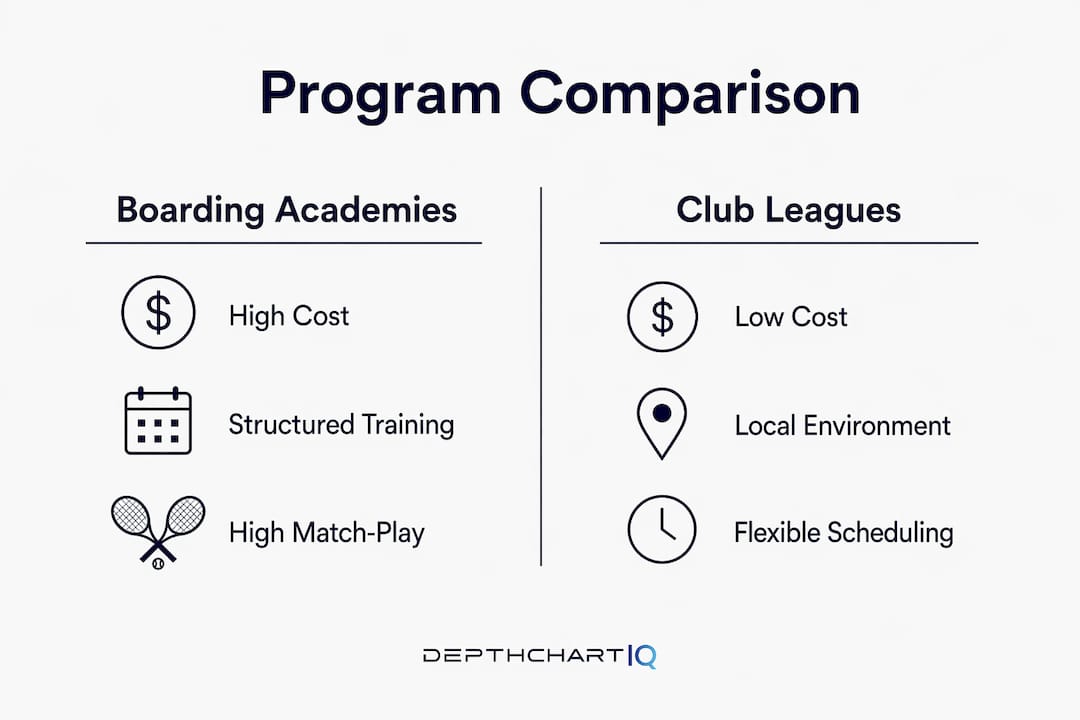
Boarding academies offer the highest training volume and the most structured environment. They also carry the highest cost and the greatest disruption to normal life. Elite boarding programs run from $46,000 to over $70,000 annually. That investment makes sense for athletes with clear professional aspirations and the maturity to thrive away from home.
Club leagues and local development pathways cost $2,500–$6,000 per year and keep you in your home environment. Local development routes often provide better academic stability and lower daily disruption than elite academies requiring heavy travel. For younger athletes still developing maturity and study habits, this format frequently produces better long-term outcomes.
Hybrid models combine local schooling with part-time academy training. They sit in the middle on cost and commitment. They work well for athletes who need elite coaching access without the full boarding commitment.
| Program Type | Annual Cost | Training Volume | Academic Stability | Best For |
|---|---|---|---|---|
| Boarding Academy | $46,000–$70,000+ | Very High | Low | Mature athletes, pro track |
| Club League | $2,500–$6,000 | Moderate | High | Developing athletes, college track |
| Hybrid Model | $8,000–$20,000 | High | Moderate | Athletes balancing both goals |
Who benefits from each format:
- Boarding academies suit athletes who are 16 or older, emotionally ready for independence, and targeting professional contracts or Division I scholarships.
- Club leagues suit athletes under 16, those prioritizing GPA, or families managing financial constraints without sacrificing quality coaching.
- Hybrid models suit athletes who have identified a specific skill gap requiring elite coaching but are not ready for full-time residential commitment.
The daily structure and purpose of a program matters more than its name. Prioritize the format that matches where you are right now, not where you hope to be in three years.
How do you align athletic development with academic fit and personal goals?
The best programs for athletic growth are the ones where athletic and academic demands reinforce each other instead of competing. That alignment requires deliberate evaluation before you sign anything.
Standard program assessment at collegiate programs includes information sessions, physical combines, portfolio reviews, and interviews, often with application deadlines as early as August 31st. That multi-step process exists because programs are evaluating your academic readiness alongside your athletic potential. You should be running the same evaluation in reverse.
Key questions to ask during your evaluation:
- Does the academic schedule allow for full training participation without missing classes?
- What tutoring and academic support services are available specifically for athletes?
- How does the program handle exam periods and competition conflicts?
- What is the average GPA of athletes in the program?
- Does the program have relationships with specific colleges or universities for placement?
Balancing study with training is not a soft concern. Athletes who fall behind academically lose eligibility, lose scholarship opportunities, and lose leverage in transfer negotiations. Programs that treat academic support as an afterthought are programs that do not actually care about your long-term success.
For athletes using the college athletic program evaluation process, the academic fit score should carry at least 20% of your total weighted scorecard. That weight reflects reality: your degree outlasts your playing career.
When to prioritize stability over athletic challenge: if you are in your first two years of high school, your GPA is below a 3.0, or you have not yet identified a clear athletic career path, choose the program that keeps your academic options open. You can always increase athletic intensity later. Recovering lost academic standing is far harder.
What are the biggest mistakes athletes make when comparing programs?
Choosing based on prestige is the most common and most costly mistake in athlete program selection. A program’s reputation reflects its history, not your future. The question is never “Is this program famous?” The question is “Does this program develop athletes like me?”
Ignoring total cost is the second major error. Athletes and families often compare tuition figures without accounting for travel, equipment, boarding, and administrative fees. A program listed at $15,000 per year can easily cost $25,000 once you add flights, gear, and tournament entry fees. Always request a full cost breakdown in writing before making any decision.
Overlooking daily life routine is a mistake that shows up six months into a program. Training quality matters. So does sleep, nutrition access, recovery time, and the ability to call home. Programs that run athletes into the ground with no recovery structure produce burnout, not development.
Failing to evaluate coaching system cohesiveness is the subtlest error. A program with one excellent head coach but no consistent methodology across assistants produces inconsistent athlete development. Ask how the coaching staff communicates, how they track athlete progress, and what happens to your development plan when the head coach is traveling.
Pro Tip: Request a written development plan for your first 90 days before you commit. Programs that cannot produce one do not have a real system. Programs that hand you one immediately have been doing this right for years.
Key takeaways
The most effective way to compare athlete development programs is to use a weighted scorecard, a trial week, and a full cost breakdown before making any commitment.
| Point | Details |
|---|---|
| Use a weighted scorecard | Assign 30% to coaching and 20% to match-play to score programs objectively. |
| Run a trial week | Live inside the program for five to seven days to observe real coaching quality. |
| Account for total cost | Request a full written breakdown including travel, boarding, and fees. |
| Match format to maturity | Boarding academies suit older athletes; local pathways suit younger or academic-focused athletes. |
| Weight academic fit at 20% | Academic support directly affects eligibility, scholarships, and long-term career options. |
What i’ve learned about picking the right program
I have watched athletes choose programs the wrong way more times than I can count. They pick the name on the jersey, not the system behind the training. Then six months in, they are sitting in a large group session getting zero individual feedback, wondering why they are not improving.
The athletes who make the best choices do one thing differently: they evaluate the system, not the story. They ask how many individual coaching corrections they receive per session. They track their match-play minutes. They read the academic support policy before they read the marketing brochure.
Trial weeks changed how I think about program selection entirely. You learn more in five days of real training than in five months of campus visits and highlight reels. The coach who ignores you during a trial week will ignore you during the season. The program that cannot answer your cost questions clearly will surprise you with fees later.
My honest advice: weight coaching quality at 30% and hold that line. Prestige fades. A coach who gives you specific, consistent, individual feedback every week compounds over time. That compounding is the difference between a good athlete and a great one.
Local pathways also deserve more credit than they get. For athletes under 16, staying close to home, maintaining academic stability, and working with a high-quality local coach often produces better long-term outcomes than an expensive boarding program. The data on local development sustainability backs this up. Prestige is not a development plan.
— John
How DepthchartIQ helps you make a smarter program decision
Choosing the right program is one of the most consequential decisions of your athletic career. DepthchartIQ gives you the data infrastructure to make that choice with confidence instead of guesswork.
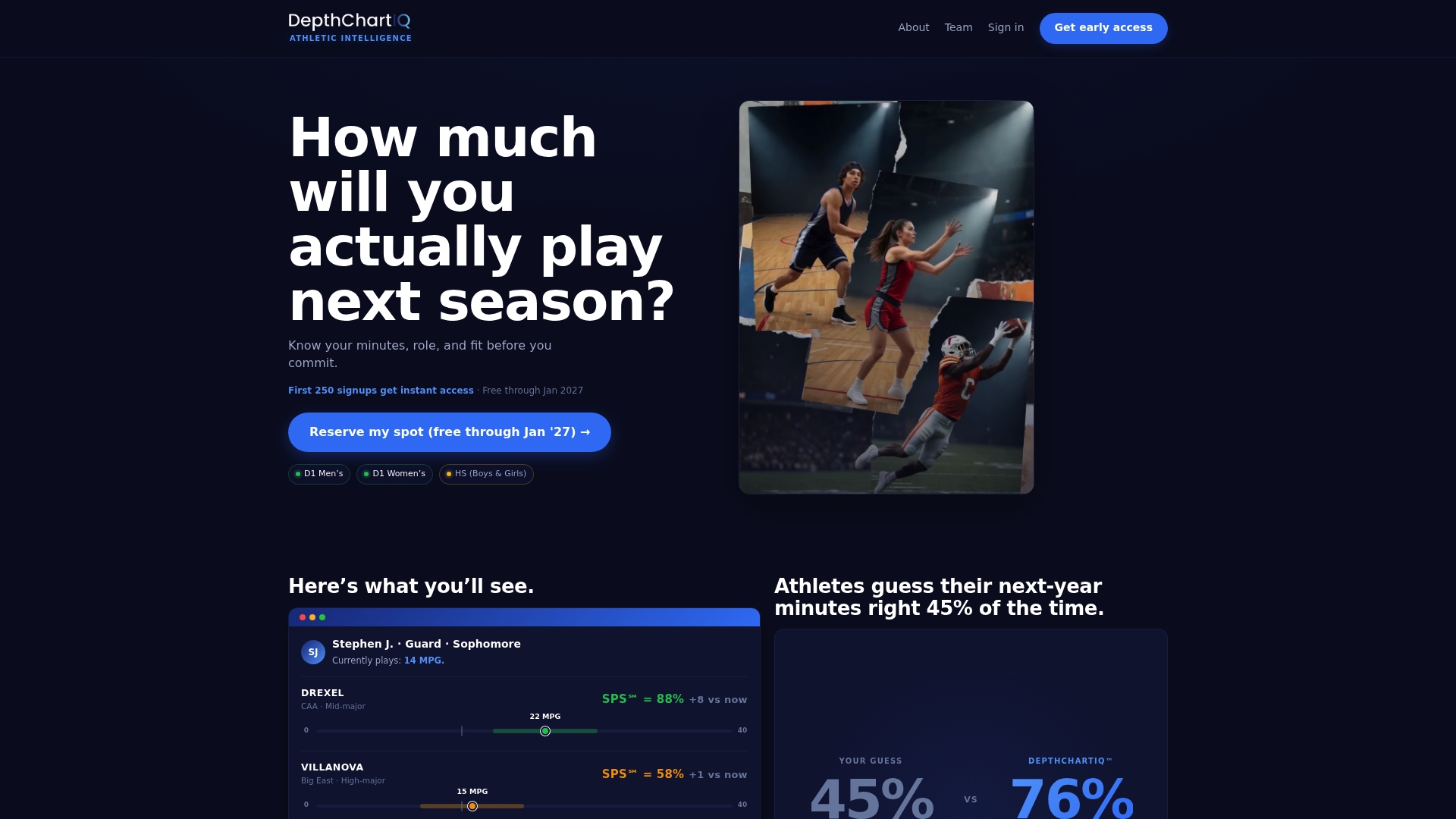
DepthchartIQ’s weighted scorecard methodology mirrors the framework in this guide, built on real roster data, Success Probability Scores, and Roster Pressure insights that show you exactly where you fit within a program’s depth chart. The platform’s 76% accuracy rate in predicting player outcomes means you are working with real signal, not marketing noise. Whether you are a high school recruit evaluating your first collegiate program or a current athlete weighing a transfer, DepthchartIQ gives you the objective comparison tools your decision deserves.
FAQ
What factors matter most when comparing athlete development programs?
Coaching quality carries the most weight, with a recommended 30% of your evaluation scorecard. Match-play volume, academic support, total cost, and daily program structure round out the core criteria.
How much do athlete development programs cost per year?
Annual costs range from $2,500 for club leagues to over $70,000 for elite boarding academies. Always request a full written cost breakdown that includes travel, boarding, and equipment fees.
What is a weighted scorecard for program comparison?
A weighted scorecard assigns percentage values to each evaluation criterion so you can score programs consistently and objectively. Coaching gets 30%, match-play 20%, with the remaining 50% split across academic fit, cost, and daily structure.
Should younger athletes choose boarding academies or local programs?
Local development pathways typically offer better academic stability and lower disruption for athletes under 16. Boarding academies suit older athletes with clear professional goals and the maturity to thrive independently.
How does a trial week improve program selection?
A trial week gives you direct observation of real coaching quality, daily structure, and training volume without relying on marketing materials. It is the single most reliable method for cutting through program branding and evaluating actual fit.