
How to Evaluate if Your Current School Fits Athlete Goals
Discover how to evaluate if current school fits athlete goals with key strategies. Make informed decisions for your athletic future!

DepthChartIQ
Athletic Intelligence

How to Evaluate if Your Current School Fits Athlete Goals

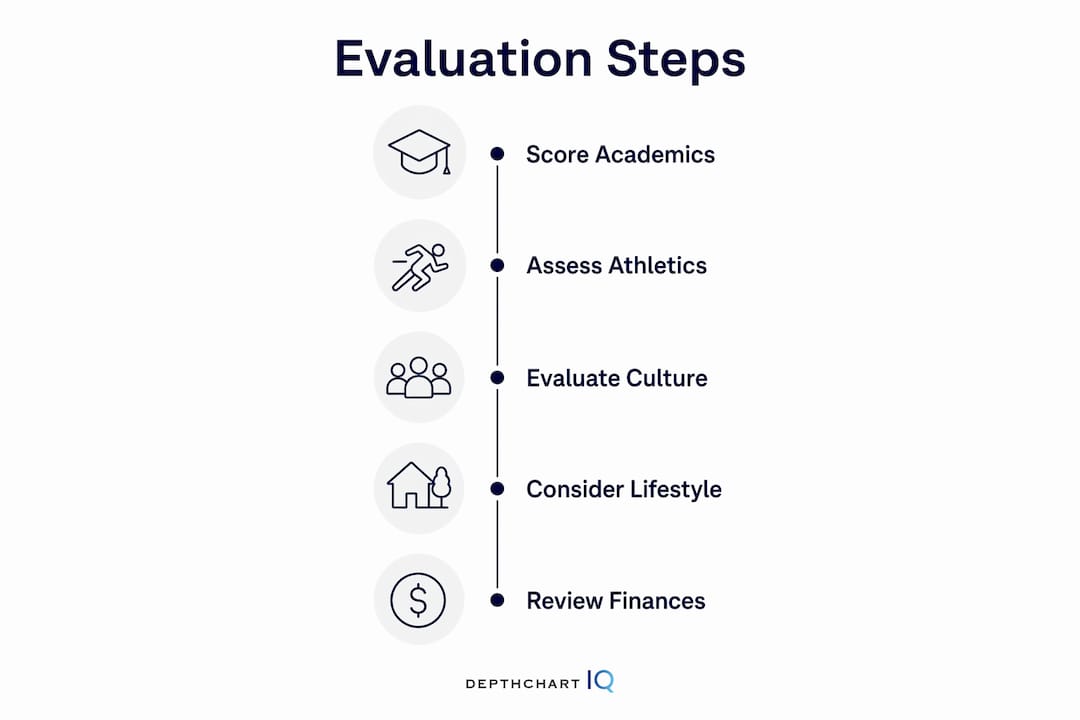
School-athlete fit is defined as the degree to which a program’s academic offerings, coaching philosophy, team culture, and financial support align with an individual athlete’s goals and development needs. Getting this wrong costs you more than playing time. It costs you years. Whether you’re a high school recruit narrowing your list or a current college athlete questioning your situation, the ability to evaluate if current school fits athlete goals is the single most important skill in your recruiting toolkit. Structured scoring frameworks, direct culture observation, and honest self-assessment are the three tools that separate confident decisions from expensive regrets.
What criteria should athletes use to assess athletic program compatibility?
School-athlete fit assessment covers four core categories: academics, athletic program quality, lifestyle factors, and financial considerations. Each one carries real weight, and ignoring any of them produces an incomplete picture.
Academics is where most athletes underestimate the stakes. Your major needs to be available, respected, and manageable alongside your training schedule. Ask whether the school offers your intended field of study, whether academic support services exist specifically for student-athletes, and whether the program’s reputation holds value in your career field after sports.
Athletic program quality goes deeper than win-loss records. You need to understand the coaching staff’s development philosophy, how athletes at your position have grown over four years, and whether the team culture supports or suppresses individual growth. Different programs emphasize different playing styles, whether that’s speed, power, or positional depth, and your skills need to match the system to get meaningful development and playing time.

Lifestyle factors shape your daily experience in ways that directly affect performance. Campus size, social environment, and distance from home all influence how comfortable and focused you stay across a full season. These factors are not secondary concerns. Long-term happiness often depends more on non-athletic lifestyle factors than on winning records or program prestige.
Financial considerations close the loop. Scholarship coverage, cost of attendance, and NIL potential all determine whether you can sustain your commitment without financial stress pulling your focus off the field.
- Does the school offer your major with a strong academic support system for athletes?
- Does the coaching staff have a track record of developing players at your position?
- Does the campus size and social environment match your personality and needs?
- Is the scholarship package competitive, and does the program have active NIL opportunities?
- Does the geographic location work for your family access and mental health?
Pro Tip: Rate each category on a scale before your campus visit. Your gut will shift during the trip. Having pre-visit scores gives you a baseline to compare against your emotional reaction.
How can athletes use structured scoring systems to compare schools?
A structured scoring system removes the emotional noise from one of the most consequential decisions of your life. Experts recommend a 0–4 scale scoring method that multiplies each criterion’s weight by the score you assign each school, then totals the results for a clear, side-by-side comparison.
Here is how to build and use the system:
- List your criteria. Write out every factor that matters: major availability, coaching style, team culture, campus environment, scholarship value, NIL potential, and distance from home.
- Assign weights. Give each criterion a weight from 1 to 5 based on how much it matters to you personally. Playing time development might be a 5. Campus size might be a 2.
- Score each school. Rate each school on a 0–4 scale for every criterion. Zero means it does not meet your need at all. Four means it exceeds your expectations.
- Multiply and total. Multiply each school’s score by the criterion weight. Add all weighted scores together per school.
- Compare totals. The school with the highest weighted total is your strongest objective match.
Here is a simplified example of what that comparison table looks like in practice:
| Criterion | Weight | School A Score | School A Weighted | School B Score | School B Weighted |
|---|---|---|---|---|---|
| Major availability | 5 | 4 | 20 | 3 | 15 |
| Coaching development | 5 | 3 | 15 | 4 | 20 |
| Team culture | 4 | 4 | 16 | 2 | 8 |
| Campus environment | 3 | 2 | 6 | 4 | 12 |
| Financial fit | 4 | 3 | 12 | 3 | 12 |
| Total | 69 | 67 |
Using consistent scoring across schools reduces emotional bias and lets you compare programs without getting distracted by prestige or hype. The numbers do not make the decision for you. They clarify which choice aligns with what you actually said matters most.
Pro Tip: Run the scoring exercise twice: once before your campus visit and once after. A significant shift in scores after the visit tells you something important about how the reality matched your expectations.
What cultural indicators reveal true athletic program fit?
Recruitment pitches are designed to impress you. The actual program culture reveals itself in unscripted moments, and you need to know what to look for. A strong athletic program culture shows up in daily player interactions, communication patterns, and team focus during drills, not in highlight reels or coach speeches.
Watch how players treat each other when no one is performing for the camera. Do teammates encourage each other after a mistake, or does the bench go quiet? Athletes who observe how quickly players transition between drills and support each other get a more accurate read on program discipline than any official tour provides.
The coach-athlete relationship is equally telling. Notice whether the head coach addresses players by name, whether assistants seem engaged or disengaged, and whether athletes look energized or worn down at the end of practice. Coaching vision and daily reality are often two different things. Your job is to see past the vision and assess the reality.
“Current players offer honest reflections on balancing academics, training, and pressure that no coach or admissions officer will give you.” — College Program Culture, EXACT Sports
Here is what to look for during a campus visit and practice observation:
- Player communication: Are athletes talking to each other constructively during drills, or is the environment silent and tense?
- Coaching tone: Does the staff correct with instruction or with frustration? Both tell you about the culture.
- Drill transitions: Fast, focused transitions between drills signal discipline. Slow, distracted ones signal a loose culture.
- Peer support: Watch for unscripted moments where players encourage each other without being prompted.
- Current player candor: Ask players directly what they wish they had known before committing. Their hesitation or openness says as much as their words.
Coaches value recruits who observe team culture carefully because it signals maturity and self-awareness. Asking sharp questions about daily life also signals that you are serious about fit, not just playing time.
How do lifestyle and academics affect long-term school fit for athletes?
The non-athletic elements of your school experience determine whether you thrive or just survive. Evaluating school for athlete needs means looking at the full picture of your daily life, not just what happens between the lines.
Campus size has a direct effect on social comfort and academic access. A large university offers more resources but can feel isolating if you are not naturally outgoing. A smaller school creates tighter community bonds but may limit your major options or career networking reach. Neither is objectively better. The right answer depends on who you are.
Proximity to home matters more than most recruits admit. Research consistently shows that daily reality factors like campus size and proximity to home have significant impact on athlete happiness and academic success. Being four hours from family during a tough season or an injury recovery is a different experience than being forty minutes away.
Academic balance is a real operational challenge. Use resources like the academic balance checklist from DepthchartIQ to map out how your training schedule interacts with class requirements, exam periods, and travel days. Programs that claim to prioritize academics but schedule mandatory film sessions during finals week are telling you something important.
Financial fit is the factor athletes most often underestimate until it is too late. Scholarship and NIL opportunities must be evaluated alongside fit because financial stress directly undermines athletic performance and academic focus. A school that offers a partial scholarship at a program you love may cost you more in stress than a full ride at a program that is a weaker cultural match.
- Does the academic calendar align with your sport’s competition schedule?
- Are there dedicated academic advisors for student-athletes?
- What is the realistic NIL market at this school and in this sport?
- How far is the campus from your support network?
- Does the athletic department have a mental health support system in place?
Key takeaways
Evaluating school-athlete fit requires scoring academics, athletic culture, lifestyle, and financial factors objectively before emotion or prestige distorts your judgment.
| Point | Details |
|---|---|
| Use a scoring framework | Apply a 0–4 weighted scale across all criteria to compare schools without emotional bias. |
| Observe culture directly | Watch unscripted practice moments and speak with current players to see past recruitment pitches. |
| Include lifestyle factors | Campus size, proximity to home, and daily environment affect performance as much as coaching quality. |
| Evaluate financial fit early | Scholarship coverage and NIL potential determine long-term viability at any program. |
| Reassess after campus visits | Rescore schools after visiting to measure how reality matched your pre-visit expectations. |
Why most athletes evaluate fit too late
I have worked with enough athletes to see the same pattern repeat. The decision gets made on emotion, usually during an official visit when everything looks polished and everyone is performing their best version. Then the athlete arrives in August and realizes the daily reality is nothing like the recruitment weekend.
The athletes who get this right are the ones who treat the evaluation like a structured process, not a feeling. They build their criteria list before they visit. They ask current players uncomfortable questions. They run the numbers and then check their gut against the numbers, not the other way around.
The most common mistake I see is overweighting prestige. A Power Four program with a famous name and a coaching staff that does not develop your position is a worse fit than a mid-major where you get real reps and real coaching attention. Prestige does not follow you into your professional career the way development does.
If you are a current athlete questioning your fit, the transfer decision checklist from DepthchartIQ is worth running through before you make any move. The goal is not to transfer. The goal is to make the right decision with clear information. Sometimes that means staying. Sometimes it means leaving. The structured process is what tells you which.
— John
How DepthchartIQ helps athletes assess program fit objectively
DepthchartIQ gives athletes the data layer that most school evaluations are missing. The platform’s Success Probability Scores and Roster Pressure insights show you exactly where you stand in a program’s depth chart, not where a coach says you might stand after two years of development.

For athletes weighing their current situation or evaluating new programs, the DepthchartIQ methodology walks through the scoring framework the platform uses to predict player outcomes with 76% accuracy. That kind of clarity turns a stressful decision into a confident one. If you are serious about choosing the right school for your athletic and academic future, start with the data at DepthchartIQ.
FAQ
What does school-athlete fit actually mean?
School-athlete fit is the alignment between an athlete’s academic, athletic, financial, and lifestyle needs and what a specific program actually delivers day to day. It goes beyond rankings or reputation to cover coaching style, team culture, major availability, and campus environment.
How do I know if my current school is the right fit for my sports goals?
Score your school across academics, athletic development, culture, lifestyle, and financial support using a weighted 0–4 scale. If your total score falls significantly below what you expected when you committed, that gap is worth examining seriously.
What questions should I ask current players during a campus visit?
Ask what they wish they had known before committing, how the coaching staff handles player development at your position, and how the program balances academic demands with training. Honest answers to those three questions reveal more than any official tour.
How important is NIL when evaluating school fit?
NIL opportunities are a direct financial factor in school fit evaluation. A program in a larger market with active brand partnerships can significantly affect your financial stability as a student-athlete, which in turn affects your focus and performance.
Can a structured scoring system really remove bias from school selection?
A weighted scoring system does not eliminate bias entirely, but it forces you to define your priorities before emotion takes over. Consistent scoring across schools introduces clarity and confidence into a decision that most athletes make with incomplete information.