
How to Predict Minutes at a New School as an Athlete
Learn how to predict minutes at a new school effectively. Use data-driven insights to enhance your athletic recruitment strategy.

DepthChartIQ
Athletic Intelligence

How to Predict Minutes at a New School as an Athlete

Athletes can predict their playing minutes at a new school by systematically analyzing roster depth, skill alignment, and enrollment timing before committing to a transfer. This process is known in athletic recruitment circles as playing time projection. The variables are measurable, and the results are far more reliable than gut instinct or a coach’s verbal promise. Whether you are a high school prospect weighing your first college offer or a college athlete eyeing the transfer portal, learning to predict minutes at a new school gives you a real competitive edge. DepthchartIQ reports a 76% accuracy rate in predicting player outcomes using this kind of data-driven approach.
What factors influence how many minutes you’ll play at a new school?
Playing time at a new program is determined by five core variables. Understanding each one before you commit changes your entire decision-making process.
Roster depth and competition level sit at the top of the list. Count how many athletes are competing for your position. A program with three returning starters at your spot gives you a very different outlook than one with a single senior who is graduating. Depth charts are public on most official athletic websites, so there is no excuse for skipping this step.

Athletic skill alignment is the second variable. Your strengths must match what the coaching staff actually runs. A power forward who thrives in a slow, post-heavy offense will struggle for minutes in a fast-break system, even if the raw talent is there. Study game film, read the program’s stats, and ask direct questions during your official visit.
Enrollment timing shapes your integration window. Mid-year transfers disrupt roster preparations far more than summer arrivals. Coaches who are mid-season have less bandwidth to assess and develop a new player. Arriving before preseason gives you the maximum runway to earn minutes.
Coaching preferences and team needs are harder to quantify but equally real. A coach who prizes veteran leadership will rarely hand minutes to a newcomer in week one, regardless of skill level. Conversations with current players on the roster reveal this dynamic faster than any public data source.
Academic and eligibility requirements are the wildcard. Paperwork delays can sideline you for weeks. Most school districts require enrollment within 5–10 days of arrival, and athletic clearance runs on a separate timeline. Missing either deadline costs you practice reps and, ultimately, minutes.
Pro Tip: Contact the new school’s registrar and athletic department at least 6–8 weeks before your intended arrival date. That lead time is the minimum needed to process transfer paperwork and athletic eligibility clearance without delays.
How to read depth charts and roster data to estimate playing time
The most reliable sources for roster data are official athletic department websites, the NCAA transfer portal, and direct conversations with coaching staff. Each source gives you a different layer of information.
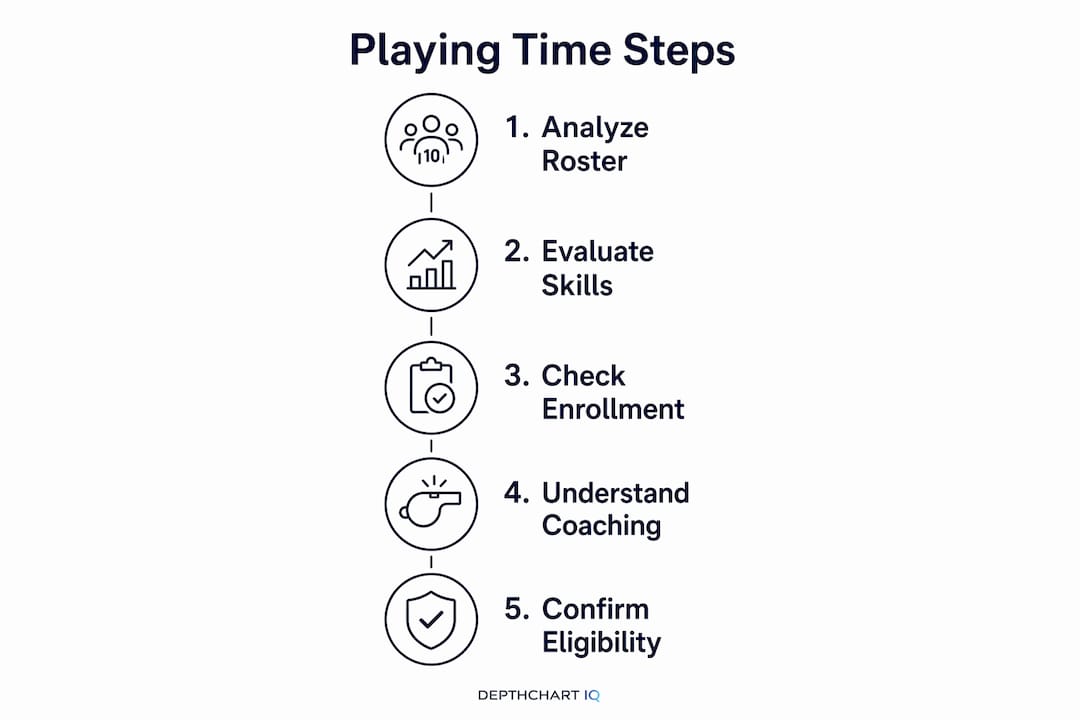
Start by identifying confirmed starters. These are athletes with two or more seasons of starting experience at your position. They represent the ceiling on your immediate minutes. Next, map the bench players. Athletes in their second or third year who have not broken into the starting lineup are often the ones you will compete with directly.
Historical roster churn rates tell you how often spots actually open up. A program that loses three or four players per year to graduation, transfer, or injury creates more opportunity than one with a stable, returning core. You can calculate this by comparing rosters from the past two seasons side by side.
Use comparative metrics to benchmark yourself honestly. If the current starter at your position averages 28 points per game and you averaged 14 at your previous school, the gap is real. That does not mean you cannot close it, but it does mean your minute projection for year one should be conservative.
The table below shows a typical position depth breakdown and what it means for a transfer athlete’s realistic playing time in their first season.
| Roster depth at your position | Returning starters | Typical first-year minutes for transfer |
|---|---|---|
| Thin (1 starter, 1 backup) | 0–1 | High (20+ minutes per game) |
| Moderate (1 starter, 2 backups) | 1 | Medium (10–20 minutes per game) |
| Deep (2 starters, 3+ backups) | 2+ | Low (under 10 minutes per game) |
| Very deep (full rotation returning) | 3+ | Minimal or redshirt likely |
Pro Tip: Ask the coaching staff directly how many minutes they project for your position in year one. A coach who cannot give you a number is either uncertain about roster plans or unwilling to commit. Both answers are useful data.
How skill diagnostics speed up your playing time readiness
Arriving at a new program with documented performance data gives you an immediate advantage. Rapid skill diagnostics administered in the first 2–3 days after arrival help coaches quickly understand what you bring, rather than waiting weeks for transcripts or film review to surface.
The EduGenius team has found that the receiving school’s speed of assessment shapes transfer success far more than the sending school’s records. That principle applies directly to athletic transfers. The faster a coach can place you accurately in the rotation, the sooner you earn real minutes.
Here is what a strong early diagnostic package looks like for an athlete:
- A one-page performance summary covering your stats from the previous two seasons
- Video clips (3–5 minutes) showing your best plays at your primary position
- A written note from your previous coach confirming your role and strengths
- Any physical testing results: vertical jump, sprint times, strength benchmarks
Providing a timely skill summary to the receiving coach can reduce integration time from weeks to days. That compression directly improves your playing time prospects in the early part of the season.
Athletes who wait for the coaching staff to figure them out on their own consistently fall behind peers who show up with a clear, organized case for their own value. Proactive communication is not arrogance. It is preparation.
How commute time and school adjustment affect your playing time expectations
Physical readiness and playing time are directly connected to how quickly you settle into a new environment. Commute length is one factor athletes routinely underestimate. The ideal commute for high school athletes is 20–35 minutes. Commutes beyond 45 minutes negatively affect sleep, recovery, and training consistency.
Social and academic adjustment timelines compound the issue. High school athletes typically need 2–4 weeks to adjust to basic routines at a new school, with full social integration taking 3–6 months. Emotional and academic adjustment can extend to 12 months for older students. Every week spent adjusting is a week where your athletic focus is split.
The table below maps adjustment phases to their likely impact on playing time.
| Adjustment phase | Typical timeline | Impact on playing time |
|---|---|---|
| Basic routine adjustment | 2–4 weeks | Moderate distraction, reduced practice quality |
| Social integration | 3–6 months | Improving focus, better team chemistry |
| Full academic and emotional adjustment | Up to 12 months | Stabilized performance, full availability |
Dr. Ana Aznar recommends practicing your commute and meeting peers before the school year starts to reduce anxiety and sharpen focus from day one. For athletes, that translates directly to arriving early, attending optional workouts, and building relationships with teammates before the competitive season begins.
Balancing academics, travel, and training during a transition is genuinely hard. Athletes who plan the academic side of their transfer with the same rigor they apply to athletic preparation consistently report faster integration and more playing time in their first semester.
Common mistakes athletes make when predicting playing time
Most playing time prediction errors come from overconfidence in the wrong data sources and underconfidence in direct communication.
- Over-relying on public interest surveys. Survey data and public projections over-predict enrollment and team demand by 20–40%. Raw public projections require significant discounting before they become useful for playing time estimation.
- Ignoring enrollment and eligibility delays. Athletes who assume paperwork will process itself routinely lose the first two to four weeks of practice. Those reps are irreplaceable in a competitive roster environment.
- Underestimating team dynamics. Depth charts show positions, not relationships. A coach who has built a culture around a specific group of veterans will not disrupt that chemistry for a newcomer, regardless of talent level.
- Failing to communicate early. Athletes who wait for the coaching staff to reach out first consistently earn fewer minutes in their first season than those who initiate contact and provide performance data proactively.
Pro Tip: Start your transfer evaluation and school communications 6–8 weeks before your planned move. That window covers enrollment paperwork, athletic eligibility processing, and gives you time to build a relationship with the coaching staff before you arrive.
Key takeaways
Accurate playing time projection requires combining roster analysis, skill diagnostics, and enrollment timing into a single, coordinated plan before you commit to a transfer.
| Point | Details |
|---|---|
| Start the process early | Contact the new school 6–8 weeks before your move to handle eligibility and enrollment paperwork. |
| Read the depth chart honestly | Count returning starters at your position to set a realistic first-year minutes expectation. |
| Bring your own data | Provide coaches with a performance summary and video within the first 2–3 days of arrival. |
| Factor in adjustment time | Expect 2–4 weeks of routine adjustment and plan your athletic focus around that window. |
| Avoid public projections | Survey-based demand data over-predicts by 20–40% and should not drive your decision. |
What I’ve learned from watching athletes get this wrong
Athletes consistently make the same mistake: they treat a coach’s verbal encouragement as a playing time guarantee. A coach saying “we’d love to have you” and a coach saying “you’ll start in week three” are completely different statements. Most athletes hear the first and assume the second.
The athletes who predict their minutes most accurately are the ones who treat the process like a job interview. They research the roster, they prepare a performance package, and they ask direct questions. They also account for the adjustment period honestly. A player who arrives mid-season and expects to start within two weeks is setting themselves up for frustration, not success.
Realistic prediction is not pessimism. It is the foundation of a real plan. If the data shows you are walking into a deep roster with limited opportunity, that is critical information. It means you either need to find a different program or commit to a longer development timeline. Both are valid paths. The mistake is ignoring the data and hoping for the best.
The role of data in athletic decisions is not to replace your instincts. It is to sharpen them. Use the numbers to confirm what you already sense, or to challenge assumptions you have not examined closely enough.
— John
DepthchartIQ gives athletes a data-driven edge on playing time
Athletes who want to move beyond manual roster research have a direct path to better answers. DepthchartIQ uses advanced metrics and prediction algorithms to give athletes tailored insights into their potential playing time based on real roster changes, not guesswork.
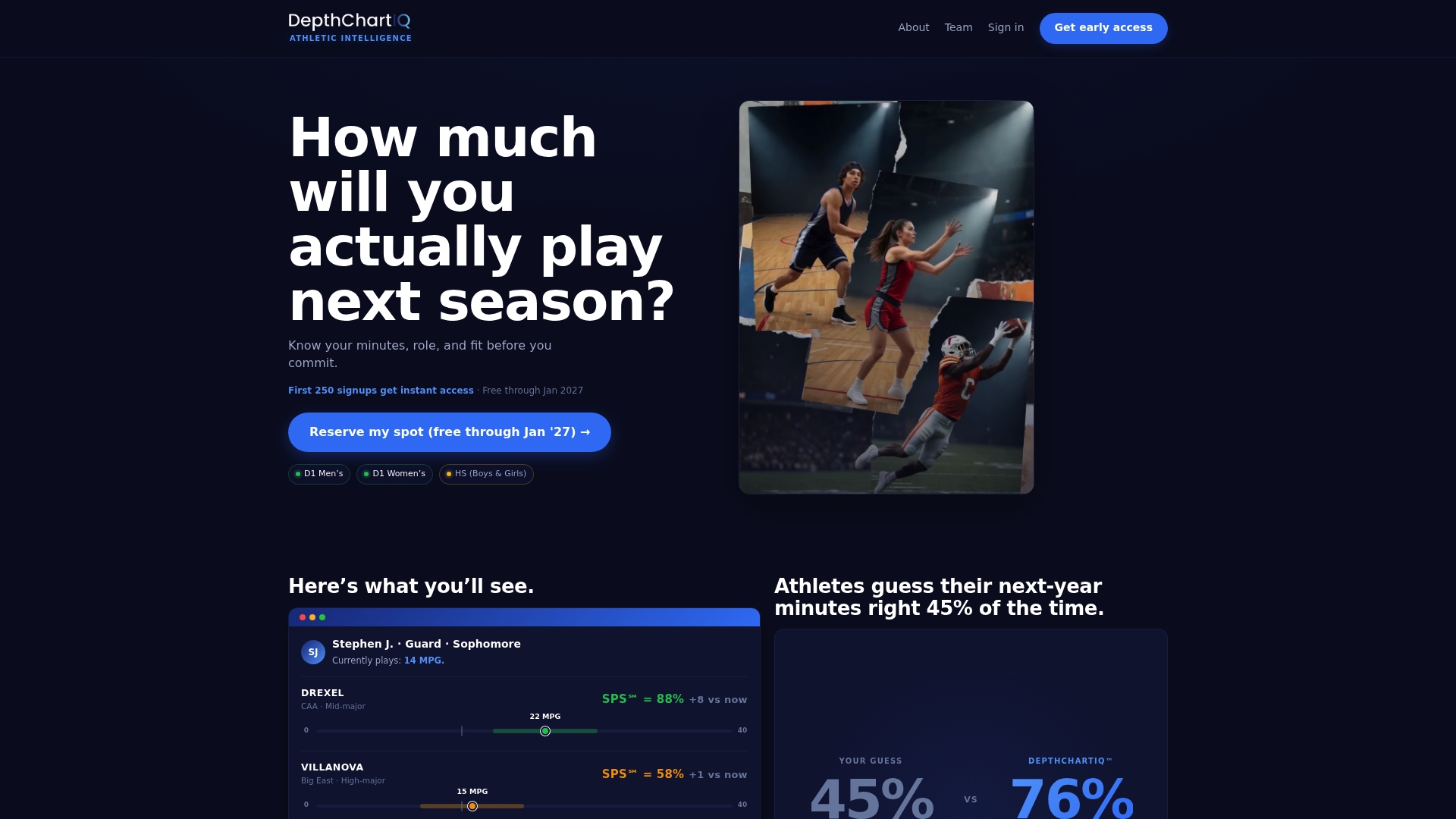
The platform’s Success Probability Scores and Roster Pressure insights are built specifically for transfer athletes and high school recruits evaluating program fit. DepthchartIQ delivers real-time data updates so your projections reflect current roster conditions, not last season’s numbers. With a reported 76% accuracy rate in predicting player outcomes, the DepthchartIQ methodology gives you a structured, reliable framework for making one of the most consequential decisions in your athletic career. Explore the full platform to see how your profile stacks up against current rosters at your target schools.
FAQ
How early should I start predicting my playing time at a new school?
Start your evaluation 6–8 weeks before your transfer to allow time for eligibility paperwork, roster research, and early communication with the coaching staff.
What is the most reliable way to estimate playing time at a new program?
Analyze the depth chart at your position, count returning starters, and compare your performance metrics directly against current roster players. Platforms like DepthchartIQ automate this comparison with real-time roster data.
Does commute time actually affect how many minutes I’ll play?
Yes. Commutes beyond 45 minutes negatively affect sleep and recovery, which reduces practice quality and athletic readiness. The ideal commute for high school athletes is 20–35 minutes.
How long does it take to fully adjust to a new school as an athlete?
Basic routine adjustment takes 2–4 weeks, while full social and academic integration can take 3–6 months or longer. Plan your playing time expectations around that adjustment curve.
Can I trust public interest surveys to predict my role on a new team?
No. Public surveys and enrollment projections over-predict demand by 20–40%. Use official roster data and direct coach conversations instead.