
Why Athlete Mental Health Matters in College Sports
Discover why athlete mental health matters in college sports. Understand its impact on performance and explore effective support programs.

DepthChartIQ
Athletic Intelligence
Why Athlete Mental Health Matters in College Sports
Mental health is a direct performance variable for college athletes, not a secondary concern. Research from Mass General Brigham confirms that mental skills build resilience the same way physical training builds strength. Understanding why athlete mental health matters in college sports means recognizing that anxiety, depression, and sleep disruption do not stay off the field. They show up in reaction time, decision-making, and recovery. The C.A.R.E. framework and peer-support programs like Brown University’s Bruno Cares represent the leading edge of how programs are responding in 2026.
Why athlete mental health matters in college sports
Mental health conditions are not rare among college athletes. They are the norm. Depression, anxiety, and sleep disturbances affect a significant share of Division I and Division II rosters every season. The challenge is that sport culture treats these conditions as weakness rather than injury, which delays care and compounds the damage.
Depression and anxiety rates are higher than most coaches expect
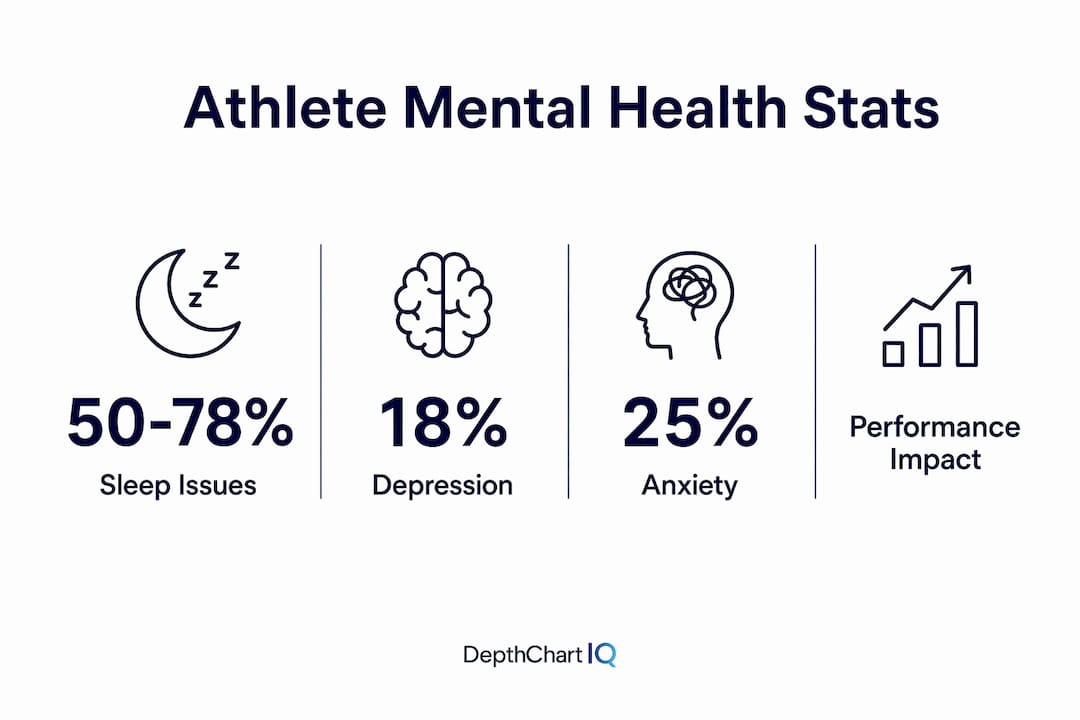
The numbers are stark. Among a studied sample of international student-athletes, 18% reported depressive symptoms and 25% reported anxiety within a two-week window. That is not a fringe population. Those rates reflect what sports medicine professionals are seeing across programs at every level.
Depression affects concentration, motivation, and the ability to process coaching feedback. Anxiety disrupts pre-competition routines and increases injury risk through distraction and muscle tension. Neither condition is visible on a depth chart, but both show up in performance outcomes.
Sleep disturbances are the hidden performance tax
Sleep is where mental and physical recovery converge. Elite athletes experience sleep disturbances at rates of 50–78%, and those disruptions are directly linked to increases in depression, anxiety, and stress symptoms. That range is not a minor inconvenience. It means the majority of elite athletes are operating with compromised recovery on any given night.
Poor sleep degrades reaction time, mood regulation, and immune function. Research also shows that lower sleep quality correlates with worse mental wellbeing and higher illness occurrence. Coaches who track physical load but ignore sleep data are missing one of the most measurable levers in athlete management.
The identity problem no one talks about
College athletes often define themselves entirely through their sport. When injury, poor performance, or roster changes threaten that identity, the psychological fallout can be severe. Mental health difficulties in this population frequently lead to:
- Loss of athletic identity and purpose
- Performance decline that reinforces negative self-perception
- Risky coping behaviors, including substance misuse
- Withdrawal from teammates and support systems
The academic balance challenges that college athletes face compound this further. Balancing coursework, practice, travel, and recovery leaves little room for processing emotional strain.
How do coach and teammate relationships shape mental wellness?
Relationships inside the program are the single most powerful environmental factor in athlete mental health. This is not a soft claim. Relationship quality with coaches, teammates, and staff strongly predicts mental health outcomes, sometimes more than factors outside sports entirely.
Supportive communication changes outcomes
A coach who communicates with clarity, consistency, and respect creates a psychologically safe environment. Athletes in those environments are more likely to report distress early, seek help, and maintain performance under pressure. The opposite is also true. Critical, dismissive, or unpredictable communication from coaches correlates with higher anxiety and disengagement.
Team culture follows the same logic. When teammates normalize struggle and support each other openly, the entire roster benefits. When the culture rewards toughness and punishes vulnerability, athletes suffer in silence.
Stigma is the structural barrier
Stigma and sport culture discourage athletes from seeking help. Fear of being perceived as weak, fear of losing playing time, and fear of judgment from coaches are the most commonly cited reasons athletes avoid mental health care. This is not a personal failing. It is a predictable response to an environment that has historically treated mental health as incompatible with athletic identity.
Athletic departments that post a therapist’s name on a website and call it a mental health program are not solving this problem. The barrier is cultural, and it requires active, visible leadership from coaches and athletic directors to dismantle.
International athletes face compounded stressors
International student-athletes carry all the standard pressures of college sports plus a separate layer of cultural adjustment, homesickness, and discrimination. Their mental health needs are distinct and frequently unmet by programs designed for domestic athletes. Coaches working with international athletes need specific training in culturally informed communication, not just general wellness awareness.
What programs actually work for college athlete mental health?
Evidence-based programs share three features: structured access, peer involvement, and integration with physical recovery. Programs that check all three boxes produce measurable results.
The c.a.r.e. framework
The C.A.R.E. framework is a structured approach to organizing mental health communication and resources within athletic departments. Research analyzing Division I mental health webpages found that most programs lack universal screening tools and clear help-seeking guidance. C.A.R.E. addresses this by giving departments a consistent structure for presenting resources, reducing stigma language, and creating clear pathways to care.
The four components work together:
- Communicate resources clearly and without stigma-reinforcing language
- Access pathways must be specific, not vague references to “support available”
- Respond with defined protocols for crisis situations
- Educate athletes and staff on recognizing distress in themselves and others
Brown university’s bruno cares model
Brown University’s Bruno Cares program is the most well-documented peer-support model in college sports as of 2026. Bruno Cares trains student-athletes over four weeks to recognize distress signals and connect peers to professional help. The program complements existing expert support in sports psychology, nutrition, and mindfulness rather than replacing it.
The key design principle is structured escalation. Peer supporters know exactly when and how to refer a teammate to a professional. This prevents role confusion and protects both the peer supporter and the athlete in distress.
Pro Tip: If your program is building a peer-support initiative, require a written escalation protocol before launch. Peer supporters without clear referral pathways often freeze in crisis situations, which defeats the program’s purpose.
Integrating sleep and recovery into mental health programs
Sleep management belongs inside mental health programming, not separate from it. Sleep and circadian rhythm interventions show stronger improvements in positive affect and anxiety reduction than many traditional mental health interventions alone. Programs that track sleep alongside mood and performance data create a more complete picture of athlete wellbeing.
The comparison below shows how integrated and siloed approaches differ in practice:
| Approach | Sleep Tracking | Mood Monitoring | Crisis Pathway | Peer Component |
|---|---|---|---|---|
| Integrated Model | Yes | Yes | Defined | Trained peers |
| Siloed Model | No | Rarely | Unclear | None |
How do domestic and international athletes compare in mental health risk?
The mental health risk profile for international student-athletes is measurably different from their domestic peers. Among 207 international student-athletes studied, homesickness was prevalent and directly linked to higher rates of depression and anxiety. Only 41% used available mental health services, suggesting access and cultural fit are both barriers.
Key differences between the two groups include:
- International athletes face language barriers that complicate help-seeking
- Discrimination and cultural isolation increase baseline stress levels
- Dissatisfaction with coaching staff relationships has a stronger negative mental health effect in international athletes
- Adjustment stress from academic and social systems adds a layer domestic athletes do not experience
NCAA programs competing for international talent need to treat culturally informed mental health support as a recruiting and retention factor, not an afterthought. The role of data in athletic decision-making extends to understanding which athletes face the highest mental health risk and why.
Key takeaways
Mental health in college sports is a performance variable that coaches, athletes, and athletic departments must treat with the same rigor as physical conditioning.
| Point | Details |
|---|---|
| Sleep is a performance lever | Elite athletes experience sleep disturbances at rates of 50–78%, directly worsening anxiety and mood. |
| Relationships predict outcomes | Coach and teammate relationship quality is among the strongest predictors of athlete mental health. |
| Stigma blocks access | Fear of judgment stops athletes from seeking care; cultural change requires active leadership, not just posted resources. |
| Peer programs need structure | Bruno Cares shows that peer-support works when paired with clear escalation protocols and professional backup. |
| International athletes need tailored support | Higher rates of homesickness and discrimination create distinct mental health risks that generic programs miss. |
Mental health is the training variable most programs still ignore
I have spent years watching athletic programs invest heavily in nutrition science, biomechanics, and recovery technology while treating mental health as a compliance checkbox. The research in 2026 makes the cost of that approach undeniable.
What strikes me most is how fixable this is. The Bruno Cares model at Brown does not require a massive budget. It requires commitment, structure, and a willingness to train athletes as mental health allies rather than just competitors. That is a culture decision, not a financial one.
Coaches carry more influence here than they typically acknowledge. An athlete who trusts their coach is far more likely to report distress early. That early report is the difference between a two-week intervention and a season-ending crisis. The NIL financial pressures athletes now navigate add another layer of psychological strain that programs are only beginning to address.
The most practical shift I would recommend to any coaching staff is this: start tracking sleep and mood alongside physical metrics. Not as a wellness gesture, but as performance data. When athletes see their mental state treated as seriously as their sprint times, the stigma around discussing it starts to erode.
Mental health is trainable. Resilience is a skill. Programs that build both will outperform those that do not.
— John
Build your athlete’s complete performance picture with DepthchartIQ
Mental health is one piece of a larger performance equation. DepthchartIQ gives college athletes and coaches the data layer that connects roster decisions, playing time projections, and career planning into a single view.
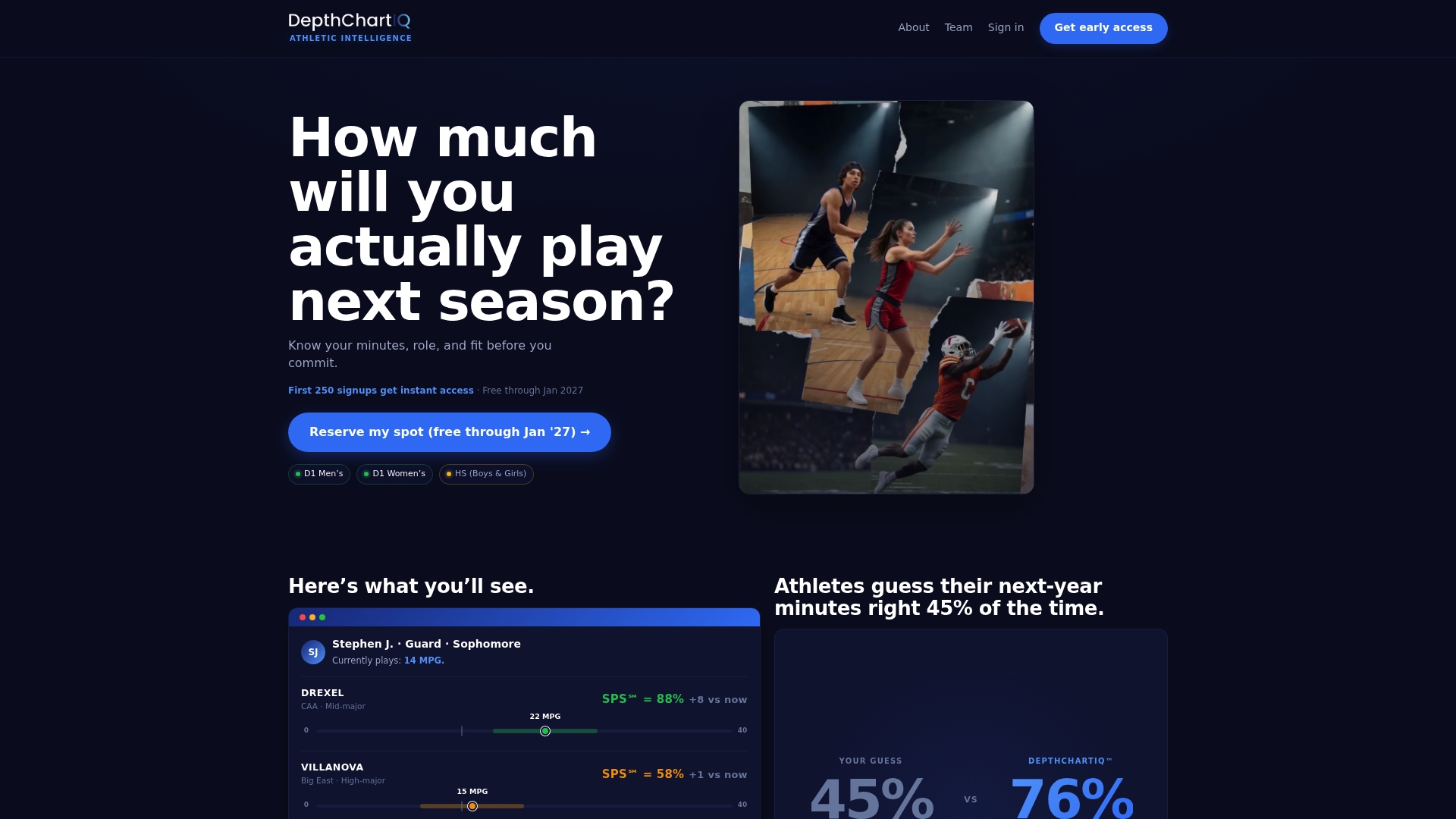
The platform’s Success Probability Scores and Roster Pressure insights help athletes make informed decisions about transfers, program fit, and development timelines. With a 76% accuracy rate in predicting player outcomes, DepthchartIQ provides the kind of objective clarity that reduces the uncertainty-driven anxiety so many college athletes carry. Explore the platform’s methodology to see how data-driven athlete assessment works in practice.
FAQ
How does mental health affect athletic performance?
Mental health directly affects concentration, reaction time, motivation, and recovery. Practicing coping strategies builds resilience that improves both mental wellbeing and on-field performance.
What mental health challenges are most common in college athletes?
Depression, anxiety, and sleep disturbances are the most prevalent conditions. Research shows elite athletes experience sleep disturbances at rates of 50–78%, with direct links to mood and performance decline.
Why do college athletes avoid seeking mental health help?
Stigma and fear of judgment are the primary barriers. Sport culture historically frames help-seeking as weakness, and inconsistent resource communication on athletic department websites makes access harder than it needs to be.
What is the bruno cares program?
Bruno Cares is Brown University’s peer-support program that trains student-athletes over four weeks to recognize distress and connect teammates to professional care, with structured escalation protocols built in.
Do international college athletes face greater mental health risks?
Yes. International student-athletes report higher rates of homesickness, discrimination, and adjustment stress. Among those studied, 25% reported anxiety and 18% reported depressive symptoms within a two-week period.