
How NIL Income Works for College Athletes in 2026
Discover how NIL income works for college athletes in 2026. Learn the essentials of monetizing your brand and understanding tax implications.

DepthChartIQ
Athletic Intelligence

How NIL Income Works for College Athletes in 2026

NIL income is defined as money college athletes earn by licensing their name, image, and likeness through endorsements, social media content, personal appearances, and direct school compensation under NCAA and state-level rules. Understanding how NIL income works for college athletes is no longer optional. Since the NCAA’s 2021 policy shift, athletes at every level can monetize their personal brand, but the financial and legal responsibilities that come with it are real, complex, and often misunderstood.
How NIL income works for college athletes: the tax basics
NIL income is classified as self-employment income by the IRS, not wages, not scholarship money, and not a gift. That distinction matters enormously. An athlete earning $30,000 in NIL deals faces roughly $4,240 in self-employment tax alone before federal income tax is calculated. That number surprises most first-year earners who assume NIL money works like a paycheck with taxes already removed.
The self-employment tax rate is 15.3% on net earnings up to $176,100. This covers Social Security and Medicare contributions that an employer would normally split with a traditional employee. Because no employer exists in a NIL arrangement, the athlete pays both sides.

Sponsors and brands that pay you $600 or more in a calendar year are required to issue a Form 1099-NEC. No tax is withheld at the time of payment, which means the IRS expects you to manage your own tax obligations throughout the year. Athletes use Form 1040-ES to make quarterly estimated payments and avoid penalties at year-end.
Filing your NIL taxes requires three core IRS forms. Schedule C reports your business income and deductible expenses. Schedule SE calculates the self-employment tax owed. Form 1040 is the main return that pulls everything together. If you earn NIL income in multiple states during travel for games or appearances, you may also owe state income tax filings in each of those states.
Pro Tip: Set aside 35 to 40 percent of every NIL payment the moment it hits your account. Open a separate checking account labeled “taxes” and treat it as untouchable until your quarterly payment is due.
Here is a quick reference for the forms you will use:
| IRS Form | Purpose | When to Use |
|---|---|---|
| Schedule C | Report NIL income and deductible business expenses | Filed annually with Form 1040 |
| Schedule SE | Calculate self-employment tax owed | Filed annually when net earnings exceed $400 |
| Form 1040-ES | Estimate and pay quarterly taxes | Due April, June, September, January |
| Form 1099-NEC | Received from sponsors paying $600 or more | Issued by payer, not filed by athlete |
Revenue sharing vs. NIL deals: what’s the difference?
The 2025 House v. NCAA settlement created a new income category that many athletes confuse with traditional NIL deals. Under this agreement, schools can directly compensate athletes with a total pool of up to $20.5 million for the 2025-26 academic year, growing to $32.9 million over ten years. This money comes from the school itself, not from outside sponsors.
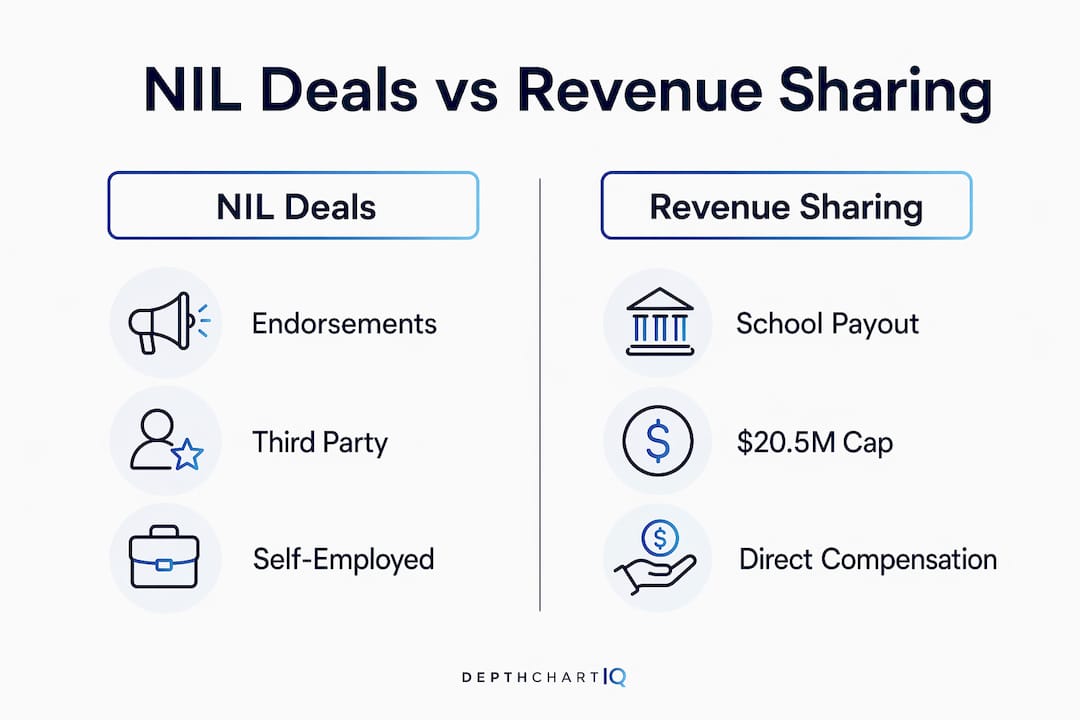
Traditional NIL deals are completely separate. A local car dealership paying a quarterback for social media posts, a nutrition brand sponsoring a gymnast’s YouTube channel, or a fan-supported platform like Patreon where followers pay for exclusive content. These are third-party arrangements with no school involvement.
The critical difference is income predictability. Revenue sharing payments from your school arrive on a schedule and are negotiated through your athletic department. NIL deals from external sponsors depend on your personal brand, your sport’s visibility, and your ability to market yourself. Understanding both income streams is the foundation of a smart financial plan.
Revenue sharing is not distributed equally across sports. The allocation reality looks like this:
- Football and men’s basketball programs receive the majority of direct school compensation funds
- Olympic sports like swimming, track, and wrestling receive minimal or no allocation
- Women’s sports outside of basketball often depend almost entirely on external NIL deals
- Walk-ons and depth players in major sports may receive far less than starters
This means that if you play a non-revenue sport, NIL deals remain your primary income path. Building your personal brand, growing your social following, and pursuing local and national sponsorships is not optional. It is your financial strategy. When evaluating programs, understanding how a school allocates its revenue sharing pool is as important as evaluating playing time. DepthchartIQ’s guide on evaluating college athletic programs covers what to look for when comparing schools.
Common NIL income mistakes that cost athletes money
The most expensive mistake athletes make is treating NIL income like a scholarship. Scholarships are generally excluded from taxable income when applied to tuition and fees. NIL income is entrepreneurial revenue with no such exemption. Every dollar is taxable, and the IRS treats you as a small business owner.
Non-cash compensation creates another blind spot. If a brand sends you free apparel, a car for a weekend, hotel stays, or meals as part of a deal, those benefits must be reported at fair market value. A $2,000 pair of shoes is $2,000 of taxable income. Most athletes never report these items, which is exactly why the IRS flags NIL earners for closer review.
IRS audit risk is elevated for NIL income recipients because of unfamiliarity with tax rules, inconsistent income reporting, and the absence of formal business accounting. Young taxpayers with irregular income patterns and no prior filing history draw scrutiny. The solution is documentation.
Here are the most common pitfalls to avoid:
- Failing to track mileage for appearances, photo shoots, and promotional events
- Missing receipts for equipment, software, or services used in content creation
- Ignoring income earned in states you visited for games or sponsored appearances
- Underreporting non-cash benefits received from sponsors
- Skipping quarterly estimated payments in year one because income feels small
Most athletes lack proper expense documentation such as mileage logs and receipts, which causes otherwise deductible expenses to be disqualified during audits. Every dollar you can document as an “ordinary and necessary” business expense reduces your taxable income directly. A $500 camera used for content creation is a deductible business expense. A $200 monthly phone plan used partly for brand management is partially deductible.
Pro Tip: Use a free app like Google Sheets or a paid tool like QuickBooks Self-Employed to log every NIL-related expense the same day it occurs. Waiting until tax season means you will forget half of what qualifies.
Practical steps to manage your NIL income effectively
Managing NIL income well is a skill you build before the money gets complicated, not after.
-
Document every deal in writing. Use your school’s NIL compliance platform, such as NIL Go or a similar tool your athletic department provides, to register all agreements. A verbal deal with a local business is not protected. Written contracts define payment terms, deliverables, and usage rights.
-
Set aside taxes immediately. Begin quarterly estimated payments by your second year of NIL income. The first year offers a grace period because your prior-year tax baseline is zero, but that window closes fast. Missing estimated payments triggers penalties on top of the tax you already owe.
-
Track non-cash benefits with the same discipline as cash. Create a log for every product, service, or perk received as part of a deal. Record the item, the date, and its retail value. This protects you during an audit and gives your tax preparer accurate numbers.
-
Separate your finances. Open a dedicated checking account for NIL income. Mixing NIL money with personal spending makes expense tracking nearly impossible and raises red flags if the IRS requests records.
-
Understand multi-state obligations. If you earn income while traveling to another state for an appearance or a sponsored event, that state may require a tax return. Multi-state tax filings are one of the most overlooked compliance issues for college athletes.
-
Hire a tax professional who knows athletes. A general CPA may not understand NIL-specific deductions, revenue sharing classifications, or multi-state athlete tax rules. Find someone with direct experience in sports income. The cost of professional advice is itself a deductible business expense.
College golfers and athletes in individual sports face unique complications around amateur status rules that intersect with NIL income. Knowing where those boundaries sit before signing a deal prevents eligibility problems that no amount of tax planning can fix.
Key takeaways
NIL income is self-employment income, and athletes who treat it like a business from day one avoid the tax surprises, audit risks, and missed deductions that catch most first-year earners off guard.
| Point | Details |
|---|---|
| NIL income is self-employment income | Athletes owe federal income tax plus a 15.3% self-employment tax on net NIL earnings. |
| Quarterly payments are required | Use Form 1040-ES to pay estimated taxes each quarter starting in year two of NIL earnings. |
| Non-cash compensation is taxable | Free products, travel, and meals from sponsors must be reported at fair market value. |
| Revenue sharing and NIL deals are separate | School payments come from a $20.5M annual pool; third-party deals depend on your personal brand. |
| Documentation prevents audit losses | Mileage logs, receipts, and written contracts protect deductions and reduce IRS scrutiny. |
What I’ve learned watching athletes navigate NIL income
The athletes who struggle most with NIL income are not the ones who earn the least. They are the ones who earn just enough to create real tax obligations but not enough to feel like they need professional help. A $12,000 NIL year sounds manageable until you realize you owe $1,836 in self-employment tax, missed two quarterly payments, and forgot to report $800 in free gear. That is a $3,000 problem hiding inside what felt like a good year.
What I find genuinely underappreciated is how much the revenue sharing conversation has shifted athlete expectations without shifting athlete preparation. Schools are talking about $20.5 million pools, but the actual distribution to any individual athlete, especially in a non-revenue sport, is often far smaller than recruits imagine. I would tell every high school recruit to ask their prospective program for specific allocation data before counting on that income.
The athletes who handle NIL income well treat it exactly like a small business from the first dollar. They open separate accounts, log expenses in real time, and get a tax professional involved before they file their first return. That is not overcautious. That is the minimum viable approach for anyone earning irregular income with no employer handling withholding on their behalf. Parents play a real role here too. The DepthchartIQ article on parent involvement in athletic decisions covers how families can help athletes avoid costly financial missteps.
— John
How DepthchartIQ helps athletes make smarter NIL decisions
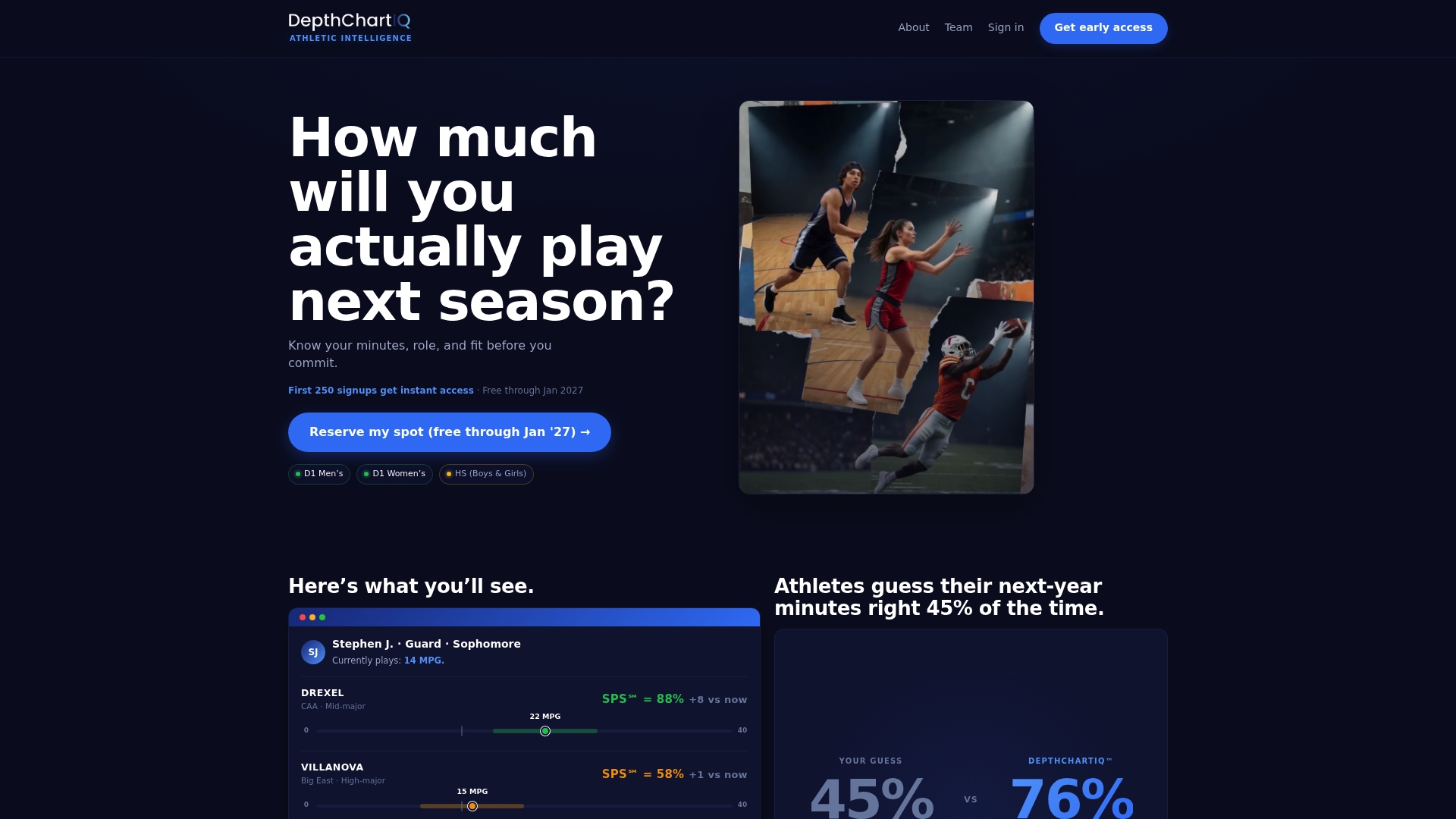
DepthchartIQ is built for athletes who want more than general advice. The platform’s methodology applies real data to the decisions that shape your athletic and financial future, from evaluating which programs offer genuine playing time to understanding how roster dynamics affect your income potential. When your NIL earnings depend on visibility and playing time, knowing where you actually stand on the depth chart changes everything. DepthchartIQ’s Success Probability Scores and Roster Pressure insights give you the specific, data-backed picture you need to plan your career and your income strategy with confidence. Explore DepthchartIQ to see how the platform supports athletes at every stage of the recruiting and transfer process.
FAQ
What is NIL income for college athletes?
NIL income is money earned by college athletes through the use of their name, image, and likeness, including endorsements, social media content, personal appearances, and direct school compensation. The NCAA permitted this starting in 2021, and state laws further define what is allowed at each institution.
How is NIL income taxed?
NIL income is treated as self-employment income, subject to federal income tax and a 15.3% self-employment tax on net earnings. Athletes must file Schedule C and Schedule SE with their Form 1040 and make quarterly estimated payments using Form 1040-ES.
Do athletes have to report free products from sponsors?
Non-cash compensation such as apparel, meals, travel, and equipment must be reported at fair market value as taxable income. Failing to report these items is one of the most common reasons NIL earners face IRS scrutiny.
What is the difference between revenue sharing and a NIL deal?
Revenue sharing is direct compensation from the school, drawn from a pool capped at $20.5 million for 2025-26, and is concentrated in football and men’s basketball. NIL deals are independent agreements with outside sponsors, brands, or fan platforms and are available to athletes in all sports.
When do quarterly tax payments start for NIL income?
Athletes must begin making quarterly estimated tax payments by their second year of NIL income. The first year carries a grace period because the prior-year tax liability is zero, but missing payments in subsequent years triggers penalties.