
COVID Year Eligibility in 2026: What Basketball Players Need to Know
Is the COVID year still alive in 2026? How the NCAA's age-based model, the five-year clock and Class of 2022 lawsuits affect college basketball players.
 DepthChartIQ13 min read


The COVID year is mostly a closed chapter for college basketball, and the rule that decides your seasons in 2026-27 is a new one. In June 2026 the Division I Cabinet unanimously approved an age-based model that gives athletes up to five years of eligibility if they enroll no later than the academic year after their 19th birthday. If you used a pandemic waiver, you may use the old rules or the new model, whichever is more beneficial. Before you decide whether to stay, transfer or commit, you need to know which clock you are on and what your playing time could look like once you know it.
TL;DR
- The 2021 COVID waivers restored seasons that the pandemic affected, and in basketball that extra year has largely cycled out of rosters.
- For 2026-27, current athletes with eligibility remaining after 2025-26 can use either the previous rules (four seasons in five years) or the new age-based model.
- Athletes who used their final season in 2025-26 get no additional eligibility from the new model, and courts are still hearing Class of 2022 cases.
- Only your compliance office can confirm your personal status, so ask for it in writing.
- Once you know your seasons, compare programs on playing time, not only on the pitch.
Table of Contents
- What the COVID year was, and why it matters less now
- The rule that replaced the old clock
- Who gets to choose between old and new rules
- The Class of 2022 fight
- Three questions to answer before you decide anything
- What to ask your compliance office
- Turning an extra season into playing time
- Our perspective
- Try it on your own shortlist
- FAQ
- Sources
What the COVID year was, and why it matters less now
In 2021 the Division I Council extended self-applied season-of-competition waivers to eligible fall and winter sport athletes who competed in 2020-21, giving them five seasons of competition including 2020-21. Division I athletes who qualified for that additional year are, in the NCAA’s wording, considered to have eligibility remaining.
Two details from the NCAA’s 2021 guidance still explain a lot of confusion. First, the extension lengthened the period of eligibility in the sport by one year and had to be used at the first available opportunity. Second, it restored COVID-impacted years for athletes who actually competed. It was not a bonus year handed to athletes who were eligible but did not play.
That is why the search term “COVID year” feels dated. AP reported in October 2024 that the pandemic-era extra year was largely cycling out of men’s and women’s basketball in 2024-25, with fifth-year players such as Brandon Miller and Hunter Dickinson headlining that last wave. The same report noted that the extra year had made rosters older, because coaches preferred veterans.
So if you are asking whether a COVID year gives you a new season in 2026-27, the honest answer is that the question has moved on. What matters now is the age-based model, how your own waiver history fits into it, and the court cases around it.
The rule that replaced the old clock
The NCAA’s age-based model removes several pieces of the old system. According to the NCAA Eligibility Center, it eliminates seasons-of-competition limits, athletic redshirt rules, delayed-enrollment rules and sport-specific enrollment timelines, along with several waiver categories. Pregnancy, active-duty military service, official religious missions and similar service commitments may still be exceptions.
Here is how the clock works in plain terms:
- When it starts. A June 2026 Division I Cabinet report shows the clock starts at initial full-time enrollment or the academic year after the 19th birthday, whichever comes first. Graduating from high school is no longer a starting trigger, a change made at the recommendation of men’s basketball, men’s ice hockey and the service academies.
- How long it runs. Once it starts, the five-year period runs continuously. It does not pause because you sit out, transfer, change teams or take time away, and athletic redshirts are no longer tracked.
- What it is not. The NCAA itself says the “5 for 5” label is inaccurate. The rule is built on age and initial enrollment, it does not guarantee five years to everyone (particularly athletes who delay enrolling), and academic and other athletics rules still apply. Being inside the window does not by itself make you eligible.
If you remember the old “redshirt” conversation, that vocabulary is fading. The question is no longer “do I have a redshirt year left?” It is “where am I on my five-year clock?”
Who gets to choose between old and new rules
The transition is where most athletes and parents get tangled. Under the NCAA’s transition rules, current athletes with eligibility remaining under the previous rules after 2025-26 may use either the previous rules (four seasons within five years) or the age-based model, whichever is most beneficial. Prospects enrolling in 2026-27 get the same choice, while prospects enrolling in fall 2027 or later use the age-based model only. Athletes who used their final season in 2025-26 get no additional eligibility.
That last line is the one that stings. The Division I board decided the new rules would not apply to outgoing seniors, with the reasoning, as AP reported, that an influx of unexpected veterans would take opportunities from incoming freshmen who had already signed.
If you earned a waiver in the past, your school decides how it fits. UNF’s student handbook, for example, explains that for athletes with previously approved waivers the compliance office determines the most beneficial model case by case, and that medical hardship and extension waivers are eliminated except for pregnancy, active-duty military service or a religious mission. Your school’s process may differ, which is another reason to get your status confirmed directly.
The NCAA also set a deadline for the old system: requests under the previous rules based on circumstances during or before 2025-26 were due July 31, 2026. If you are unsure whether anything was filed for you, that is the first thing to ask about.

The Class of 2022 fight
The loudest part of this story is not in the rulebook. It is in court. The five-year rule did not apply to high school Class of 2022 players, who were finishing their fourth season when it was adopted, and many sued for a fifth season. Judges in Ohio, Indiana, Kentucky and elsewhere granted injunctions, and the Kentucky Court of Appeals denied the NCAA an emergency injunction covering 30 athletes, including Missouri’s Mark Mitchell and LSU’s Skyy Clark.
The scale is large. As of early November 2026, the NCAA reported roughly 200 lawsuits and 850 plaintiffs across sports, including 362 men’s and 62 women’s basketball players, with 171 men and 30 women having received some judicial relief to play, per AP’s November 2 report.

A class-wide track also existed. On July 31, 2026, Judge Charlotte Sweeney ordered the NCAA to declare Class of 2022 athletes who finished their fourth season that spring eligible for another year, and the 10th U.S. Circuit Court of Appeals later voted 2-1 to halt that ruling. Separately, the Pavia lawsuit, which challenges counting junior-college seasons against Division I eligibility time, was slated for trial in February.
What should you take from this? Court outcomes are individual, they move quickly, and they can be reversed or paused on appeal. If you are in this group, your lawyer and your school’s compliance office are the people who can tell you where you stand. Treat any plan that depends on a ruling as something to revisit often.
The effect on the floor is real. Rosters are getting older and deeper in veterans, and fans following the return of experienced players can see it in college basketball game previews that spotlight key players and storylines.
Three questions to answer before you decide anything
Eligibility is a gate, not a destination. Once you know you can play, the question is where you will play. Work through these in order.
1. Which seasons do I actually have?
Write down your first full-time enrollment date, your birthday, which seasons you played, and any waiver ever filed. Then ask your compliance office to tell you which model (old or age-based) gives you the most seasons, and whether you are certified for 2026-27. The NCAA’s Eligibility Center guide on our blog walks through the basics for athletes and families.
2. Does my eligibility survive a move?
Transferring changes more than your uniform. Credits, graduation timing and transfer windows all affect whether you can play right away. Our posts on the one-time transfer rule, transfer credits and eligibility and midyear transfer eligibility cover those pieces. If you are moving from another country, read international transfer eligibility. If you have a degree in hand, see graduate transfer admissions.
3. Will there be minutes for me?
This is where an extra season can quietly go to waste. Veterans returning under the new model and court orders mean more experienced players competing for the same rotation spots. A coach’s promise of “a role” is a pitch, and it does not tell you how crowded your position is. Scholarship counts matter too, and our explainer on scholarship limits in basketball shows how roster space is capped.
What to ask your compliance office
Your compliance office is the authority on your personal eligibility, so go in with specific requests. One sports law firm’s guidance for athletes suggests asking whether your eligibility is certified for 2026-27 and whether any old-rule waiver issues are still open, requesting your full athletic eligibility record, gathering medical and academic documentation for any waiver, and confirming how the school is submitting it, with a confirmation number or internal ticket.
A short checklist to bring:
- Your enrollment history and birthday, so the clock start can be confirmed.
- A list of every season you competed in, including any COVID-affected one.
- Any waiver paperwork, approved or pending.
- A written answer on whether the old rules or the age-based model applies to you.
- The name of the person at the school who owns your file.
Keep every reply in writing. If a coach at another school tells you that you are “cleared,” the clearance that counts comes from your current or future school’s compliance staff.
Turning an extra season into playing time
Most athletes weigh these decisions on gut feel and a coach’s pitch. That is understandable, because nobody hands you a number. But an extra year is only valuable if it lands you in a rotation, and the number of experienced players on rosters keeps climbing.
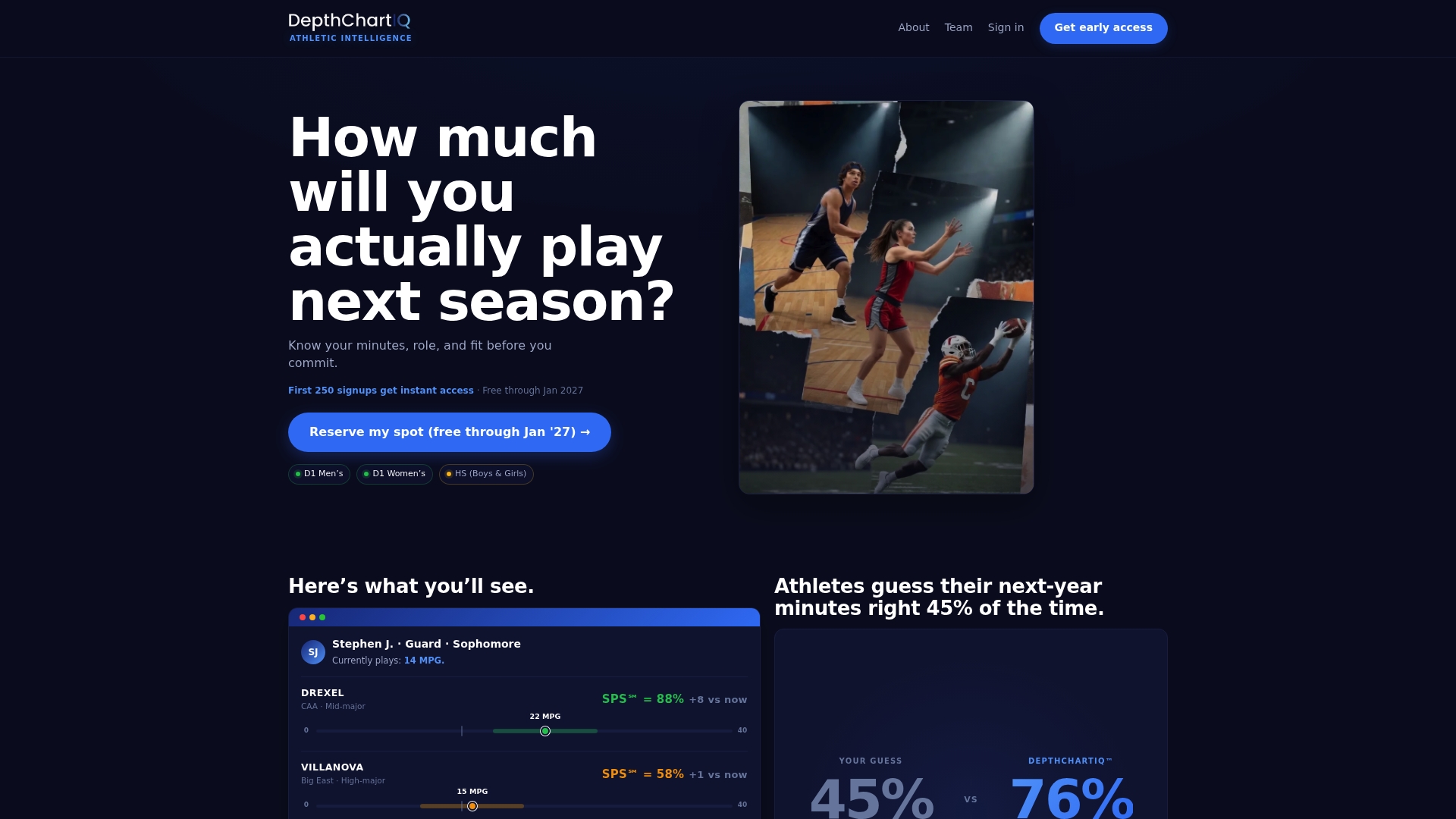
That is the gap DepthChartIQ is built to fill for college basketball players and their families. For each program you are considering, you see a projected minutes-per-game range for next season, a Success Probability Score (the chance of gaining minutes) and a Roster Pressure Score (how crowded your position is at that school), plus best-fit programs. The projections are estimates with ranges, not guarantees, which is exactly how you should treat any forecast.
Here is how that helps with an eligibility decision:
- Staying for another season. Compare your projected range at your current school with other programs before you commit to one more year.
- Transferring. A program that looks like a fit on paper can have a packed position. The Roster Pressure Score shows how crowded it is.
- Incoming players. High school and junior college players can look at how much room exists before they sign.
Spotter, our assistant, helps you research schools and draft messages to coaches once you have a shortlist. DepthChartIQ is built for athletes and families, not coaching staffs.
It is also worth reading our piece on 2026 rules and playing time forecasts if you are sorting fact from portal chatter, and our guide to National Letter of Intent rules before you sign anything.
Our perspective
Every eligibility headline this year has been about who is allowed to play. We think the next question matters just as much for athletes and families: what role will you have?
The new rules and the court cases have added veterans to many rosters. That makes the decision between staying, transferring and committing harder, and it makes a pitch from a coach less useful by itself. A projected minutes range for each program, alongside how crowded your position is, gives you something concrete to weigh next to the pitch.
We built DepthChartIQ for athletes and their families, not for coaching staffs. Our projections are estimates with ranges, and we want you to use them as one input next to your compliance office’s answer and your own conversations with coaches.
Try it on your own shortlist
Once your compliance office has confirmed your seasons, put your profile into DepthChartIQ. It is free during Early Access, and you can compare projected minutes, Success Probability and Roster Pressure across every program on your list. You can also look at pages such as Pacific Tigers women’s basketball or Portland Pilots women’s basketball to see how a program is presented.
If you want help drafting a first message to a coach, Spotter handles the research and the draft with you.
FAQ
Can college basketball players still get a COVID year in 2026?
Not as a new, separate benefit. The 2021 COVID extension was a one-time action, and AP reported that it largely cycled out of basketball by 2024-25. What exists now is the age-based model, which current athletes with eligibility remaining after 2025-26 can use if it is more beneficial than the old rules. Athletes who used their final season in 2025-26 get no additional eligibility from it.
Does the new rule mean everyone gets five seasons?
No. The NCAA says the “5 for 5” label is inaccurate. The five-year period starts at initial full-time enrollment or the academic year after your 19th birthday, whichever comes first, and it keeps running even if you sit out or transfer. Academic and other athletics rules still apply inside that window.
What if I graduated high school in 2022 and played four seasons?
You are in the group that has been going to court. Many Class of 2022 players sued for a fifth season, and some have received injunctions, but a class-wide ruling was halted on appeal. Talk to your compliance office and a lawyer about your own case, because outcomes depend on the athlete and the court.
How do I find out if I personally have another season?
Ask your compliance office for your full eligibility record, a written confirmation that you are certified for 2026-27, and a written answer on whether the old rules or the age-based model applies to you. If you ever had a waiver, ask whether anything is still open.
Sources
- NCAA: Division I adopts age-based eligibility model
- NCAA: Division I and II age-based eligibility rules
- NCAA: Division I COVID-19 Question and Answer Guide (2021)
- NCAA: Season of Competition and COVID-19 extension guidance (2021)
- NCAA: Division I eligibility remaining memo
- NCAA Division I Cabinet report, June 5, 2026
- AP News: COVID-19 led to extra college eligibility
- AP News: College basketball season opens amid eligibility chaos
- The Alligator: Denzel Aberdeen files injunction against NCAA
- ESPN: Court ruling clears Stephen Daley, Kellan Wyatt to play for Indiana
- AP via 21Alive: NCAA panel approves new eligibility rules
- UNF: NCAA Eligibility and Participation
- Christine Brown Sports Law: NCAA eligibility waiver deadline