
Graduate Transfer Admissions for College Basketball Players
Planning a graduate transfer in college basketball? Learn how NCAA rules, grad school admission and the portal window fit together, and how to judge playing time.
 DepthChartIQ12 min read
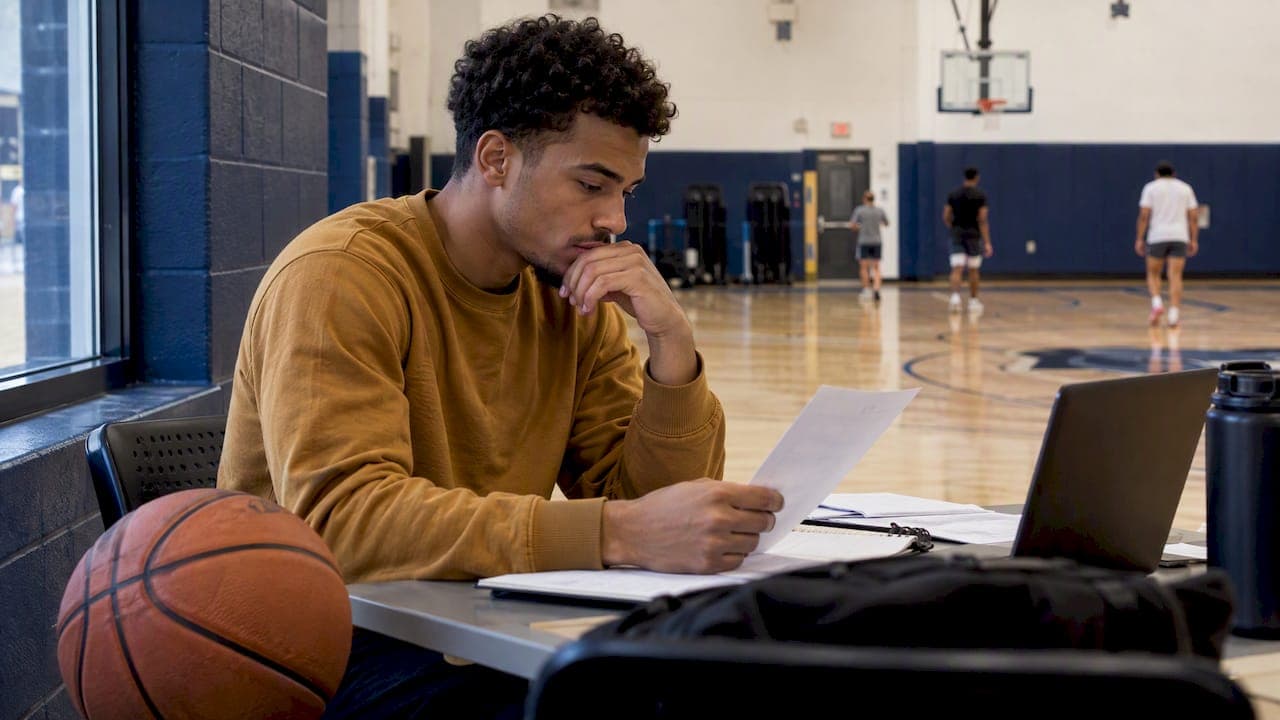

A graduate transfer is a basketball player who has earned a degree, still has eligibility left, and enrolls in a postgraduate program at a new school. Two separate gates apply. The NCAA has to say you can play, and the graduate program has to say you can enroll. Miss either one and the move falls apart, so plan both at once and weigh a third question before you commit: whether you will actually play.
This guide covers the admissions side, the NCAA side, the timing, and how to judge minutes before you sign.
TL;DR
- A graduate transfer needs two yeses: NCAA eligibility and admission to a real graduate program, with full-time enrollment.
- Division I basketball players use one 30-day notification window each year, plus an extra 30 days if the head coach leaves.
- Do not talk to another Division I staff before your name is in the portal. It can put your future eligibility at risk.
- Apply to programs like any grad applicant: transcripts, a statement, recommendation letters. Athletic interest does not replace them.
- Before you commit, estimate your minutes at each school. A roster spot is not a role.
Table of Contents
- Two admissions processes, not one
- What the NCAA says about graduate transfers
- Timing: when to enter the portal and when to apply
- What graduate programs actually ask for
- Contact rules to follow before you enter the portal
- Will you play? The question admissions can’t answer
- Where DepthChartIQ fits
- Our perspective: treat the degree and the role as one decision
- Common mistakes to avoid
- FAQ
- Sources
Two admissions processes, not one
Most pages that rank for this topic are written for ordinary students moving between colleges, and they miss the basketball angle. A graduate transfer is both a student applicant and an athlete in the portal. Those tracks run on different calendars and answer to different people.
The academic track belongs to the graduate school or department. It decides whether you are admitted. It cares about your transcript, your degree, your standing at your last school and your fit with the program.
The athletic track belongs to the NCAA and the coaching staff. It decides whether you are eligible and whether there is a roster spot and a role for you.
A coach can want you badly and still be unable to help if the department says no. A department can admit you and the roster can still have no room. Treat them as separate approvals and line them up early.
What the NCAA says about graduate transfers
According to the NCAA’s Division I transfer FAQs, a Division I graduate with eligibility remaining may use it at another school. The conditions: you request entry into the portal by the final day of the window, and you enroll full-time as a postgraduate.
The Division I Council has also approved changes to the transfer rules. The release describes graduate transfer requirements built around three things: a degree from your previous school, academic eligibility there, and full-time postgraduate enrollment while meeting minimum academic standards. Read the current rule text with your compliance office, because transfer legislation has changed repeatedly in recent years.
The practical takeaways:
- Finish the degree first. A graduate transfer starts from a completed degree, not a nearly completed one.
- Stay academically eligible where you are. Your current school’s standing travels with you.
- Enroll full-time in a graduate program. Dropping to a part-time load or a non-degree status can cost you eligibility.
If you are earlier in your career and still weighing the standard route, our guide to the one-time transfer rule covers what applies before you graduate. For a broader look at certification and academic standards, see our NCAA eligibility guide for athletes and families.
Division III works differently
If Division III is on your list, the vocabulary changes. The NCAA’s guide for four-year transfers says Division III does not treat graduate or postbaccalaureate students as transfers. Graduates may compete while pursuing a graduate or second bachelor’s degree if they have seasons and semesters remaining.
The same guide adds a condition for someone who graduated from a non-Division III school. Division III requires graduation within four academic years and continuous full-time enrollment. Check the details for your own timeline with the compliance staff at the school you are targeting.
Timing: when to enter the portal and when to apply
Graduate admissions deadlines and the basketball portal window rarely match. That is the main planning problem.
For Division I basketball, the NCAA’s notification-of-transfer window is 30 days. It opens the day after the second round of the Division I championship concludes. The same announcement says athletes whose head coach leaves the school get an additional 30-day window starting the day after the departure.
Two points from the NCAA’s FAQ matter here. First, the portal is for administrative notice only. It does not change how long you have to decide where you will land. Second, you must request entry by the window’s last day, but your decision can come later.
That gives you a workable sequence:
- Before the window: research graduate programs at schools you would consider, and learn their deadlines, prerequisites and required materials.
- Early in the window: enter the portal. Do this deliberately, with your academic standing in order.
- After you enter: coaches can talk to you. Compare roles and programs while your applications are in motion.
- After you choose: finish admission, confirm full-time enrollment and have compliance sign off on eligibility.
The recruiting side has its own calendar of contact periods. Our 2026 basketball recruiting calendar and our post on the dead period explain who can contact whom and when.
Program staff plan around these windows too. A look at transfer portal strategy from the coaching side shows why roster spots can fill quickly once the window opens, which is one more reason to have your applications ready before you enter.
What graduate programs actually ask for
Admission requirements belong to each program, not the NCAA, and they vary a great deal. Use a real example to see the typical shape.
Franklin College’s master of science in athletic training lists its application requirements as a completed application through the centralized service, an official transcript sent directly to that service, a CV or resume, a personal statement and two recommendation letters. The same page says prior graduate-level coursework is evaluated individually, with the student and the program director building a plan of study. Your program may ask for more or less, but expect this general package.

Standing at your last school can matter as well. Shenandoah University’s admissions guidelines require graduate transfer applicants to show good social and academic standing at their last college, and say the university may deny admission to applicants who were suspended or dismissed from previous institutions. Other schools set their own rules, so ask each one directly.
A practical checklist
- Request official transcripts early. They take time and often must be sent directly by your school.
- Ask two professors or advisors for recommendation letters now, not during the portal window.
- Draft a personal statement that explains why this program fits your career, not only your basketball plans.
- Check each program’s prerequisites. A degree in a different field may mean extra courses.
- Ask the admissions office whether a deadline exists that falls inside or before the portal window.
- Confirm that the program is a true full-time graduate program that meets eligibility standards.
That last point is where athletes get burned. Some players pick a program because admission seems easy, then find the course of study does not lead anywhere useful. You will spend years in that degree. Choose one you would be glad to finish.
Contact rules to follow before you enter the portal
The NCAA FAQ is blunt on this point. Communicating with athletics staff at another Division I school before you appear in the official portal can jeopardize your future eligibility.
In practice:
- Do not text, email or DM another school’s coaches to “feel things out.”
- Do not let a friend, trainer or agent do it for you and assume that is safe.
- Contacting the graduate admissions office with a plain academic question is a different thing from talking to coaches. Still, keep your compliance office in the loop if you are unsure.
- If a coach contacts you first, tell your compliance staff.
We break down what counts and what does not in our guide to portal tampering rules.
Will you play? The question admissions can’t answer
Getting in is only half the decision. A grad transfer usually has one season, maybe two, of eligibility left. A year spent on the bench is a year you do not get back, so playing time deserves as much weight as the academic fit.
Most players decide on a coach’s pitch and a feeling. Coaches recruit hopefully, and “we need a guard like you” is not the same as a minutes commitment. Here is how to pressure-test it yourself.
Read the roster like a coach would
- Count your position. How many players at your spot return? How many are incoming freshmen or other transfers?
- Check who is leaving. Graduating seniors open minutes. Underclassmen who might leave for the portal or the draft make the picture less certain.
- Look at last season’s minutes. Who played them, and in what role? Starters who return are hard to displace.
- Ask about incoming recruits. Highly ranked newcomers can absorb minutes you expected. Our post on incoming recruit impact shows how to think about that.
- Ask about stability. A new staff often rebuilds the rotation. Our piece on lineup churn covers what changes when the lineup shifts.
- Know the bubble. Players at the end of a rotation are the ones most exposed to roster moves. See our guide to roster bubble players.
Ask coaches direct questions
Once you are in the portal and conversations are allowed, ask:
- Where do I fit in the rotation today, and what happens if you sign another player at my position?
- Who do you see me competing with for minutes?
- What role did the last graduate transfer play here?
- What would make me a starter, and what would keep me out of the rotation?
- What happens to my role if the roster changes after I enroll?
Write down the answers. Compare them with what the roster tells you. If a coach’s story and the numbers disagree, believe the numbers and ask again.
Where DepthChartIQ fits
We built DepthChartIQ so athletes and their families can weigh playing time before they commit, instead of leaning on gut feel alone. For each program you are considering, you see a projected minutes-per-game range for next season, a Success Probability Score (the chance of gaining minutes) and a Roster Pressure Score (how crowded your position is at that school). It also points to best-fit programs. These are estimates shown as ranges, not guarantees.
For a graduate transfer, that helps in a specific way. When you have three admission offers and a short decision window, the school with the easiest admission and the school with the best chance at minutes may not be the same school. Seeing both side by side makes the tradeoff plain.
DepthChartIQ is free during Early Access, and you can start with DepthChartIQ Pro. Our assistant, Spotter, is available now to help you research schools and draft messages to coaches. It is built for athletes and families, not coaching staffs.

Our perspective: treat the degree and the role as one decision
We talk with players who treat grad transfer as a basketball decision with a paperwork step attached. The athletes who tend to be happiest treat it the other way too: the degree is real, it will outlast the season, and the program should be one they would choose even if the minutes did not come.
We also see the opposite mistake. A player falls for a campus visit or a coach’s enthusiasm and never checks how crowded the position is. The roster is public. A pitch is not a plan. Our view is that you should ask for a range of outcomes, not a promise, because a promise can change when the roster does.
So we suggest a simple rule. Shortlist programs on the academics first, because admission and enrollment are the gate. Then rank the survivors by likely role. Then talk to coaches with your questions ready. That order keeps a good pitch from pulling you into a bad fit.
Common mistakes to avoid
- Waiting for the portal to start applications. Deadlines, transcripts and letters take weeks.
- Assuming a coach can overrule admissions. The graduate department makes that call.
- Contacting staff too early. Pre-portal contact is the quickest way to create an eligibility problem.
- Picking a program just because it is easy to enter. You will do the coursework for a year or more.
- Ignoring roster math. An open scholarship is not an open role.
- Skipping compliance. Your current school’s compliance office can confirm the rules for your case before you act.
FAQ
Can a college basketball player transfer into a graduate program at another school?
Yes, if you have a degree, remaining eligibility and meet the school’s admission standards. At the Division I level, the NCAA says you must request portal entry by the window’s final day and enroll full-time as a postgraduate. Confirm your specifics with your compliance office.
Do graduate transfers need separate admission to the school?
Yes. The graduate program decides admission on its own terms, typically using transcripts, a statement and recommendation letters. The athletics staff cannot admit you. Start the academic application at the same time you plan your portal entry.
When is the Division I basketball transfer window?
It is 30 days, opening the day after the second round of the Division I championship ends. Athletes whose head coach leaves get a further 30-day window beginning the day after the departure. Check the NCAA’s current announcement for the dates in your year.
Can I talk to a coach before I enter the portal?
Not safely. The NCAA says communicating with another Division I school’s athletics staff before you appear in the portal can jeopardize your future eligibility. Wait until you are listed, and ask compliance if you are unsure.
How do I know whether I will play at a new school?
Study the roster at your position, who is leaving and who is arriving, then ask coaches direct questions about your role. Tools like DepthChartIQ add a projected minutes range, a Success Probability Score and a Roster Pressure Score for each program, but treat any projection as an estimate, not a promise.
Sources
- NCAA Division I Transfer FAQs
- Division I Council approves changes to transfer rules
- NCAA Guide for Four-Year Transfers
- DI Council approves changes to notification-of-transfer windows in basketball, football
- Franklin College MSAT Admissions and Policies
- Shenandoah University Admissions Guidelines