
Transfer Credits and Eligibility for College Basketball Players
How transfer credits, progress-toward-degree benchmarks and NCAA eligibility clocks fit together when a college basketball player transfers, with a checklist.
 DepthChartIQ13 min read


Transfer credits and athletic eligibility are two separate tests, and you have to pass both. Your new school decides which credits it will accept toward your degree. The NCAA then checks whether those credits, plus your academic record, leave you eligible to compete. If you plan to transfer in Division I, find out how many credits will count before you enter the portal, not after.
TL;DR
- Each school decides how many credits and which ones it accepts. Credits that transfer on paper can still land as electives that do not move you toward your major.
- Division I athletes must hit progress-toward-degree benchmarks: 40% of degree credit before year three, 60% before year four, and 80% before year five.
- Your five-year Division I clock keeps running whether you transfer, redshirt or sit out. Division II and III count semesters instead.
- Talk to compliance and an academic advisor before you notify your school, because notification can affect your athletics aid.
- Pair the academic check with a playing-time check, since credits only matter if you are on the floor.
Table of Contents
- Who decides which credits transfer?
- How credits affect your NCAA eligibility
- Your eligibility clock
- Can you play right away after transferring?
- How the rules differ by starting point
- The notification and portal steps
- A pre-transfer checklist
- Perspective: credits get you eligible, minutes get you developed
- See the playing-time side of your shortlist
- Common mistakes to avoid
- FAQ
- Sources
Who decides which credits transfer?
The school you are going to decides. The NCAA’s guide for two-year transfers defines transferable degree credit as the hours from your previous school that the new school will accept toward your degree, and it says each school determines how many and which hours are acceptable. The NCAA does not hand out a universal credit conversion.
In practice, that means three outcomes are possible for any class you took:
- It transfers and counts toward your major. This is the best case, and the one you want to confirm in writing.
- It transfers as general elective credit. You keep the hours, but they may not satisfy a requirement in your new program.
- It does not transfer. This often happens with courses where you earned a low grade, or ones the new school has no equivalent for.
The difference between the first two outcomes is where most athletes get surprised. You may arrive with 60 hours on the transcript and still be looking at three or more years of remaining requirements if the major you want does not recognize the courses.
Official transcripts and evaluations
A credit evaluation starts with official transcripts from every school you attended. Many registrars require them to be sent directly from the institution, and some require that they be recent. Policies vary, so ask the admissions office at each target school what it needs, and how long its evaluation takes. A slow evaluation can leave you in limbo during the window when your decision matters most.
How credits affect your NCAA eligibility
The NCAA certifies academic eligibility for a transfer athlete after you are enrolled at the new school, and the certification includes an evaluation of your transfer credits, according to the two-year transfer guide. It also says Division I transfers must meet progress-toward-degree benchmarks at the time of transfer.
The NCAA’s Division I transfer FAQ adds a point that catches people out. An undergraduate transferring after the second year needs to bring enough academic credit to the new Division I school to be academically eligible to compete immediately. That is separate from leaving your old school academically eligible. You need both.
Progress-toward-degree benchmarks
Division I sets minimums for how much of your degree you must have finished. According to the NCAA’s Division I academics page, athletes must complete:
| Before the start of… | Required share of degree credit |
|---|---|
| Third year of enrollment | 40% |
| Fourth year of enrollment | 60% |
| Fifth year of enrollment | 80% |
The same page says all Division I athletes must earn at least six credit hours each term to be eligible for the following term, and 18 semester hours (or 27 quarter hours) over the year to be eligible the next academic year.
Notice the phrase “required degree credit.” The percentage is measured against the degree you are pursuing. That is why a credit that transfers as a free elective can hurt: it counts as hours, but it may not count toward the degree the benchmark is measured against. If you change majors at the same time you transfer, run the math with your academic advisor before you commit.
A worked example
Say a sophomore guard is moving from one Division I school to another and needs 120 hours to graduate. Heading into year three, 40% of the degree means 48 hours that apply to the new degree program. If the new school accepts 52 hours but only 40 of them fit the chosen major, the athlete is short. The numbers here are illustrative, not a real case, but the pattern is real: what matters is how many hours apply to the specific degree at the specific school.

Your eligibility clock
Credits are the academic half. The other half is time.
Division I. The NCAA describes a five-calendar-year period to play four seasons. It starts when you first attend class in a regular term as a full-time student, and it keeps running even if you spend a year in residence because you transferred, redshirted, did not attend school, or enrolled part time. This comes from the two-year transfer guide.
Division II and III. The same guide describes 10 full-time semesters (or 15 full-time quarters) to play four seasons. A term is used when you attend full time, or enroll part time and compete. It is not used when you are not enrolled, or attend part time without competing.
The practical takeaway: a semester spent sorting out credits is not free in Division I. If your degree plan at the new school is going to take longer than your clock allows, you want to know that before you sign.
Can you play right away after transferring?
The NCAA’s four-year transfer guide says a move to a Division I school generally brings immediate eligibility if you:
- leave your previous school academically eligible,
- were in good standing, meaning not under a disciplinary suspension, and
- meet the progress-toward-degree requirements to compete at the new Division I school.
For Division III, the same guide lists several paths to immediate eligibility. They include never having practiced or competed in intercollegiate athletics, or having been academically eligible at the time of transfer had you stayed. Athletes who are not immediately eligible can regain eligibility after one full-time regular term if they meet academic requirements at the new school.
For a deeper look at the one-time rule and what changed, see our guide to the one-time transfer rule for basketball players. If you are thinking about moving mid-season, read midyear transfer eligibility.
How the rules differ by starting point
Where you are coming from changes what the NCAA and the new school look at.
Incoming high school recruits
Recruits are not transferring credits. They are being certified for the first time. The NCAA says Division I requires a 2.3 core-course GPA, while Division II requires 2.2, and Division III schools set their own admissions and eligibility standards. Core courses are NCAA-approved high school classes, and your core GPA may differ from your transcript GPA. Check your school’s approved list early, with your counselor. Our NCAA Eligibility Center guide walks through the process for families.
Junior college transfers
JUCO players are the group for whom credit transfer matters most, because the two-year guide exists for them. Which of your associate-level credits count toward a bachelor’s degree is up to the four-year school, and the benchmarks and clock above still apply. Because the Division I clock keeps running during your JUCO years, plan your course selection with your target major in mind from the start. We cover the path in detail in JUCO transfer basketball to Division I.
Four-year transfers
If you are leaving one four-year school for another, the portal process, the immediate eligibility conditions and the benchmark math all apply. This is where the credit evaluation and the roster decision collide, because you usually have a short window to choose.
Graduate transfers
If you have already earned a degree, the question shifts from credits toward a bachelor’s to admission into a graduate program. See graduate transfer admissions for basketball players.
The notification and portal steps
Credits and eligibility sit inside a process with its own rules. Here is the sequence for Division I, based on NCAA guidance:
- Talk to compliance and an academic advisor first. The NCAA’s notification guidance says athletes should consider how many credits will transfer, whether the new school offers their major, and the academic implications of moving.
- Complete the Transfer Module and notify your school within your sport’s transfer window. Compliance then enters you in the Transfer Portal within two business days.
- Expect contact only after portal entry. The NCAA says another school cannot recruit you, directly or indirectly, until you complete the notification steps for Divisions I and II, or permission to contact for Division III.
- Keep recruiting rules in mind afterward. Tryout rules, official visit rules and recruiting calendars still apply once you are in the portal.
Two cautions are worth the attention of every family. First, the NCAA’s transfer rules page describes the portal as the database that signals your availability and opens the door to coach contact. Second, the NCAA’s transfer FAQ warns that communications with another Division I school’s staff or boosters before you appear in the portal can jeopardize future eligibility. Our explainer on portal tampering rules covers what counts.
Also know that after you notify your school, a Division I school can cancel or reduce your athletically related aid for the next term and later terms, per the NCAA’s notification of transfer document. Read our guide to scholarship limits in basketball so you know what a new offer should look like.
A pre-transfer checklist
Before you notify anyone, work through this list:
- Request a credit evaluation from each target school, using your official transcripts. Ask for the result in writing.
- Map credits to your major. Count how many hours apply to the degree, not just how many are accepted.
- Run the benchmark math. Compare your applicable hours against the 40%, 60% and 80% marks for your enrollment year.
- Count your clock. In Division I, figure out how many of your five years remain.
- Confirm good standing. A disciplinary suspension can block immediate eligibility.
- Check the major exists. Some programs are not offered everywhere.
- Plan the term load. Six hours per term and 18 per year are the floor, not the goal.
- Ask about aid. Understand what happens to your scholarship if you notify and the move does not work out.
Perspective: credits get you eligible, minutes get you developed
We built DepthChartIQ because we saw athletes make transfer decisions on gut feel and a coach’s pitch. Credits and eligibility are the part of the decision with rules you can look up. Playing time is the part most families have to guess at.
A transfer that clears every academic check can still leave a player on the bench. Eligibility says you may compete. It says nothing about whether the roster has room for you.
That is why we give athletes a range to weigh instead of a hunch. For each program you are considering, you see a projected minutes-per-game range for next season, a Success Probability Score and a Roster Pressure Score. They are estimates with ranges, not guarantees, and they are meant to sit next to your advisor’s credit evaluation, not replace it.
Our advice: do the academic check and the playing-time check together, before you enter the portal. Both can change which schools belong on your list.
See the playing-time side of your shortlist
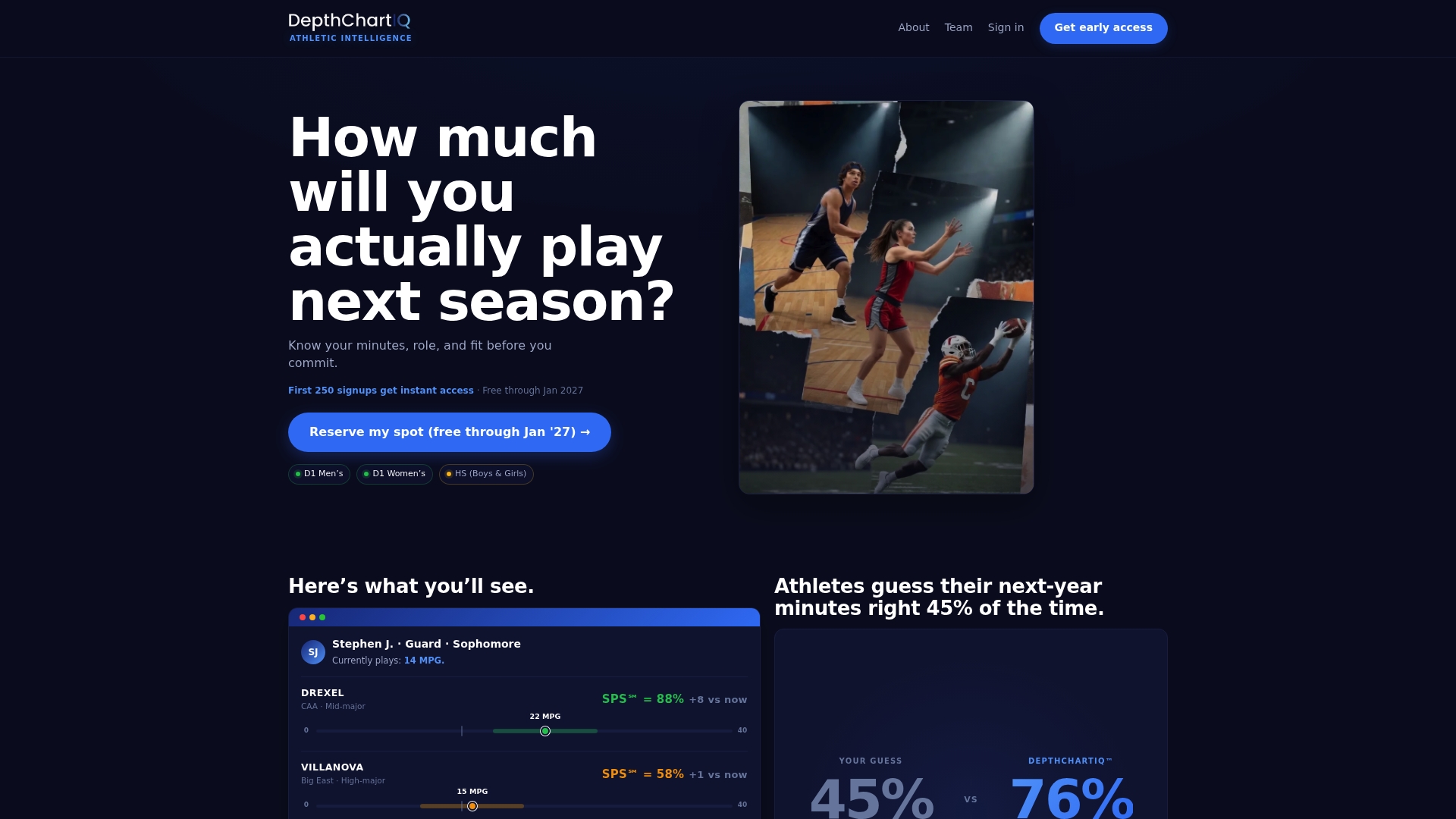
Once your credits and clock look workable, the next question is where you would actually play. DepthChartIQ shows athletes and families a projected minutes-per-game range, a Success Probability Score and a Roster Pressure Score for each program they are considering, plus best-fit programs. It is free during Early Access, and it is built for athletes and families, not coaching staffs. You can start at DepthChartIQ.
If you want help researching schools and drafting messages to coaches, Spotter is available now. Remember that contact with coaches at another Division I school has to wait until you are in the portal.
Common mistakes to avoid
Assuming accepted means applicable. Hours that transfer as electives still count as hours, but your degree plan may not shrink.
Waiting for certification to find out. The NCAA certifies after you enroll. By then it is too late to pick a different school, so do the math in advance.
Forgetting the clock. A year spent sitting out, redshirting or part time still uses up time in Division I.
Changing majors during a transfer. Switching can reset how much of your credit applies toward the benchmarks.
Talking to coaches too early. Contact before portal entry can put future eligibility at risk.
Treating the portal as the whole plan. The decision starts earlier, with an honest look at your academics, your clock and your role.
FAQ
Can I transfer all my credits to a new college?
Not automatically. Each school decides how many and which credits it accepts toward your degree. Ask for a written evaluation from each school on your list before you decide.
Do transfer credits affect whether I can play immediately?
Yes. In Division I, immediate eligibility generally requires leaving your old school academically eligible, being in good standing, and meeting progress-toward-degree requirements at the new school. Athletes transferring after their second year must also bring enough credit to be eligible at the new school.
How many credits do I need each year as a Division I athlete?
The NCAA requires at least six credit hours each term to be eligible for the next term, and 18 semester hours (or 27 quarter hours) over the year to be eligible the next academic year. You also need to hit the 40%, 60% and 80% degree-completion benchmarks.
Does my eligibility clock stop if I sit out a year?
In Division I, no. The five-year period continues even if you transfer, redshirt, skip school or enroll part time. In Division II and III, terms are counted by semester or quarter based on whether you attended full time or competed.
Who should I talk to before transferring?
Start with your school’s compliance office and an academic advisor, as NCAA guidance recommends. Then ask each target school’s admissions or registrar office for a credit evaluation.
Sources
- NCAA Guide for Two-Year Transfers
- NCAA Guide for Four-Year Transfers
- NCAA Division I Transfer FAQs
- NCAA Division I: Notification of Transfer
- NCAA Division I Academics
- NCAA Transfer Rules and Eligibility
- NCAA Initial Eligibility Requirements