
International Transfer Eligibility in College Basketball
How international basketball players can transfer between U.S. colleges and stay eligible: NCAA registration, academics, portal rules, F-1 steps and playing time.
 DepthChartIQ14 min read

If you are an international basketball player in the U.S. and want to transfer, you can. The NCAA does not bar anyone from transferring. Your eligibility to play right away depends on three things: your division, your academic standing and your paperwork, including your visa record. Clearing those gets you on the roster. It does not get you on the floor, because minutes depend on how crowded your position is at the new school. Check that before you commit, and DepthChartIQ shows it program by program.
TL;DR
- International players moving to Division I or II, or to Division III as an international student-athlete, must register with the NCAA Eligibility Center before they transfer.
- Division I players who leave academically eligible, in good standing and on pace toward a degree can generally seek immediate eligibility.
- On an F-1 or J-1 visa, the new school’s international office must transfer your SEVIS record and issue a new I-20 or DS-2019 before you start there.
- Compliance and the portal come first. Do not talk to another school’s coaches before the written notification is done.
- Eligibility only gets you on the roster. Check projected minutes and roster pressure at each school before you commit.
Table of Contents
- Who counts as an international transfer athlete
- Can you transfer and still be eligible?
- Register with the NCAA Eligibility Center
- Seasons of competition and degree progress
- Notification, the portal and the windows
- Your visa is part of the transfer
- The question eligibility does not answer: will you play?
- A sample checklist before you enter the portal
- Get a read on your minutes before you move
- FAQ
- Sources
Who counts as an international transfer athlete
The NCAA uses more than one definition, and which one applies to you depends on the division.
For Divisions I and II, the NCAA’s 2026-27 College-Bound Student-Athlete guide says you are an international student-athlete if you attended school abroad at any point from ninth grade through secondary graduation. The school must not be under U.S. sponsorship, and it must not have offered the standard U.S. curriculum. American schools overseas and Department of Defense Dependent Schools are excluded. In Division III, the test is wider: you attended high school outside the U.S. or its territories, you competed individually or on a team based outside the U.S., or you have permanent residence outside the U.S.
The NCAA’s Guide for Four-Year Transfers uses the broadest version. It covers any student who attends secondary or postsecondary school, participates in sport, or has permanent residence outside the U.S.
That has a practical effect. A U.S. citizen who played club ball abroad can be treated as international in Division III. A player who graduated from an American school in another country may not be international in Division I or II. Read the definition for the division you are moving into, not the one you came from.

Can you transfer and still be eligible?
Yes. There is no separate international lane in the transfer process. You enter the same portal and work with the same compliance staff as a domestic player. What changes is the extra layer of documents and immigration steps around it.
The NCAA has said that it does not prevent any student-athlete from transferring. Its rules govern how quickly you can compete after you move. That same explainer describes a one-time transfer exception that lets most athletes compete immediately after a first transfer, if they are academically eligible and their previous school supports it. There is an appeal process if it does not.
The rules have loosened since then. A 2025 Fordham Law Review article notes the exception was extended to all sports in 2021. It also says a December 2023 court order blocked sit-out requirements after a second transfer, after which the NCAA relaxed its rules to allow multiple transfers without a sit-out year, with few conditions. Details can still change, so confirm the current rule with your compliance office. For a basketball-specific walkthrough, see our guide to the one-time transfer rule.
What the guide says by division
| Division | Immediate eligibility, in general |
|---|---|
| Division I | You leave academically eligible, in good standing (not under disciplinary suspension) and meet progress-toward-degree requirements. Sport-specific rules, such as midyear transfers in basketball, and school and conference policies also apply. |
| Division II | You meet one of the guide’s academic and practice or competition conditions, and you have at least nine semester or eight quarter hours from your last full-time term. |
| Division III | You never practiced or competed in intercollegiate athletics, would have been academically eligible had you stayed, or were a nonparticipant for two consecutive years. Otherwise you regain eligibility after one full-time regular term if you meet the new school’s academic requirements. |
This summary comes from the Guide for Four-Year Transfers. If you are moving partway through the year, read our explanation of midyear transfer eligibility in college basketball before you plan anything.
Register with the NCAA Eligibility Center
The Four-Year Transfers guide says students transferring to Division I or II must register with the NCAA Eligibility Center. So must students going to Division III as an international student-athlete. Registering is often the longest item on your list, so start it first.
What the Eligibility Center looks at depends on your path:
- Records. The 2026-27 international guide asks for official transcripts from ninth grade onward in the original language, plus acceptable proof of graduation. Any document not in English needs a certified line-by-line English translation. The Center may also request items such as year-eight transcripts, diplomas and grading scales.
- Division I academics. The NCAA’s international initial-eligibility page lists 16 NCAA-approved core-course credits and a minimum 2.3 core-course GPA. It also lists a final official transcript with certified translation, proof of graduation, and academic, athletics and period-of-eligibility certification. Students with solely international credentials are exempt from the 10/7 core-course progression requirement.
- Division III amateurism. According to the Division III amateurism standards, international players who first enroll full time at a Division III school on or after Aug. 1, 2023, must have their amateur status certified by the Eligibility Center. They must also request final athletics certification. Division III schools set their own academic standards, but the Center may still ask schools for academic records to establish when you finished secondary school.
If you want a plain-English walk through the account setup and what the Center does, our NCAA Eligibility Center guide covers it. A separate guide on NCAA Eligibility Center steps and timing explains the academic certification stage and the international records it relies on.
Translation and record-gathering from schools abroad can take weeks. Ask for transcripts early, and keep the original-language copy next to the translation.
Seasons of competition and degree progress
Transferring does not give you extra years. Athletes have four seasons in each sport, per the transfer guide. One advisory group’s explainer says the eligibility period starts at first full-time enrollment, and that time at two-year colleges and universities abroad can count toward it. If you played a year or more at a university in your home country, ask compliance how that time is treated before you assume you have four years left.
Progress toward your degree decides whether you stay eligible after you arrive. The NCAA International Student-Athlete Handbook says Division I athletes must complete 40% of their degree by the end of year two, 60% by the end of year three and 80% by the end of year four. Division II athletes must complete 24 term hours of degree credit each academic year. Missing those marks can make you ineligible to compete.

This is where transfers fail quietly. A credit that counted at your old school may not count toward the new school’s major. Before you commit, ask the registrar for a credit evaluation, not just a promise from a coach. Our guide to transfer credits and eligibility explains what to ask. If you already have a degree and want to move for a graduate program, see graduate transfer admissions.
Notification, the portal and the windows
The order of steps matters because recruiting contact can be a violation if you skip one.
Per the Four-Year Transfers guide, in Divisions I and II you complete the division’s transfer education module and give your compliance office written notification before you have recruiting conversations with another NCAA school. The school then enters you in the portal within the applicable deadline. In Division III, you need written permission to contact other schools first. After portal entry or permission, normal recruiting rules apply.
Men’s basketball has its own window. In 2026, FanSided’s key-dates report put it in April. The portal opened April 7, with a dead period through April 9 and official visits starting April 10. A separate window follows a head-coaching change: it opens five days after the new coach is hired or announced and lasts 15 days. These windows are set by the NCAA each year and can shift, so check the current calendar with your compliance office. Do not plan around last year’s dates.
If you are a senior-year recruit rather than a current college player, the related commitment paperwork is covered in our National Letter of Intent rules guide.
Your visa is part of the transfer
For an international player, the immigration record is as important as the NCAA record. The NCAA International Student-Athlete Handbook lays out what happens when you change schools:
- Contact the international student services office at your current school. They handle the transfer of your I-20 (F-1 students) or DS-2019 (J-1 students).
- You may need to resubmit supporting documents to the new school, which must issue you a new I-20 or DS-2019.
- F-1 students must register with the new school’s international office within 15 days of attending, or lose lawful F-1 status.
- F-1 students must stay enrolled full time, generally 12 undergraduate credits, and need prior written approval from the designated school official to drop below that.
- For J-1 students, the new DS-2019 must be issued before the current one expires.
- If you finish a degree at one U.S. school and begin another at a new school, an F-1 student must submit a Transfer Out Request form within 60 days of completing the degree.
The Christine Brown & Partners guide says the same in practice: keep full-time enrollment, make normal academic progress, keep your passport valid, keep I-20 records current and follow transfer procedures. A portal entry does not change your immigration status. If your situation is unusual, such as a gap between schools, a visa expiring soon or a change of degree level, talk to the designated school official at your current school and, if needed, an immigration attorney before you move.
The question eligibility does not answer: will you play?
Say your paperwork is perfect. You are eligible at three schools, and each coach tells you that you fit their system. Which one do you pick?
Most players decide this on gut feel and the coach’s pitch. A coach is recruiting you, and a pitch about your role is an offer, not a forecast. A roster with two returning guards at your size and a top freshman class in your position can leave you on the bench even with a clean eligibility ruling. That is a heavy cost for an international player, who is also paying the costs of moving: new visa paperwork, new credits, another year of a four-season clock.
It helps to weigh four things beside the rules:
- Roster pressure. How many players at your position are already there, and how many are returning?
- Projected minutes. What range of minutes per game is realistic next season, not the best case?
- Academic fit. Will your credits count, and will you stay on pace for the degree?
- Timing. Does the school’s admission and I-20 timeline fit the portal window?
DepthChartIQ is built for the first two. Enter your profile and, for each program you are considering, you see a projected minutes-per-game range for next season, a Success Probability Score (the chance of gaining minutes) and a Roster Pressure Score (how crowded your position is at that school), plus best-fit programs. These are estimates with ranges, not guarantees. They sit beside your compliance answers, not in place of them. You can see what a program page looks like in our Pacific Tigers women’s basketball example. For more on weighing role risk, read about roster bubble players and scholarship limits in basketball.
A sample checklist before you enter the portal
Here is an order that avoids the common mistakes.
- Talk to compliance and your international office. Ask which division rules apply to you and what your seasons of competition look like.
- Confirm your Eligibility Center status. Register if you are moving to Division I or II, or to Division III as an international athlete. Gather transcripts and translations.
- Pull your academic record. Know your degree progress and whether you leave in good standing.
- Give written notification before any recruiting conversation, and finish the transfer education module.
- Shortlist programs by roster pressure and projected minutes, not only by name or conference.
- Ask each school for a credit evaluation and the timeline for issuing your I-20 or DS-2019.
- Register with the new international office within the deadline once you arrive.
Steps 1 to 4 are about being allowed to play. Step 5 is about whether you will. Skipping it is how players end up eligible and unused.
What we tell international players
The rules for international transfers are stricter on paperwork than on talent. Most of the stress comes from timing: transcripts, translations, a visa transfer and a short portal window all land at once. Our advice is to handle the paperwork with your compliance office and your international office, and to use a different tool for the other half of the decision.
That other half is the question of minutes. We built DepthChartIQ so a player and a family can see a range of projected minutes, a Success Probability Score and a Roster Pressure Score for every school on the list. It gives you a range to weigh against the coach’s pitch. The ranges are estimates, and they are made for athletes and their families, not for coaching staffs.
Eligibility tells you that you can transfer. A clear look at your likely role helps you decide whether you should, and where.
Max
Get a read on your minutes before you move
DepthChartIQ Pro gives you the program-by-program view described above: projected minutes-per-game range, Success Probability Score, Roster Pressure Score and best-fit programs. It is free during Early Access. Spotter, our assistant, is available now to help you research schools and draft messages to coaches once you are cleared to make contact.
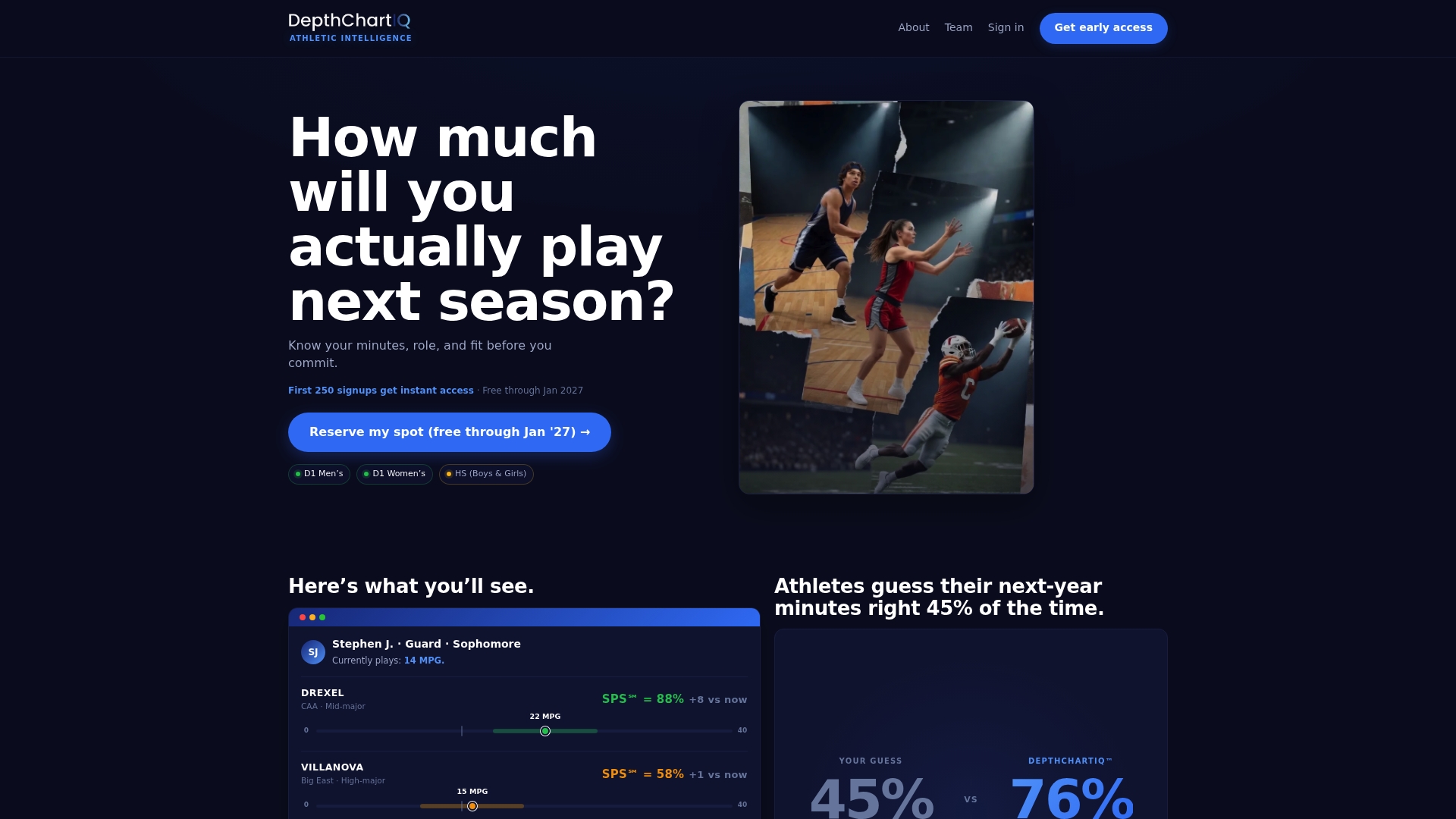
Build your profile and compare your options on DepthChartIQ.
FAQ
Can an international player transfer without sitting out a year?
Often, yes. Division I players who leave academically eligible, in good standing and on pace toward a degree can generally seek immediate eligibility, according to the NCAA’s Guide for Four-Year Transfers. Midyear basketball transfers have their own rules, and school and conference policies also apply. Confirm your case with compliance.
Do I need to register with the NCAA Eligibility Center to transfer?
If you are moving to Division I or II, or to Division III as an international student-athlete, yes. The Four-Year Transfers guide says so. Start early, because official transcripts and certified English translations take time to collect.
What happens to my F-1 visa if I transfer?
Your SEVIS record must move to the new school, which issues a new I-20. Per the NCAA International Student-Athlete Handbook, you must register with the new international office within 15 days of attending and stay enrolled full time. Work with the designated school official at both schools.
Does transferring reset my four seasons of competition?
No. You have four seasons in each sport, and one advisory group’s explainer says the eligibility period begins at first full-time college enrollment and is not reset by a transfer. Ask compliance how time at a university abroad or a two-year college counts for you.
Is eligibility enough to know a transfer is a good move?
No. Eligibility means you may play. It does not show how many minutes are open at the new school. Compare projected minutes and roster pressure for each program alongside your academic fit.
Sources
- NCAA 2026-27 College-Bound Student-Athlete guide
- NCAA Guide for Four-Year Transfers
- NCAA: What to Know About Division I Transfers
- Fordham Law Review, 2025, on NCAA transfer rules
- NCAA 2026-27 international guide
- NCAA international initial-eligibility requirements
- NCAA Division III amateurism standards
- The Student-Athlete Advisors: NCAA Eligibility 101
- NCAA International Student-Athlete Handbook
- FanSided: college basketball transfer portal 2026 key dates
- Christine Brown & Partners: international student-athlete guide