
College Basketball Recruiting Process: A Family Guide
Learn what the college basketball recruiting process involves. This family guide helps you navigate evaluations, communication, and decision-making.

DepthChartIQ
Athletic Intelligence
College Basketball Recruiting Process: A Family Guide
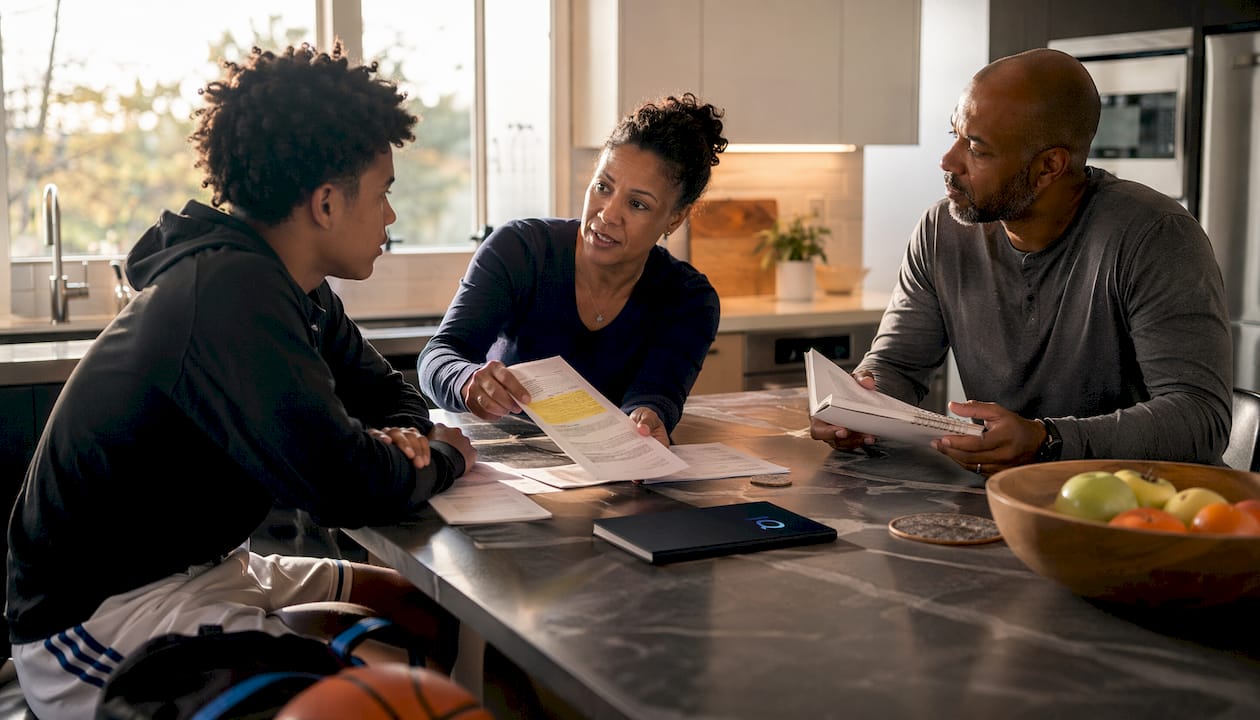
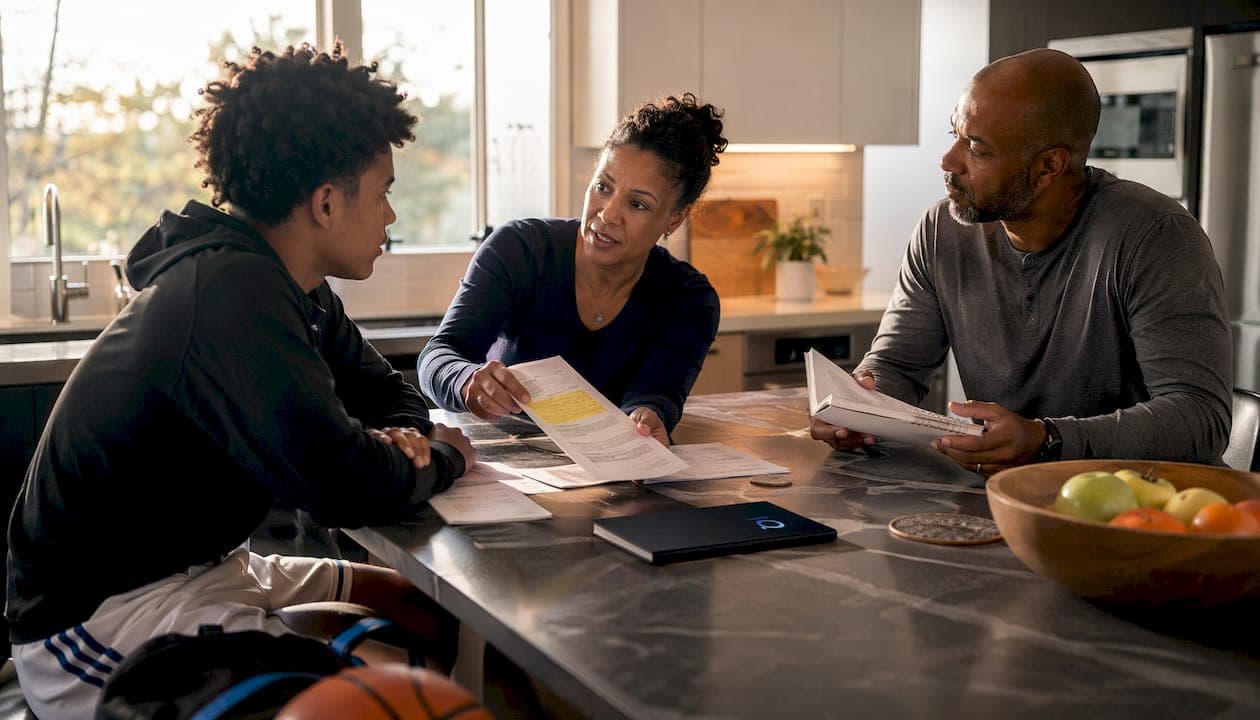
The college basketball recruiting process is the organized sequence by which high school players are evaluated, contacted, and selected by college programs. It spans multiple years, follows strict NCAA rules, and requires athletes and families to take deliberate action at every stage. Most players who earn scholarships do not wait to be discovered. They build their profiles early, target realistic programs, and communicate consistently with coaches. Understanding this process from the start is the single biggest advantage a recruit can have.
What is the college basketball recruiting process, and how does it work?
The recruiting process runs in three distinct phases: evaluation, communication, and decision. Each phase has its own rules, timelines, and requirements set by the NCAA.
-
Evaluation phase. Coaches review film and attend games year-round. The most critical windows are the NCAA live evaluation periods in april, june, and july, when coaches can watch players compete at sanctioned events. AAU circuits like the Nike EYBL, Adidas 3SSB, and Under Armour Association are the primary stages where D1 coaches scout talent.
-
Communication phase. For D1 men’s basketball, formal contact begins June 15 after a player’s sophomore year. Before that date, coaches can send questionnaires and camp invitations but cannot call or text directly. Once the window opens, coaches can communicate through calls, texts, emails, and campus visits.
-
Decision phase. Programs extend verbal offers, players take official visits, and commitments are made. Signing periods fall in the fall and spring of a player’s senior year.
| Phase | When It Happens | What Coaches Do |
|---|---|---|
| Evaluation | Year-round, peak in april/june/july | Watch film, attend live events |
| Communication | After June 15 (sophomore year, D1 men) | Call, text, email, visit |
| Decision | Junior/senior year | Extend offers, schedule visits |
Pro Tip: Film quality matters more than quantity. Send a 3–5 minute highlight reel that shows your best plays in the first 60 seconds. Coaches watch dozens of reels weekly and rarely watch past the two-minute mark.
How do recruiting timelines differ across D1, D2, D3, and NAIA?
Division level shapes everything: scholarship type, timeline, and how coaches find players. Knowing which division fits your profile saves time and opens more doors.
Division I is the most competitive tier. D1 scholarships are full rides covering tuition, room, board, and books, with a 15-player roster cap. Coaches recruit early and deliberately. High-major programs (ACC, Big Ten, SEC) often identify targets in the 8th and 9th grade. Mid-major programs typically begin serious evaluation in the sophomore and junior years.
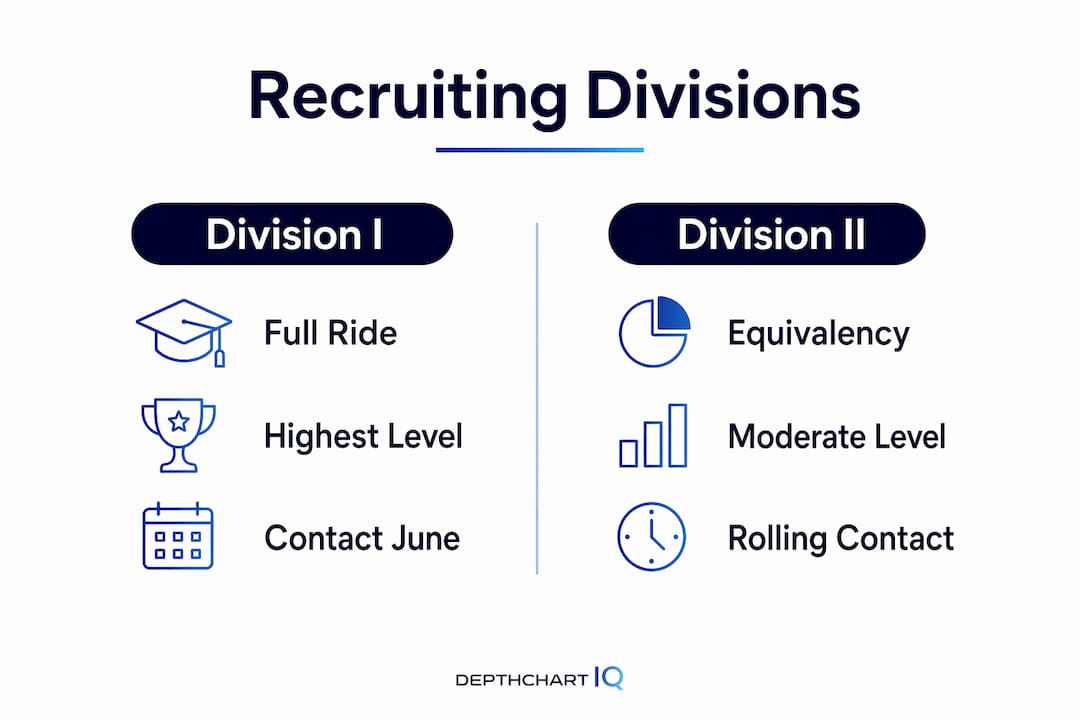
Division II uses equivalency scholarships, meaning one full scholarship can be split among multiple players. Recruiting focuses on camps, direct outreach, and communication during junior and senior years. Players targeting D2 benefit more from targeted emails and campus visits than from expensive elite AAU circuits built for D1 exposure.
Division III programs offer no athletic scholarships, but they recruit actively. Coaches at D3 schools look for players who fit their academic culture and playing style. Most D3 recruiting happens during junior and senior years through direct outreach and unofficial visits.
NAIA and JUCO programs operate outside NCAA rules and often have later, more flexible recruiting windows. Junior college (JUCO) is also a legitimate path to D1 for players who need academic or athletic development time.
- D1 full scholarships cover all costs; roster spots are limited and competitive
- D2 partial scholarships vary widely; fit and communication matter most
- D3 recruits on culture and academics; no athletic aid but strong academic aid is common
- NAIA offers athletic scholarships with fewer restrictions than NCAA
- JUCO provides a two-year bridge to four-year programs at any division level
Understanding scholarship equivalency differences across divisions helps families set realistic financial expectations before committing to a recruiting path.
What should players do each year to get recruited for college basketball?
A year-by-year plan is the most reliable way to stay on track. Recruiting rewards preparation, not reaction.
-
Freshman year. Focus on skill development and joining a competitive AAU or travel team that plays in NCAA-sanctioned events. Coaches cannot contact freshmen directly, but they can watch them play. Starting the process by freshman year gives athletes time to align academically and get seen on the right circuits. Take your core courses seriously from day one.
-
Sophomore year. Build your first highlight reel and create a recruiting profile. Begin emailing college coaches directly with your film, stats, and academic information. Attend college camps to get in front of coaches in a controlled setting. The June 15 contact window opens this year for D1 men’s programs, so be ready to respond professionally when coaches reach out.
-
Junior year. This is the most active recruiting year for most players. Update your film every few months. Take official and unofficial visits to programs that have shown interest. Register with the NCAA Eligibility Center and confirm you meet the minimum 2.3 core-course GPA required for D1 eligibility. Narrow your target list and deepen relationships with coaches at your top schools.
-
Senior year. Finalize your decisions. Take remaining official visits (NCAA allows five total for D1). Evaluate written scholarship offers carefully before committing. Sign during the early signing period in november or the regular signing period in april.
Pro Tip: Register with the NCAA Eligibility Center by the start of your junior year, not your senior year. Late registration delays certification and can cost you scholarship offers during the most critical window.
What are common mistakes in the college basketball recruiting process?
Most recruiting mistakes come from misunderstanding how the process actually works. Correcting these early saves players from costly setbacks.
-
Treating verbal offers as binding. Verbal offers are not binding for either side. Coaching changes, roster needs, and scholarship limits can all affect an offer before a National Letter of Intent is signed. Always secure a written scholarship agreement before making a final decision.
-
Waiting too long to start outreach. Players who delay recruiting until their junior or senior year miss critical evaluation windows and limit their options. The transfer portal has also shifted the landscape: roster spots increasingly go to experienced transfers, which means fewer openings for incoming freshmen at the D1 level.
-
Assuming AAU alone guarantees recruitment. Playing on an elite AAU team creates exposure, but it does not guarantee offers. Coaches recruit based on fit, not just talent. A player who is a great athlete but does not match a program’s current roster needs will not receive an offer regardless of their circuit.
-
Ignoring academic eligibility. A 2.3 core-course GPA is the D1 floor, and failing to meet it disqualifies a player from athletic scholarships entirely. Academic eligibility is not a formality. It is a hard requirement that ends recruiting conversations before they start.
Recruiting is not a talent contest. It is a matching process. The programs that offer you are the ones where your skill set, academics, and personality fit what the coaching staff needs right now. Chasing prestige over fit is the fastest way to end up without a scholarship.
How can players build relationships with coaches and maximize their chances?
Recruiting success comes from initiative, not passive waiting. Players who actively manage their outreach consistently outperform more talented players who wait to be found.
- Build a target list of 20–30 programs across multiple divisions. Include schools where you are a realistic fit athletically, academically, and culturally.
- Send professional, personalized emails to coaches every four to six weeks. Include your updated highlight film, academic profile, and upcoming schedule so coaches know where to find you.
- Use college camps strategically. Camps put you in front of coaches in a low-pressure setting and signal genuine interest in their program.
- Respond to every coach communication promptly and professionally. Coaches notice which recruits take the relationship seriously.
Understanding how to evaluate program fit across academics, playing style, and roster opportunity helps players build a smarter target list from the start. The goal is not to contact every school. The goal is to contact the right schools with the right message at the right time.
Pro Tip: When emailing a coach for the first time, mention something specific about their program: a recent game result, a player you admire, or a coaching philosophy you read about. Generic emails get deleted. Specific emails get read.
Key Takeaways
The college basketball recruiting process rewards players who start early, target realistic programs, and communicate consistently with coaches across all three phases.
| Point | Details |
|---|---|
| Start by freshman year | Early preparation aligns academics and exposure before contact windows open. |
| Know your division fit | D1, D2, D3, and NAIA have different scholarship structures and recruiting timelines. |
| Verbal offers are not binding | Always secure a written scholarship agreement before making a final commitment. |
| Initiative drives results | Players who manage outreach actively earn more offers than those who wait to be found. |
| Academic eligibility is non-negotiable | A minimum 2.3 core-course GPA is required for D1 eligibility and must be maintained throughout high school. |
What families often get wrong about recruiting
Most families I talk to come into the recruiting process with one of two misconceptions. Either they believe their child is so talented that coaches will find them, or they believe the process is so complicated that they need to hire an expensive recruiting service to navigate it.
Both are wrong. Recruiting is a process, and like any process, it responds to effort and preparation. The families who do best are the ones who treat recruiting like a part-time job starting in the freshman year. They research programs, build relationships with coaches, and keep academic eligibility on track from the start.
The part that surprises most families is how open coaches are to direct outreach. A well-written email with a good highlight reel genuinely gets read. Coaches are looking for players who fit their needs. Your job is to make it easy for them to see that you are that player.
My strongest advice: be flexible on division level. A D2 or D3 scholarship at a school where you will play meaningful minutes is worth more, in every measurable way, than sitting on a D1 bench. The players who commit to the right fit, not the biggest name, tend to have the best college careers.
— John
DepthchartIQ gives recruits a data-driven edge
Navigating the recruiting process without data is like applying to college without knowing your GPA. DepthchartIQ gives high school recruits and their families the metrics they need to make smarter decisions at every stage.
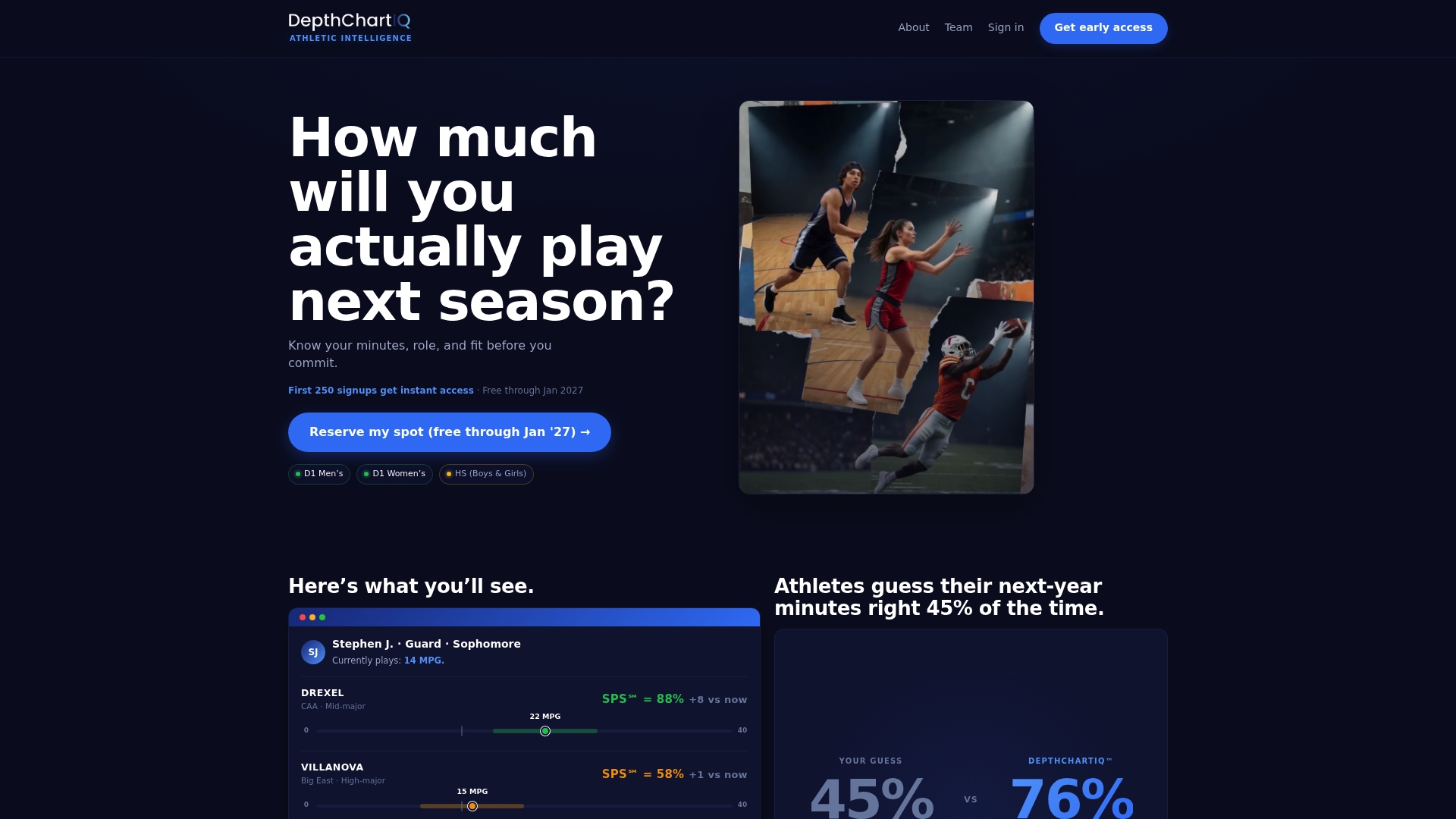
The platform’s recruiting analytics tools use real roster data and prediction algorithms to show where playing time opportunities actually exist, not just where programs look good on paper. DepthchartIQ’s Success Probability Scores and Roster Pressure insights help athletes identify programs where they have a realistic chance to contribute from day one. With a 76% accuracy rate in predicting player outcomes, DepthchartIQ turns guesswork into a plan. See how it works and build a recruiting strategy grounded in real data.
FAQ
What is the college basketball recruiting process?
The college basketball recruiting process is the multi-year sequence of evaluation, communication, and decision-making through which high school players earn spots on college rosters. It is governed by NCAA rules that set specific contact windows and evaluation periods by division.
When do D1 coaches start contacting recruits?
D1 men’s basketball coaches can begin direct contact on June 15 after a recruit’s sophomore year. Before that date, coaches can send questionnaires and camp invitations but cannot call or text.
Are verbal scholarship offers binding?
Verbal offers are not binding for either the player or the program. A scholarship only becomes official when both parties sign a National Letter of Intent or a written scholarship agreement.
What GPA do I need to play D1 college basketball?
The NCAA requires a minimum 2.3 core-course GPA for D1 athletic eligibility, along with qualifying ACT or SAT scores certified through the NCAA Eligibility Center.
How does the transfer portal affect high school recruiting?
The transfer portal has increased competition for D1 roster spots, as experienced transfers fill positions that previously went to incoming freshmen. High school recruits should widen their target lists across multiple divisions to maximize their options.