
College Roster Bubble Players: How to Decide on a Transfer
Research backed workflow for college and high school roster bubble players: pair predictive scores with roster pressure, timing, and program fit.
 DepthChartIQ9 min read
Roster bubble players are the athletes sitting on the margin, close enough to real minutes to stay motivated but not locked into a role. The single most useful move for anyone in that spot is to pair an evidence-based predictive score with a direct read on program fit and transfer timing, since probability alone does not tell the whole story.
TL;DR:
Transferring benefits underperforming players by increasing their chances of gaining meaningful minutes, especially when moving to a program with a clear need at their position.
A Success Probability Score near the middle of its range indicates high uncertainty, requiring careful analysis before making a transfer decision or staying put.
Roster moves driven by coaching changes and transfer activity can create short-term opportunities, but programs are increasingly planning for departures proactively.
Table of Contents
-
What the research says about transferring as a bubble player
-
Comparative case studies of successful and unsuccessful bubble players
-
DepthChartIQ Pro: how the platform helps roster-margin athletes
How predictive metrics evaluate roster bubble players
Playing time at a new program depends on several things at once: historical minutes, usage rate, position depth, who is entering or leaving through the transfer portal, coaching turnover, and injury history. None of those factors alone settles the question, but together they produce a probability that is far more useful than a hunch or a depth-chart guess.
Two terms matter here. A Success Probability Score estimates the chance an athlete reaches a meaningful role at a given program, while Roster Pressure measures how crowded the position group is and how likely new arrivals are to squeeze out current players. Reading these scores well means paying attention to thresholds, not just direction: a score sitting near the middle of the range signals real uncertainty, while one near the extremes is more decision-ready.
-
Historical minutes and usage trends tell you where an athlete starts from before any roster change.
-
Incoming and outgoing transfer activity shifts the position group’s depth in ways a static depth chart will not show.
-
Coaching changes often reset a program’s rotation entirely, which can blunt even a strong statistical history.
Models have blind spots too. They cannot read a coach’s private intentions or a locker room’s culture, which is why predictive scores work best as a starting point rather than a verdict.
What the research says about transferring as a bubble player
Academic research on transfer outcomes gives bubble players a clearer lens than intuition does. A national study of Division I men’s basketball transfers found that transferring is associated with improved performance for athletes who underperform relative to their teammates, but decreased performance for athletes who overperform. In plain terms, a player buried on a stacked roster often gains ground by moving, while a player already playing above their new, tougher competition risks losing the role they had.
Separate analysis of transfer networks found that moves often increase minutes and games started in the season after transfer, especially when the move is lateral or downward, meaning a step down in competition level frequently produces a bigger role rather than a smaller one. The same research points to coaching changes as a reliable trigger for transfer churn, which creates short-term openings worth tracking.
Program quality and direction of movement both shape the outcome. A big fish moving into a bigger pond tends to lose usage, while a modest contributor moving into a pond suited to their skill level tends to gain it. The practical implications for judging your own odds:
-
Moving up in competition level raises the bar you have to clear to keep your current role.
-
Moving to a program with a clearer need at your position improves your odds more than chasing prestige.
-
A coaching change at your current program, or at a target program, changes the calculation in either direction.
Roster construction has also changed how programs plan for departures. Research on labor substitution in the transfer portal era found that athletic departments increasingly treat departing transfers as predictable roster turnover and plan around portal activity rather than treating each departure as a surprise, often substituting a portal acquisition for a three-star high school recruit. That shift means bubble players should expect their spot to be actively planned around, not just filled reactively.
Timing and mechanics every bubble player must know
Transfer timing is not flexible, and missing a window can cost an athlete an entire season of eligibility planning. The NCAA publishes sport-specific transfer-window dates that govern when an athlete may enter the portal and finalize a move, and those dates constrain every decision that follows.
Roster rules changed in 2025 in ways that directly affect bubble players. The NCAA’s Division I Board of Directors adopted changes to roster limits and introduced Designated Student-Athlete provisions, which can protect certain athletes from being cut and should factor into how an athlete reads their own roster security.
A practical sequence for timing a decision:
-
Check the NCAA’s current transfer-window dates for your sport before making any plan.
-
Confirm your roster status, including whether a Designated Student-Athlete provision applies to you.
-
Monitor incoming portal activity at your position throughout the offseason, since roster changes can shift opportunity quickly.
-
Request a release only after you have a realistic target list, not before.
Pro Tip: Enter the portal as early in your window as your situation allows, since programs typically fill open roster spots on a rolling basis.
Action checklist for bubble players, families, and coaches

Turning a probability into a decision takes verification, not just a number on a screen. Ask your coach directly about their intent for your role.
Useful questions to bring to a coach:
-
What would need to change on this roster for my role to grow?
-
What is the realistic timeline for me to see meaningful minutes?
-
Which incoming players, if any, play my position?
Weigh the predictive odds against factors a model cannot see. Academic standing, NIL opportunities, and mental health all belong in the decision alongside the numbers, and none of them should be overridden by a probability score alone.
-
If your predicted minutes sit above 70%, staying and developing is usually the stronger path.
-
If your predicted minutes sit between 30% and 70%, probe the situation further before deciding.
-
If your predicted minutes sit below 30%, start exploring other programs in earnest.
A detailed decision checklist can help structure these conversations further, and comparing program fit across a few targets is worth the time before committing to any one of them.
Comparative case studies of successful and unsuccessful bubble players
Patterns repeat often enough to draw real lessons from them. A player buried deep on a roster stacked with upperclassmen, who moves to a program with a clear positional need and a coach who recruited them specifically, tends to see a jump in minutes within a season. That pattern matches the research on lateral and downward moves producing bigger roles.
The reverse pattern shows up just as often. A player who had carved out solid minutes on a mid-level roster, then transfers up to a program with deeper, more experienced talent at the same position, frequently finds themselves back on the bubble they thought they had escaped. The research on overperformers losing ground after a transfer describes exactly this outcome.
The difference between the two outcomes rarely comes down to talent alone. It comes down to fit: whether the move matches a real need at the new program or simply chases a bigger name. Programs that already have a surplus at a position, even a strong one, are a weak match for a bubble player regardless of that program’s reputation.
Using analytics responsibly in a transfer decision
Predictive scores are a tool for sharpening a decision, not a promise about how a season will go. The most useful way to treat a Success Probability Score is as one factor alongside a direct conversation with a coaching staff and an honest look at academic and personal priorities.
Numbers can tell you where the odds sit today. They cannot tell you how a coach will actually use you, or what matters most to you outside of the sport.
DepthChartIQ Pro: how the platform helps roster-margin athletes
Bubble players usually make transfer decisions with partial information: an outdated depth chart, a coach’s vague reassurance, or a gut feeling about next season’s roster. DepthChartIQ replaces that guesswork with a projected minutes range at each program, built specifically for athletes weighing playing time against a move.
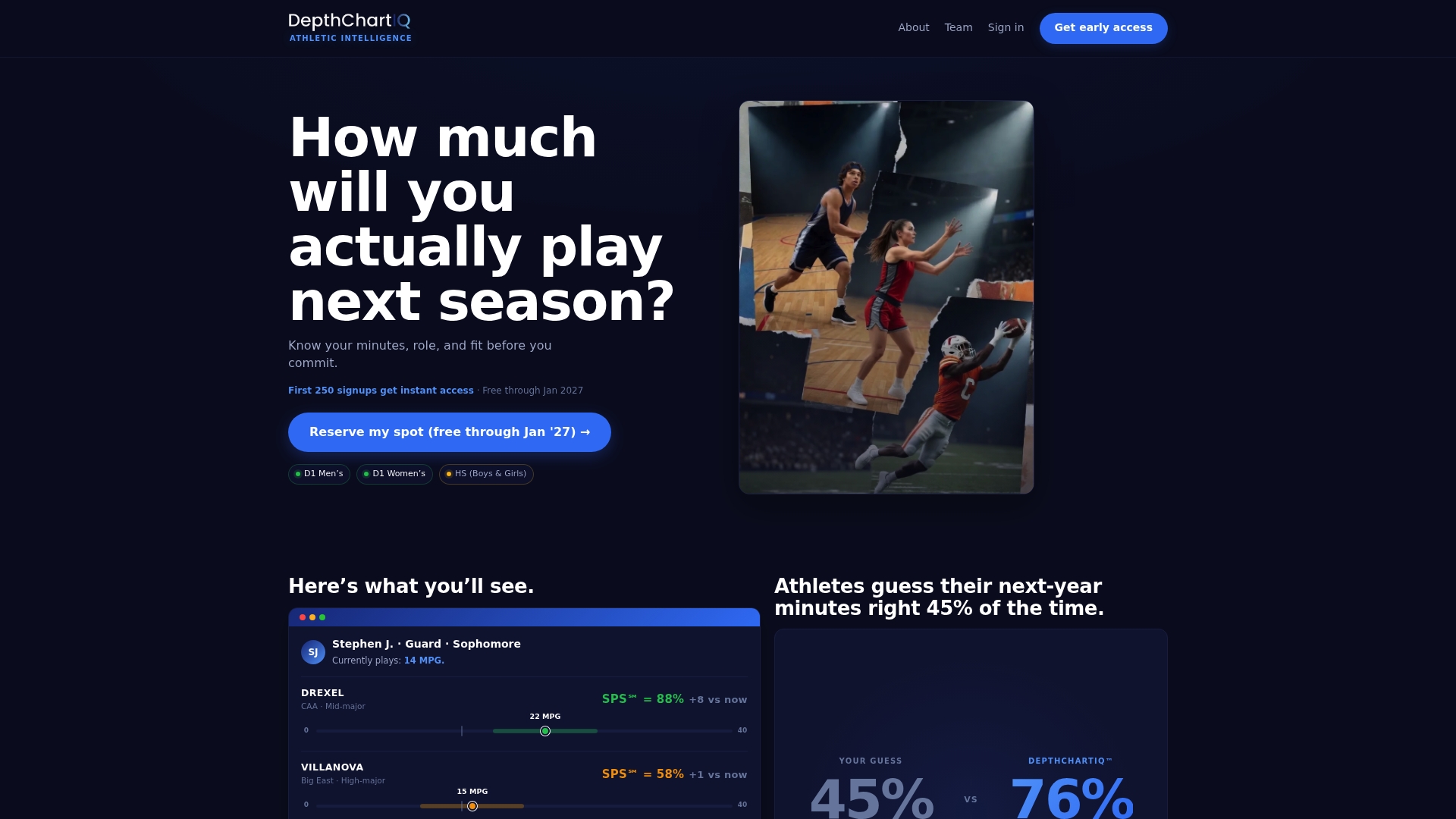
For each program you are considering, it shows:
-
A projected minutes-per-game range for next season.
-
A Success Probability Score for your current program and for programs you’re considering.
-
Roster Pressure insights showing how crowded your position group is.
DepthChartIQ is free during Early Access. Start there, or read the predicted minutes per game and Roster Pressure Score℠ glossary pages before upgrading to DepthChartIQ Pro.
Sources
FAQ
What makes someone a roster bubble player?
A roster bubble player is an athlete whose playing time or roster spot is genuinely uncertain, sitting between a clear starting role and being cut or buried on the depth chart. The label applies at both the college and high-school recruiting level, wherever predictive signals like Success Probability Scores show a close call.
Does transferring usually help a bubble player’s playing time?
Research on Division I transfers found that transferring is associated with improved performance for athletes who underperform relative to their teammates, but decreased performance for athletes who overperform. The outcome depends heavily on whether the move is lateral, upward, or downward in competition level.
When should a bubble player enter the transfer portal?
Timing is set by the NCAA’s sport-specific transfer windows, which athletes must follow to finalize a move. Entering early within that window generally gives an athlete a better shot at open roster spots before programs fill them.
What is a Designated Student-Athlete status?
It’s a roster protection introduced alongside 2025 NCAA roster limit changes that can shield certain athletes from being cut under new roster caps. Checking whether this status applies to you is a useful step before assuming your roster spot is at risk.