
How to Choose a College Basketball Program That Fits
A practical guide for players and families on choosing a college basketball program: level, roster, playing time, academics, cost, and transfer rules.
 DepthChartIQ13 min read


Choose a college basketball program by checking five things in order: the division level that matches your game, how crowded your position is on the roster, the playing time you can realistically expect, the academic and financial package, and the culture behind the coach’s pitch. Most players start with the logo on the jersey. The ones who end up happy usually start with the minutes.
This guide is for high school recruits, current college players weighing a transfer, and the parents helping them. It covers what to ask, who to ask, and how to compare programs side by side.
TL;DR
- Start with level, not brand. Division I, II, III, NAIA, and junior college each pay for and run basketball differently.
- Ask every coach how many players are at your position and what role you would have. Then ask current players the same question.
- Weigh playing time next to academics, cost, and location. A great school where you sit for three years is a hard trade.
- Current players need to understand transfer rules and timelines before they contact another school.
- Put your shortlist side by side in one table so gut feel does not decide for you.
Table of Contents
- Start With the Level That Fits You
- Judge Whether You Can Actually Contribute
- Questions to Ask Coaches and Current Players
- How DepthChartIQ Helps You See Playing Time Before You Commit
- Compare Academics, Cost, and Location
- Know the Recruiting Calendar and Visit Rules
- If You Are Already in College: Stay or Transfer?
- Putting Your Decision Together
- Try DepthChartIQ on Your Shortlist
- FAQ
- Sources
Start With the Level That Fits You
The division you play in shapes your scholarship, your schedule, and your odds of contributing. Before you compare individual schools, decide which levels belong on your list.
One published estimate puts the odds of playing college basketball out of high school at about 1.1% for Division I, 1.0% for Division II, and 1.4% for Division III, with several thousand more roster spots across 250-plus NAIA and junior college programs. The takeaway is not that the door is closed. It is that a wide list is normal, and a realistic list is smart.
Here is how the money side differs, according to College Finance’s guide to athletic scholarships:
| Level | How athletic aid works |
|---|---|
| NCAA Division I | Men’s and women’s basketball are head-count sports. An athletic scholarship on a head-count team must cover the full cost of attendance. |
| NCAA Division II | Equivalency model. Full athletic scholarships are rare, and coaches split a set number across the roster. |
| NCAA Division III | No athletic scholarships. Academic scholarships, merit grants, and need-based aid are allowed. |
NAIA and junior college programs have their own aid rules, so read each school’s athletics page for current details.
A useful first filter: ask your high school or club coach for an honest read on where you fit. The Packer Athletic Handbook advises recruits to build a tentative list of colleges that fit their academic and athletic needs and to ask their coach for feedback on realistic chances. Treat that feedback as data, not as a verdict.
If junior college is on your radar, our guide to the JUCO transfer path to Division I walks through how that route works.

Judge Whether You Can Actually Contribute
This is where most decisions go wrong. A program can be a perfect school and a poor basketball fit at the same time. Four things decide your realistic role.
Position and roster crowding
Count the players at your position, then look at their class years. A roster with two seniors at your spot opens a different door than one with three sophomores. The Packer handbook suggests asking coaches directly how many current team members play your position, what playing time you might expect, and whether that changes by grade level.
Do not stop at the roster page. Check who is committed for next year, who has entered the transfer portal, and whether the coach has been bringing in players at your position through the portal rather than developing them.
Style of play
Watch full games, not highlight clips. Does the team run in transition or slow it down? Do guards create their own shots or play off screens? Does the system ask bigs to step out and shoot? Match what you do well to what the offense needs, and be honest about the gaps.
Development goals
Write down what you want from the next two years: a starting role, a path to a pro opportunity overseas, a degree with a strong network, or all three. Then ask each coach how they develop players. The handbook also recommends asking about the coach’s philosophy and the direction of the program.
Read the pitch with care
Coaches recruit because they need players, and their needs shift. The Packer handbook notes that a coach’s interests and an athlete’s interests do not always line up in the athlete’s favor. That is not a knock on coaches. It is a reason to gather information from more than one voice, including current players and your own advisors.
Questions to Ask Coaches and Current Players
Good questions get specific answers. Here is a shortlist built from the handbook’s guidance, split by who you ask.
Ask the coach:
- How many players are at my position right now, and how do you see my role as a freshman, sophomore, and beyond?
- What is your philosophy, and where do you want the program to be in three years?
- What is the process and timeline for an admissions pre-read?
- How do you handle roster changes when new players arrive?
Ask current players:
- What does a typical day look like in season and out of season?
- How much does the team travel, and how does that affect classes?
- Is the coach approachable when something goes wrong?
- How much study time is built in, and what academic help is available?
- Did anything change from what was promised after players committed or enrolled?
- How would you describe the team culture?
The question about changed promises is the one many families skip. It is worth asking more than one player, because one answer is an opinion and three answers are a pattern.
How DepthChartIQ Helps You See Playing Time Before You Commit

Here is where our own tool fits. DepthChartIQ is built for NCAA Division I men’s and women’s basketball players and their families. You enter a profile, and for each program you are considering, you see a projected minutes-per-game range for next season, a Success Probability Score (the chance of gaining minutes), and a Roster Pressure Score (how crowded your position is at that school). You also see best-fit programs.
These are estimates with ranges, not guarantees. Their job is to give you something concrete to weigh next to what a coach tells you.
Our Perspective
Most players make the biggest decision of their basketball lives on gut feel and a coach’s pitch. We built DepthChartIQ because that is not enough information for a choice that can shape four years of your life.
The question we hear from families is rarely “Is this a good school?” It is “Will I play?” That is a fair question, and it deserves more than a hopeful answer in a living room visit.
A range of projected minutes, a read on how crowded your position is, and a clear sense of which programs fit you give you something to hold up against the pitch. They do not replace conversations with coaches or your own judgment. They make those conversations sharper, because you walk in knowing what to ask.
We built this for athletes and their families, not for coaching staffs. That is deliberate: the person living with the decision should have the clearest view of it.
Max
Compare Academics, Cost, and Location
Playing time is the headline, but it is not the whole story. Most players will spend far more of their adult lives using their degree than their jump shot.
Academics
Pick a major or at least a direction, then check whether the school offers it and whether basketball’s schedule allows you to take the required classes. Ask about class times that conflict with practice and travel. The handbook points families toward questions on study time and academic assistance for exactly this reason.
Course planning matters for eligibility too. A tool like NCAA athlete course scheduling can help you map a semester plan so your classes keep you on track for eligibility while you balance practice and games.
Cost
Compare the true price, not the sticker. A Division I head-count scholarship covers the full cost of attendance, while Division II aid is usually partial and Division III aid comes from academic and need-based sources, per College Finance. Ask each school for a written breakdown of what you would owe after all aid.
Location and daily life
Ask yourself where you would want to be if basketball ended tomorrow. Consider distance from family, climate, campus size, and whether you would be happy there during the long stretches without games.
A simple scoring table
Build one table for your top five schools. Score each from 1 to 5 and weigh what matters most to you.
| Factor | School A | School B | School C |
|---|---|---|---|
| Projected role and minutes range | |||
| Roster crowding at your position | |||
| Coach and staff relationship | |||
| Academic fit and major | |||
| Cost after aid | |||
| Location and campus life | |||
| Team culture (from player conversations) |
The exercise matters more than the totals. If one school wins every column except minutes, you have learned something important about your decision.
Know the Recruiting Calendar and Visit Rules
Timing affects when you can talk to coaches and when you can see campuses. The 2026-27 Division I men’s cycle, as laid out by Level Up Basket, moves from a dead period and a quiet period in late summer into a long contact period that runs through April, with short dead periods inside it. During dead periods, in-person recruiting contact is limited, so plan visits around them.
Rules are also shifting. In January 2026 the NCAA announced that the Division I Men’s Basketball Oversight Committee proposed letting prospects take unofficial visits starting freshman year of high school, where previously they had to wait until August 1 of their sophomore year. It also proposed letting a school designate up to six staff members for off-campus recruiting. Proposals are not final rules, so confirm the current version with the NCAA or a school compliance office.
For deeper detail, see our guides to the 2026 basketball recruiting calendar, NCAA dead periods, and official visit rules.
On the academic side, the Packer handbook says recruits pursuing Division I or II should take the ACT and/or SAT by spring of junior year and file a completed NCAA Clearinghouse release form at the end of junior year. It also recommends contacting college coaches with an introduction letter and athletic resume.
If You Are Already in College: Stay or Transfer?
Current players face a different question: is the role I have now worth keeping, or is another program a better bet?
Start with the process. The NCAA’s transfer rules page explains that the Transfer Portal is the centralized database of student-athletes who intend to transfer. When you tell your school you want to transfer, the school enters your name, which signals availability and opens the door to coach contact.
A few steps to take in order, based on the NCAA guide for four-year transfers hosted by CSU Sacramento (a 2023-24 edition, so check current rules):
- Confirm whether you count as a transfer student-athlete under the NCAA definition.
- Understand your initial-eligibility status and register with the NCAA Eligibility Center if needed.
- Talk with your current school’s staff before starting.
- As a Division I athlete, complete the transfer education module and give written notice to your compliance office before any direct or indirect recruiting conversations with a new NCAA school.
The same guide notes that admission requirements and conference rules may also affect your move. Transfer windows change from year to year, so check the NCAA’s current basketball window before you plan around a date. Our guides on the one-time transfer rule, portal tampering rules, graduate transfer admissions, and transfer portal myths cover the details.
Then run the same fit test you would for a recruit. Ask what role you would have next season, how many players share your position, and whether the coach’s plan includes you. Compare that honestly with staying. Sometimes a bigger role is waiting where you already are. Sometimes it is not.
Putting Your Decision Together
A clean process keeps emotions from taking over:
- Set your priorities. Rank basketball role, academics, cost, and location.
- Build a wide list. Include several levels and a mix of reach, target, and safer options.
- Gather facts. Roster, class years, style of play, coach history, academic programs.
- Talk to players. Use the question list above and collect more than one answer.
- Estimate your role. Compare what coaches say with an independent read on minutes and roster pressure.
- Score your table. Review it with your family and a trusted coach.
- Decide, then commit fully. Do not hold a spot open on a maybe.
Parents, our recruiting tips for parents give you a way to support without steering. Incoming players can also use our incoming recruit impact projections guide to think through how a first-year role might look.
Try DepthChartIQ on Your Shortlist
If you are comparing Division I programs, DepthChartIQ shows a projected minutes-per-game range, a Success Probability Score, and a Roster Pressure Score for each school on your list, along with best-fit programs. It is free during Early Access, and Spotter, our assistant for researching schools and drafting messages to coaches, is available now.
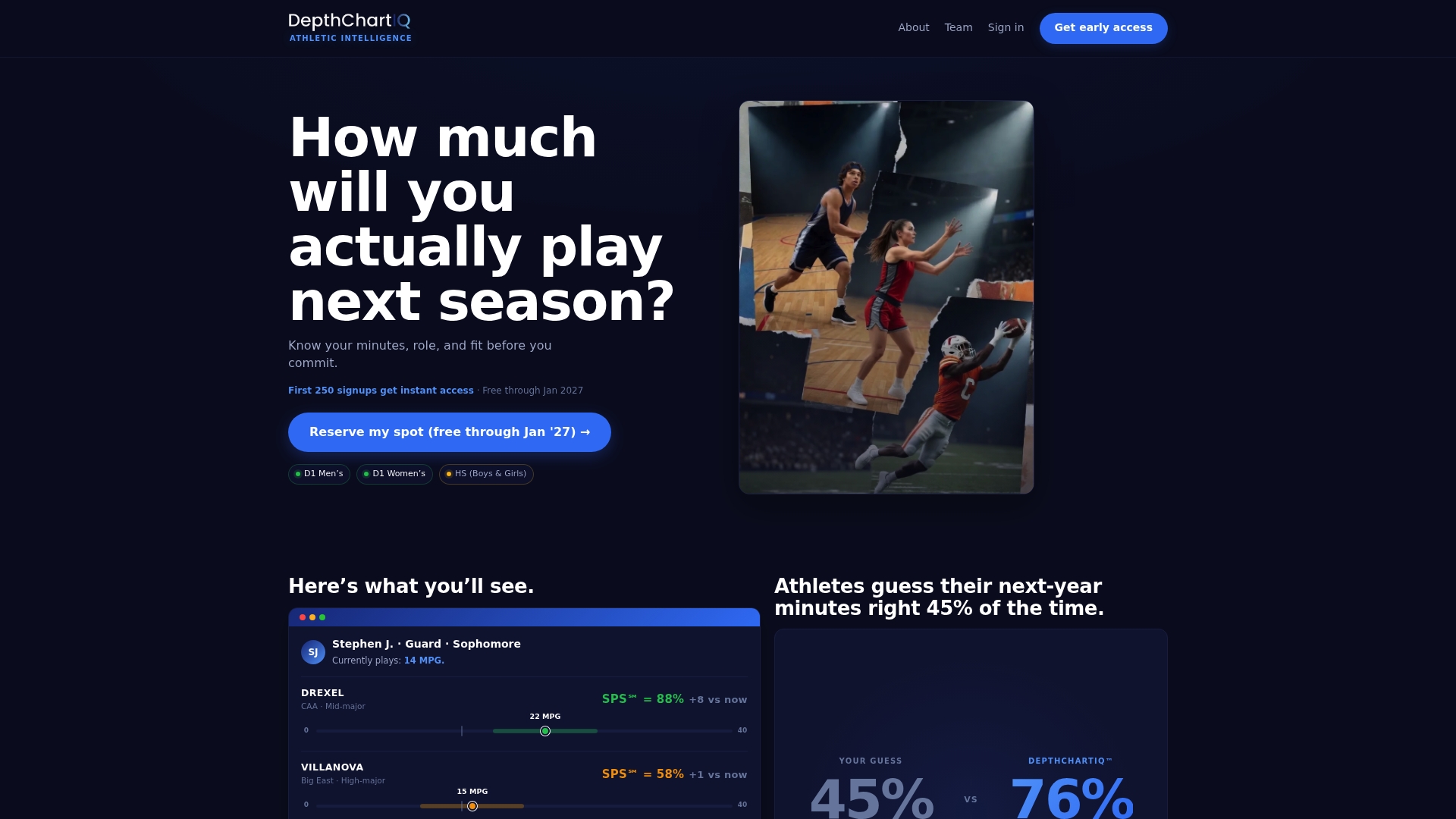
You can get started with DepthChartIQ in a few minutes. Want to see what a program page looks like? Browse examples such as Pacific Tigers women’s basketball or Portland Pilots women’s basketball.
FAQ
How early should I start choosing a college basketball program?
Start building a tentative list well before senior year. The Packer handbook points to testing by spring of junior year and, for Division I or II, filing the NCAA Clearinghouse release form at the end of junior year. Early research lets you contact coaches with a resume and ask for honest feedback on where you fit.
Is a bigger program always better for my career?
No. A bigger name can mean more competition at your position and fewer minutes. Compare the role you could realistically earn, the coach’s plan for your development, and what you would get academically. The best choice is the one where your game, your degree, and your cost line up.
What should I ask a coach about playing time?
Ask how many players are at your position, what role you could expect, and whether that changes by class year. Then ask current players whether the coach’s promises held up after they arrived. Two sources are better than one.
Can I compare programs by how crowded my position is?
Yes, and you should. Look at class years at your position, incoming recruits, and recent portal movement. DepthChartIQ’s Roster Pressure Score is designed to show how crowded your position is at each program you are considering.
Do transfers face different rules than recruits?
Yes. A current Division I player must complete the transfer education module and notify the compliance office in writing before recruiting conversations with a new school, per the NCAA transfer guide. Recruits follow the recruiting calendar and visit rules instead.
Sources
- 2026-2027 Packer Athletic Handbook
- Athletic Scholarships: NCAA, NAIA and NJCAA Guide, College Finance
- How to Play College Basketball: 10-Step Checklist, PSB
- NCAA Transfer Rules and Eligibility, NCAA.org
- 2023-24 NCAA Guide for Four-Year Student-Athlete Transfers
- DI Basketball Oversight Committees propose deregulation package, NCAA.org
- College Basketball Recruiting Calendar Explained: 2026-27, Level Up Basket