
Alternatives to NCSA for College Basketball Recruiting
Looking for alternatives to NCSA? Compare recruiting platforms, video tools and free steps, plus how to weigh playing time before you commit or transfer.
 DepthChartIQ11 min read


The best alternative to NCSA depends on the job you need done. For exposure and coach messaging, look at SportsRecruits, FieldLevel, Hudl and YouTube. For free outreach, use college questionnaires and direct emails. For the question most families skip, which roster will actually give you minutes, use DepthChartIQ. This guide compares each option by what it does, what to ask before paying, and where a basketball player’s time is best spent.
TL;DR
- You do not need a paid recruiting service to get recruited. College questionnaires and direct emails to coaches are free and are what a CollegeXpress expert recommends first.
- Alternatives split into types: profile and video hosting, recruiting networks, team video tools and general video sharing. Pick by job, not by brand.
- Exposure tools get your name in front of coaches. They do not tell you how many minutes you would play once you arrive.
- DepthChartIQ shows a projected minutes-per-game range, a Success Probability Score and a Roster Pressure Score for each program you are considering.
- Before paying anyone, get the price, the contract length and the cancellation terms in writing.
Table of Contents
- Why families look for an NCSA alternative
- The types of NCSA alternatives
- What alternatives cost
- How to vet any recruiting platform
- The free route: what works without paying
- The gap exposure tools do not fill: playing time
- Which option fits which player
- A note from us
- Try DepthChartIQ
- FAQ
- Sources
Why families look for an NCSA alternative
Most searches for NCSA alternatives come from one of three places. A family got a sales call and wants to compare. A player has a profile but no replies. Or someone wonders whether any of this is needed at all.
The third question is fair, and the answer is straightforward. CollegeXpress expert Francesca Morrissey says athletes do not need a recruitment website or agency and recommends completing college questionnaires and emailing coaches directly. Plenty of players and parents in recruiting forums say the same: put up strong performances, keep your grades up and reach out.
That does not make every tool pointless. A well-organized profile, clean game film and a way to track conversations save time, especially across a dozen programs. The real question is what you want help with, and what you can already do for free.
The types of NCSA alternatives
A September 2026 breakdown from SiteMVP describes recruiting tools as a stack rather than a single product. It groups useful options into profile and video hosting, recruiting networks, team video tools and general video sharing, and names SportsRecruits, FieldLevel, Hudl and YouTube as distinct pieces of that stack.
That framing helps, because these products do different things.
| Option | What it is mainly for | Best fit for a basketball player who… |
|---|---|---|
| SportsRecruits | Recruiting profile and coach outreach | wants one place to manage contact with coaches |
| FieldLevel | Recruiting network and profile | wants to be discoverable and message programs |
| Hudl | Team video and highlights | already has game film through a school or club |
| YouTube | General video sharing | needs a free, simple home for highlights |
| Direct outreach | Questionnaires and emails | has film, stats and the time to write coaches |
| DepthChartIQ | Playing-time projections by program | is choosing between schools, or deciding to stay or transfer |
We name these products for comparison only. Check each provider’s own site for current features and pricing before you decide.
SportsRecruits
SportsRecruits is the name that comes up most beside NCSA in search results and family discussions. It is built around a recruiting profile and the process of contacting coaches. Some families in forum threads report that a club or organization covered the cost, which is worth asking your own program about before you pay.
Ask the questions in the checklist below, and ask how it handles basketball specifically, since coaches in different sports use platforms differently.
FieldLevel
FieldLevel sits in the recruiting network category. The appeal is a profile that coaches can find and a way to reach programs from one place. As with any network, a profile only works if you keep it current and send messages, so budget the time.
Hudl and YouTube
Many coaches evaluate players on film first. Hudl is common for team video, and YouTube is free and universal. If you have game footage, a short highlight reel plus a full-game link, shared in an email, often does the same job a paid profile does.
ProductiveRecruit and CaptainU
Comparison pages from newer platforms often set themselves against NCSA, SportsRecruits and CaptainU. ProductiveRecruit, for example, publishes its own comparison of pricing and features. Treat any comparison written by a company as that company’s view and verify details on each product’s own site.
What alternatives cost
Prices change, so confirm before you buy. As one reference point, Pathley’s 2026 comparison lists free tools such as a resume builder, coach-email writer, roster analyzer and division-fit analyzer, with one-time reports starting at $19 and plans priced from $49 to $249. That is one company’s survey, not a market-wide price list, but it shows how wide the range is.
Two things matter more than the sticker price:
- Contract length. Is it monthly, annual or multi-year?
- Cancellation. Can you stop, and how? “How to get rid of NCSA” is a common search for a reason.
How to vet any recruiting platform
Use the same checklist for every product, including ours.
- Get the full price in writing. Ask for the total cost, not the monthly figure.
- Ask about cancellation before you sign. Find out how to cancel, whether refunds exist and what happens to your profile.
- Ask what is promised. A platform can improve your visibility. No platform can promise a scholarship or a roster spot, and you should be wary of anyone who does.
- Ask who sees your profile. Find out whether college coaches actively use it for basketball.
- Ask about the person calling you. If a sales rep is pushing a deadline, slow down. A legitimate offer will still be there next week.
- Talk to your high school or club coach. They know which tools the programs you want actually respond to.
If you also need to understand how contact works, our guide to official visit rules in college basketball explains what happens once a program is serious, and the NCAA eligibility guide covers the paperwork that every recruit needs regardless of which platform they use.
The free route: what works without paying
The free steps are simple, and they are the baseline every paid option is measured against. According to CollegeXpress, athletes should complete each college’s recruiting questionnaire and email the coach with athletic stats, a schedule if available, and a request to meet in person or on Zoom.
A practical version for a basketball player:
- Build a short list. Start with 15 to 25 programs across levels where your game fits.
- Fill out each questionnaire. Every program’s athletics site has one.
- Write a short email. Include your position, height, graduation year, GPA, club and school team, a highlight link and your upcoming schedule.
- Follow up. Send an update after a strong event, and keep a simple spreadsheet.
- Ask for a call. Coaches are more likely to respond to a specific request than a general introduction.
Parents can help with the spreadsheet and the deadlines. Our recruiting tips for parents explains where families help and where they should step back.
If you are not getting recruited by scholarship programs, that is not the end. Our guide to college tryouts for unrecruited athletes covers the walk-on path.
The gap exposure tools do not fill: playing time
Here is what most recruiting platforms, NCSA included, are built around: getting seen. That matters. But a player can be seen, offered and committed, and still sit on the bench.
The decision that shapes the next two to four years is not just “who wants me.” It is “where will I play.” Most athletes make that call on gut feel and a coach’s pitch. A coach telling you that you will compete for minutes is a reasonable thing to hear, and not a number you can weigh against another school’s.
This is the gap DepthChartIQ is built for. Enter your profile, and for each program you are considering you see:
- A projected minutes-per-game range for next season.
- A Success Probability Score, the chance of gaining minutes.
- A Roster Pressure Score, which shows how crowded your position is at that school.
- Best-fit programs for your profile.
These are estimates with ranges, not guarantees. They are one input to weigh alongside the coaching staff, the academics, the culture and what you see on a visit.
They are also useful beyond a first recruiting decision. DepthChartIQ covers college transfers, athletes deciding whether to stay, and incoming high school and junior college players.
How to use a playing-time read alongside your recruiting tools
You can pair DepthChartIQ with whichever profile or film tool you choose. A simple sequence:
- Use free outreach or a profile tool to get on coaches’ radar.
- When offers or serious interest arrive, compare those programs for projected minutes and roster pressure.
- Use what you find to ask sharper questions on calls and visits.
For example, a high Roster Pressure Score at your position is a prompt to ask a coach directly: who is returning, who is leaving, and who else are you recruiting at my spot? Our guides to roster bubble players, lineup churn and reading a coach’s history with transfers help you frame those questions.
Which option fits which player
A high school sophomore or junior just starting out. Begin with free outreach and a YouTube or Hudl highlight link. Add a profile platform only if you will use it weekly.

A senior with offers on the table. Exposure is no longer your problem. Compare programs on playing time, roster pressure and fit, and read up on incoming recruit impact.
A current college player thinking about transferring. Recruiting networks matter less than a clear read on which rosters have minutes available. Use DepthChartIQ to compare the programs you are considering, and the Opportunity Index guide to understand how opportunity differs from school to school.
A family unsure which level is right. Compare how crowded your position tends to be at Division I programs against your realistic role. Seeing a range of minutes can help you decide whether a different level is the better fit.
A note from us
Athletes ask us whether they should replace NCSA or add something to it. Our honest answer is that the two jobs are different. Getting seen is one job. Knowing what happens after you are seen is another.
We built DepthChartIQ for the second job, and we built it for athletes and their families, not for coaching staffs. When a player is weighing a transfer or a commitment, a clear range of projected minutes beats a hunch and a pitch. It lets you walk into a conversation with a coach holding something concrete.
Our scores are estimates, and we present them as ranges for a reason. They are meant to sharpen your questions, not to make the decision for you. If a program shows heavy roster pressure at your position, that is worth knowing before you sign, not after.
Max
Try DepthChartIQ
If you are comparing programs and want to see projected minutes, Success Probability and Roster Pressure side by side, DepthChartIQ Pro is built for that. DepthChartIQ is free during Early Access, and Spotter, our assistant that helps athletes research schools and draft messages to coaches, is available now.
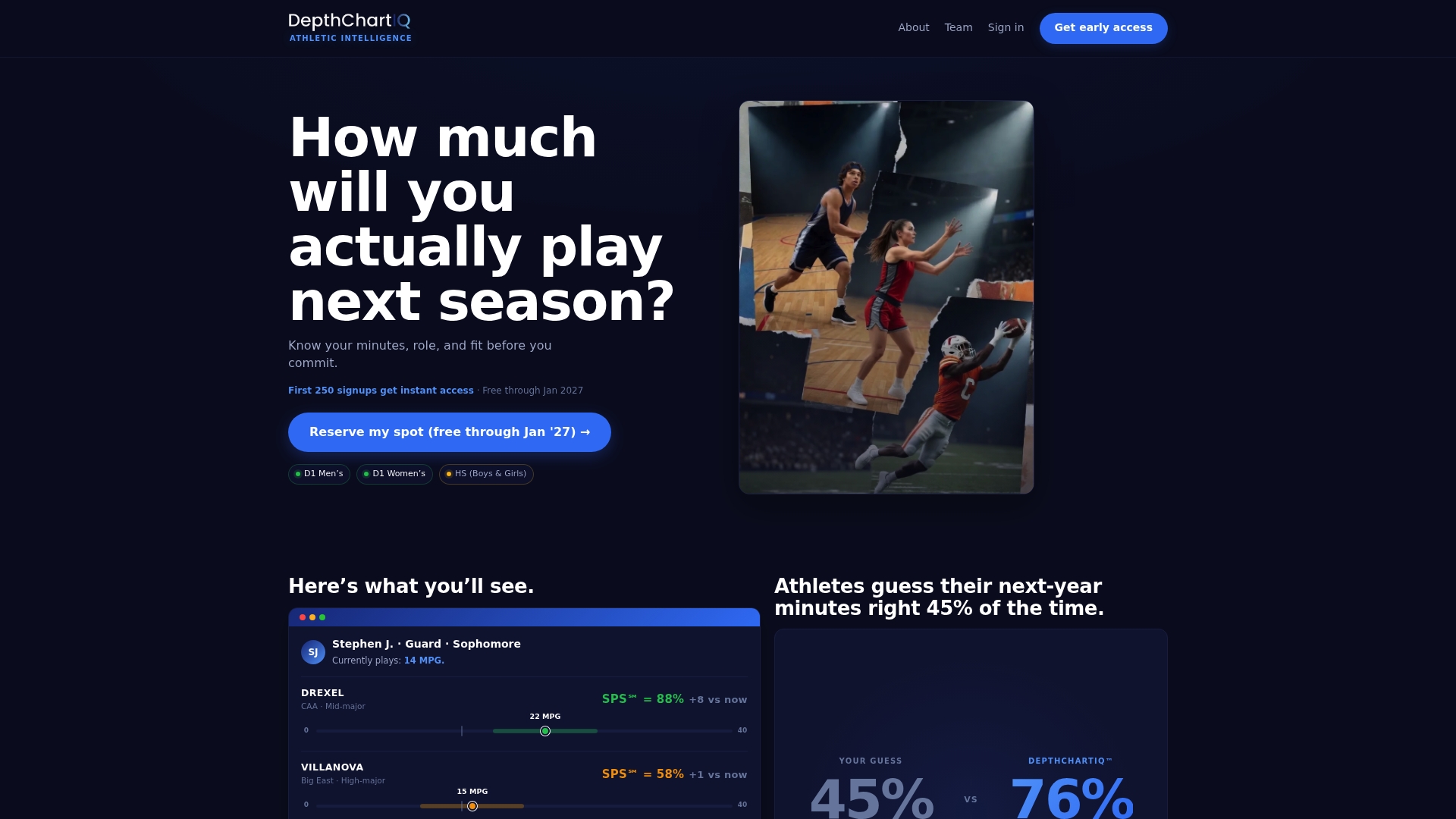
You can also look at individual program pages, such as Portland Pilots Women’s Basketball, Pacific Tigers Women’s Basketball or NC State Wolfpack Women’s Basketball, to see what a program-level view looks like.
FAQ
Do I need NCSA to get recruited for college basketball?
No. A CollegeXpress expert says athletes do not need a recruitment website or agency, and recommends questionnaires and direct emails to coaches. A paid profile can save time, but it is not a requirement.
What is the best recruiting platform for sports?
There is no single best one, because the tools do different jobs. Profile and network tools help coaches find you, video tools show your game, and free outreach costs nothing. Pick the one that matches what you need, then check price and cancellation terms.
How do I get out of an NCSA contract?
Read your agreement for the cancellation process and any refund terms, then contact the company in writing and keep a copy. If you are unsure about your rights, ask a parent or an adult you trust to review the contract. In future, ask about cancellation before signing anything.
Can DepthChartIQ replace a recruiting profile?
No, and it is not meant to. DepthChartIQ helps you compare programs by projected minutes, success probability and roster pressure. You still need to contact coaches, whether by email, questionnaire or another tool.
Is DepthChartIQ only for transfers?
No. It is built for college transfers, athletes deciding whether to stay, and incoming high school and junior college players. It is made for athletes and families rather than coaching staffs.
Sources
- Should I Pay to Get Recruited for College Sports? (CollegeXpress)
- NCSA alternatives and college recruiting tools for 2026 (SiteMVP)
- Best Recruiting Platforms for Athletes: 2026 Comparison (Pathley)