
Why Program Stability Matters for Athlete Development
Discover why program stability matters for athlete development. Learn how consistent training enhances performance and helps you reach your full potential.

DepthChartIQ
Athletic Intelligence

Why Program Stability Matters for Athlete Development

Program stability in athlete development is the foundational principle that separates athletes who reach their ceiling from those who plateau early. Defined by the National Strength and Conditioning Association (NSCA) and Long-Term Athletic Development (LTAD) guidelines as consistent, structured training sustained across full 8–16 week cycles, program stability gives your body the time it needs to adapt, grow stronger, and build the neural patterns that make elite performance possible. Whether you are a high school recruit evaluating college programs or a college athlete deciding whether to transfer, understanding why consistency beats novelty is one of the most career-defining insights you can carry.
Why program stability matters for athlete development: the physiology
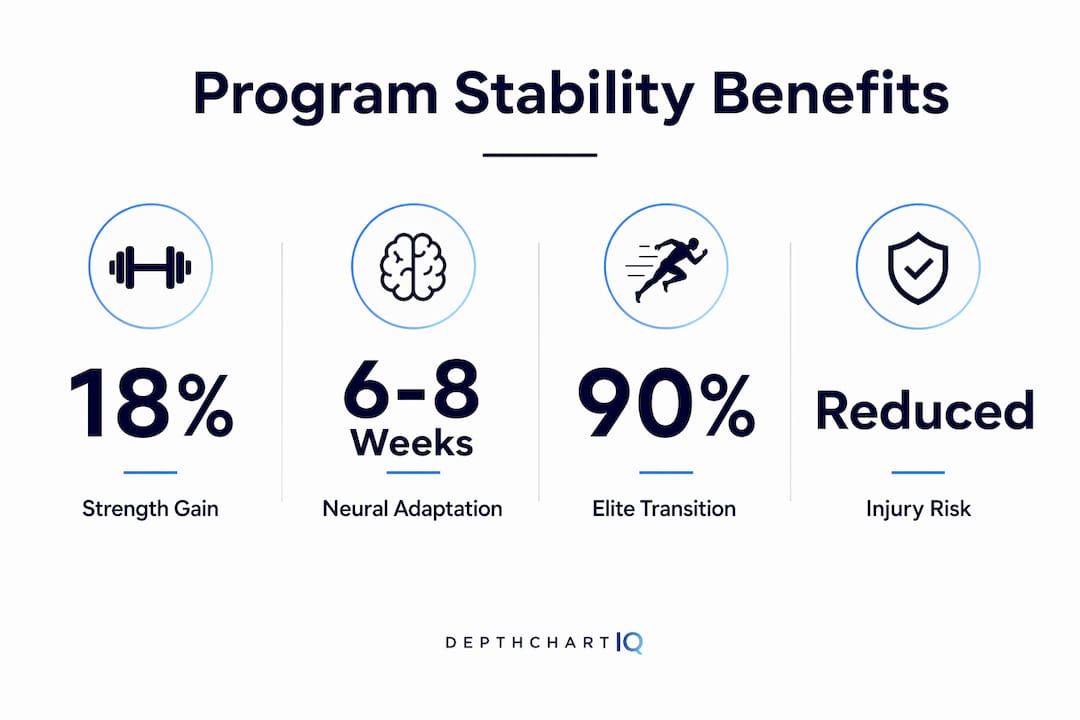
Program stability works because your nervous system and muscles adapt on a fixed biological timeline. Neural adaptations to specific movement patterns need 6–8 weeks of consistent exposure to mature. Switching programs before that window closes resets the clock and traps you in a permanent beginner state.
Progressive overload, the gradual increase of training stress over time, only functions when you track the same movements across a full cycle. Program hopping disrupts volume accumulation and the neural adaptations needed for strength and hypertrophy gains. Every time you restart a new program, you are not building on a foundation. You are pouring a new one.

The numbers make this concrete. Athletes who stay in a consistent periodized program for 6 months achieve 18% greater strength gains and 12% more hypertrophy than those switching programs every 3–4 weeks. That gap is not about talent. It is about time spent in the adaptation window.
General Physical Preparation (GPP) compounds this effect. GPP maintenance year-round creates a performance foundation that allows athletes to safely absorb high-intensity stress without injury or plateauing. Athletes who skip GPP in favor of chasing new programs often find themselves cycling through injury and recovery instead of building fitness.
Pro Tip: Track your lifts and movement metrics inside a single program for at least 8 weeks before judging whether it is working. Perceived boredom is not the same as a plateau.
What program hopping actually costs you
The real cost of switching programs is not just lost gains. It is lost time in the neural adaptation window. An athlete who changes programs every 3–4 weeks never completes a full training cycle. That athlete is always a beginner, regardless of how many years they have been training. The NSCA’s research on periodization confirms that full cycle completion is what separates athletes who develop from athletes who stagnate.
How does program stability reduce injury risk?
Injury prevention is one of the clearest benefits of stable training environments, especially for youth athletes still in growth phases. During adolescent growth spurts, bone growth outpaces soft tissue adaptation. That mismatch means tendons and ligaments are under stress even without adding aggressive or unpredictable training loads.
LTAD guidelines recommend that youth athletes limit total organized sport hours per week to their age. A 12-year-old should cap sport hours at 12 per week. That guideline exists because overuse injuries during critical growth phases have long-term consequences that no amount of future training can fully reverse.
Stable programs solve this problem by building in structured recovery and adaptation phases. When a coach controls volume, intensity, and progression across a planned cycle, the athlete’s body gets the recovery it needs between stressors. Unstable or frequently changed programs skip these phases, either accidentally or because the new program does not account for accumulated fatigue from the previous one.
- Overuse injuries spike when training volume increases faster than tissue adaptation allows
- Burnout follows when athletes never experience a planned deload or recovery week
- Growth plate stress in youth athletes requires professionally monitored volume limits
- Soft tissue injuries are more common in athletes who change training modalities frequently
Pro Tip: If you are under 18, ask your coach to show you how your weekly sport hours are tracked across all activities, not just one sport. Total load matters more than any single session.
The mismatch between bone growth and soft tissue adaptation during youth growth spurts requires stable, professionally monitored training volumes. This is not a minor concern. It is the reason LTAD frameworks exist as a structured developmental philosophy rather than a loose set of suggestions.
What role does environmental stability play in long-term success?
Physical programming is only one part of the picture. The environment around an athlete, including coaching quality, family support, and organizational consistency, shapes development just as powerfully as the training plan itself.
A 2026 systematic review found that stable environments with quality coaching and family support increase athlete confidence and reduce dropout risk. That finding matters because dropout is the most common outcome when athletes feel unsupported or uncertain about their developmental path. Confidence is not a soft metric. It is a performance variable.
“Long-term athlete success depends more on system clarity and support than finding new physical talent predictors.” — Frontiers in Psychology, 2026
Frameworks like LTAD and FTEM (Foundations, Talent, Elite, Mastery) both emphasize stable developmental phases over rapid advancement. These models exist because decades of research show that athletes who skip foundational phases to chase early performance peaks rarely sustain elite careers. The factors parents control most in career longevity, including training environment consistency and program reliability, align directly with what these frameworks prescribe.
A 2026 longitudinal study found that 90% of senior elite athletes experienced successful sports transitions aided by late specialization and diverse sports experiences. Early exclusion from programs or premature specialization consistently undermined long-term developmental efficiency. That finding should make any high school recruit think carefully about programs that promise fast results over structured development.
Unstable environments produce predictable consequences. Increased dropout rates, inconsistent skill development, and reduced motivation all follow when athletes cannot rely on their coaching staff, training structure, or organizational support. Program reliability is not a luxury. It is a developmental requirement.
What mistakes do athletes make with program consistency?
The most common mistake is changing programs because progress feels slow. Slow progress inside a well-designed cycle is normal. It is adaptation happening below the surface. Switching programs at that moment is the equivalent of pulling a plant out of the ground to check if the roots are growing.
Effective athlete programming succeeds at the intersection of physiological soundness, realistic expectations, and repeatability over time. A program you can repeat consistently for months beats a theoretically perfect program you abandon after three weeks. Matching the program to your real-life capacity is not a compromise. It is the requirement.
Here are the most common program consistency mistakes and how to avoid them:
- Switching programs before 8 weeks. Neural adaptations need 6–8 weeks minimum. Commit to the full cycle before evaluating results.
- Choosing programs too complex for your schedule. A program requiring six days per week fails the moment your academic or travel schedule changes. Pick a program you can complete on your worst week.
- Ignoring accumulated fatigue. Athletes often feel flat mid-cycle and interpret it as the program failing. Fatigue is a sign of adaptation, not stagnation.
- Skipping deload weeks. Deloads are built into periodized programs for a reason. Skipping them to chase more volume breaks the adaptation cycle.
- Not communicating with coaches. Athletes who struggle with a program in silence often quit it. A coach can adjust volume or intensity without scrapping the entire cycle.
Pro Tip: Before starting any new program, map out your full schedule for the next 12 weeks, including travel, exams, and competitions. If the program does not fit that reality, modify it before you start, not after you have already broken the cycle.
Inconsistent programming breaks adaptation cycles and reduces progress. The fix is not finding a better program. It is committing to a realistic one. Athletes who compare programs carefully before committing are far less likely to abandon them mid-cycle.
Key Takeaways
Program stability is the single most controllable factor in athlete development, and athletes who commit to full training cycles consistently outperform those who do not.
| Point | Details |
|---|---|
| Neural adaptation takes 6–8 weeks | Switching programs before this window closes resets progress and traps athletes in a beginner state. |
| Consistent programs build more strength | Athletes in stable 6-month programs gain 18% more strength than those switching every 3–4 weeks. |
| LTAD guidelines protect youth athletes | Limiting sport hours to an athlete’s age per week reduces overuse injury risk during growth phases. |
| Environment shapes development | Quality coaching and family support reduce dropout risk and build the confidence athletes need to compete. |
| Realistic programs outperform perfect ones | A program you can repeat consistently for months produces better results than one you abandon early. |
The uncomfortable truth about program stability
I have worked with athletes at every level, and the pattern is always the same. The athletes who develop fastest are rarely the most talented. They are the most consistent. They show up to the same program, week after week, and let the adaptation happen. The athletes who struggle are usually the ones chasing novelty, convinced that a better program is the answer to slow progress.
The uncomfortable truth is that most athletes do not fail because of bad programming. They fail because they cannot tolerate the boredom of doing the same thing long enough for it to work. Stability feels passive. It feels like you are not doing enough. That feeling is wrong.
What I have also seen is the gap between what coaches design and what athletes can realistically sustain. A six-day-per-week program is physiologically sound. It is also incompatible with a full academic schedule, a part-time job, and a social life. The best program is the one that fits your actual life. Coaches who ignore that reality are designing for an athlete who does not exist.
Program stability also builds something that training logs cannot measure: self-discipline. Athletes who learn to trust a process, even when progress is invisible, carry that skill into every competitive environment they enter. That is the real long-term return on consistency.
— John
How DepthchartIQ supports stable athlete development

DepthchartIQ is built on the same principle this article defends: consistent, data-driven development produces better outcomes than chasing short-term results. The platform’s methodology uses advanced metrics and prediction algorithms to give college athletes and high school recruits a clear picture of their playing time potential based on real roster dynamics, not guesswork.
For athletes evaluating programs or considering a transfer, DepthchartIQ’s Success Probability Scores and Roster Pressure insights provide the kind of clarity that makes stable, informed decisions possible. The platform reports a 76% accuracy rate in predicting player outcomes. That level of reliability gives athletes a foundation to plan their development around facts, not assumptions. Visit DepthchartIQ to see how data-backed program evaluation supports long-term athletic career planning.
FAQ
What is program stability in athlete development?
Program stability is consistent, structured training sustained across full 8–16 week cycles without frequent changes. It gives athletes the time needed for neural and physiological adaptations to mature.
How long does it take to see results from a stable program?
Neural adaptations to specific movement patterns take 6–8 weeks to develop. Full strength and hypertrophy gains from a periodized program typically require a complete 8–16 week cycle.
Why do athletes who switch programs frequently stop improving?
Frequent program changes reset neural adaptation progress and disrupt volume accumulation. Athletes who switch every 3–4 weeks never complete a full training cycle, which limits both strength and skill development.
How does program stability affect youth athletes specifically?
LTAD guidelines recommend youth athletes limit weekly sport hours to their age to prevent overuse injuries. Stable programs with planned recovery phases protect growing athletes from the bone and soft tissue stress that unstable training volumes create.
Does a stable environment matter as much as the training program itself?
A 2026 systematic review confirmed that coaching quality and family support directly increase athlete confidence and reduce dropout risk. Environmental stability and program consistency work together, and neither alone is sufficient for long-term development.