
Athletic Career Longevity Planning: Your 2026 Guide
Discover what athletic career longevity planning is and how it can extend your peak performance. Maximize your potential with smart strategies!

DepthChartIQ
Athletic Intelligence

Athletic Career Longevity Planning: Your 2026 Guide

Athletic career longevity planning is the strategic coordination of training design, recovery, workload monitoring, and career transition support to sustain peak performance and minimize avoidable injury over time. Most athletes and coaches treat these elements separately, which is exactly why careers end earlier than they should. The most effective approach integrates periodization, load management, and psychosocial planning into one operating system. Modern tools like wearable technology, heart rate variability tracking, and platforms like Depthchartiq give athletes and their support teams the data to make smarter decisions at every stage of a career.
What is athletic career longevity planning and why it matters
Athletic career longevity planning, known formally as athlete career sustainability strategy, is defined as combining training design, recovery, workload monitoring, and setback minimization to preserve high output across a competitive career. This definition matters because it reframes longevity from a passive hope into an active, measurable system. The average professional athletic career in major leagues spans roughly five years, which means every unplanned injury or burnout episode represents a disproportionate share of a finite career window.
The importance of athletic career planning becomes clear when you look at what causes early exits. Overtraining, poor recovery habits, abrupt workload spikes, and zero preparation for life after sport are the four most common culprits. None of them are inevitable. A well-designed longevity plan addresses all four through coordinated input from coaches, medical staff, psychologists, and financial advisors working from the same data set.
Long-term success in sports requires more than physical talent. Research from 2026 confirms that athlete wellness and longevity depend on physical, psychological, and financial dimensions working together. Treating any one of these in isolation produces gaps that compound over time.
How does structured periodization support long-term athletic careers?
Periodization is the systematic organization of training into macrocycles (annual or multi-year plans), mesocycles (blocks of four to eight weeks), and microcycles (weekly training units) to manage adaptation and fatigue. Periodization is essential to longevity because it prevents the two biggest performance killers: accumulated fatigue and repetitive stress injuries from monotonous loading.
The three primary models each serve different athlete profiles and career stages. Linear periodization increases volume and intensity in a straight progression, making it well-suited for younger athletes building a base. Undulating periodization varies intensity and volume within the same week, which works better for experienced athletes who need more stimulus variation to keep adapting. Block periodization concentrates specific fitness qualities into focused phases, and it is the preferred model for elite athletes managing complex multi-sport or multi-season schedules.
Age-related training adaptations change what each model can deliver. Athletes in their mid-to-late twenties recover faster from high-intensity blocks, while athletes over thirty benefit from longer deload periods and more conservative volume progressions. Deloads are structured recovery weeks where volume drops but intensity stays consistent, preserving neuromuscular adaptations while clearing accumulated fatigue. The timing of deloads should be driven by data, not guesswork.
| Periodization model | Best athlete age range | Primary benefit |
|---|---|---|
| Linear | 15 to 22 years | Foundation building, progressive overload |
| Undulating | 22 to 30 years | Stimulus variation, plateau prevention |
| Block | 26 years and older | Quality concentration, competition peaking |
Pro Tip: Track heart rate variability every morning before training. A consistent downward trend over five or more days signals accumulated fatigue and is your clearest indicator that a deload week is overdue, regardless of what the calendar says.

Elite teams use wearable technology and HRV to inform adaptive periodization in real time, adjusting training loads based on recovery markers rather than fixed schedules. This is the difference between a plan that looks good on paper and one that actually protects an athlete across decades.
How does workload management reduce injury risk?
The acute:chronic workload ratio, or ACWR, measures the relationship between an athlete’s recent training load (the past week) and their longer-term fitness base (the past four weeks). A 2025 narrative review confirms that ACWR monitoring reduces injury risk by flagging abrupt spikes before they translate into tissue damage. The practical implication is straightforward: athletes who jump from low training loads to high ones in a single week face a significantly elevated injury probability compared to those who progress gradually.

Sleep is the most underrated variable in this equation. The same 2025 review found that adolescents sleeping fewer than eight hours per night show a 1.7 times greater injury risk than those meeting sleep targets. That figure applies across age groups. Sleep is where soft tissue repairs, hormones reset, and the nervous system consolidates motor patterns learned in training.
Pro Tip: Treat recovery as an operating system, not a reward. Schedule sleep windows, hydration targets, and soft tissue work the same way you schedule training sessions. What gets scheduled gets done.
The table below summarizes the key injury risk factors connected to load and recovery variables:
| Risk factor | Mechanism | Mitigation strategy |
|---|---|---|
| Acute workload spike | Tissue stress exceeds adaptation capacity | Limit weekly load increases to 10% or less |
| Chronic sleep deficit | Impaired tissue repair and hormonal recovery | Target 8 to 9 hours per night consistently |
| Monotonous loading | Repetitive stress on same tissue structures | Rotate training modalities and vary intensity |
| Inadequate deload frequency | Fatigue accumulation without clearance | Schedule deloads every four to six weeks |
Consistent chronic training loads build the adaptation capacity that makes athletes resilient. The goal of load management is not to reduce work. It is to sequence training stress so the body absorbs it, adapts to it, and comes back stronger. Wearables from brands like Whoop, Garmin, and Polar now give athletes and coaches real-time access to readiness scores, sleep quality data, and strain metrics that make this sequencing precise rather than intuitive.
Why career transition planning belongs inside your longevity strategy
Athlete Career Transition Management, known as ACTM, is a multidimensional framework that prepares athletes for the psychological, social, educational, and financial shifts that accompany the end of a competitive career. A 2026 meta-analytical study found that integrated transition support combining psychosocial counseling, education, and financial planning produces measurably better welfare and adaptation outcomes than any single intervention alone.
Without this planning, athletes face a predictable set of challenges. Identity loss is the most acute. When sport has defined a person’s daily structure, social network, and self-worth for ten or twenty years, retirement creates a vacuum that no amount of financial security fully fills. Anxiety, depression, and social withdrawal are documented outcomes for athletes who exit sport without a structured transition plan.
The Personal Transition Project framework, developed by iSport in Australia, converts career transition from an abstract emotional event into a structured project with clear timelines, measurable goals, and resource planning. This approach replaces the downward spiral of uncertainty with a concrete roadmap.
Practical transition planning steps for active athletes include:
- Begin dual-career planning at least three years before anticipated retirement, not in the final season
- Work with a certified financial advisor to build income diversification beyond playing contracts
- Engage a sports psychologist to develop identity outside of athletic performance
- Pursue educational credentials or professional certifications during the active career
- Connect with athlete career planning resources that specialize in post-sport transitions
- Build a personal board of advisors including tax, legal, and financial professionals aligned to long-term goals
Athlete longevity depends on developing resilience and identity diversification through anticipatory planning and dual-career pathways. The athletes who transition well are not the ones who planned for retirement at the end. They are the ones who built a life alongside their sport throughout it.
What are the best practices for executing a longevity plan?
Executing athlete career sustainability strategies requires assembling the right team and following a sequential framework from early career through post-sport transition. The following steps represent the best practices for athletic longevity based on current research and applied experience:
- Assess your baseline. Map current training loads, recovery habits, sleep quality, and injury history before designing any periodization plan. You cannot manage what you have not measured.
- Build your advisory team. Assemble a strength and conditioning coach, sports medicine physician, registered dietitian, sports psychologist, and financial advisor. Each role addresses a different dimension of longevity.
- Select a periodization model. Match the model to your age, sport demands, and competition calendar. Revisit this choice annually as your body and career stage evolve.
- Implement ACWR monitoring. Use wearable technology to track weekly and chronic training loads. Set a threshold for load increases and treat breaches as mandatory rest triggers, not optional ones.
- Schedule deload weeks proactively. Place them in the calendar before the season begins, then adjust timing based on HRV and readiness data.
- Start transition planning early. Begin the Personal Transition Project framework at least three years before anticipated retirement. Treat it as a parallel career project, not a post-sport afterthought.
- Review and adjust quarterly. Longevity planning is not a one-time document. Quarterly reviews with your advisory team catch drift before it becomes damage.
A common pitfall is treating the plan as complete once it is written. Effective longevity planning requires a matched system of season-to-season periodization, day-to-day workload monitoring, and medical decision rules that adapt in real time. The plan is a living document, and the athletes who treat it that way are the ones who play longer.
Key takeaways
Athletic career longevity planning succeeds when periodization, workload monitoring, and career transition support operate as one integrated system rather than three separate efforts.
| Point | Details |
|---|---|
| Define longevity as a system | Combine training design, recovery, load monitoring, and transition planning into one coordinated strategy. |
| Match periodization to age | Use linear models for younger athletes and block or undulating models for experienced competitors over 26. |
| Monitor ACWR and sleep | Limit weekly load spikes and target 8 to 9 hours of sleep to cut injury risk significantly. |
| Start transition planning early | Begin dual-career and financial planning at least three years before anticipated retirement. |
| Use data to drive decisions | Wearables and HRV tracking replace guesswork with real-time evidence for deload timing and load adjustments. |
Why durability is now the most underrated competitive advantage
I have spent years watching talented athletes exit sport not because they lacked ability but because no one around them treated durability as a performance metric. The conversation in most programs still centers on what athletes can do at their peak, not how long they can sustain it. That framing is backwards.
The athletes I have seen thrive longest share one trait: they treat their body and career as a long-term investment, not a short-term output machine. They use data from tools like Whoop and Garmin not to obsess over numbers but to make better decisions on the days when the body is telling them something the ego does not want to hear. They also build lives outside sport while they are still competing, which means retirement is a transition rather than a collapse.
The gap I see most often is not in physical preparation. It is in the psychological and financial dimensions. Athletes who have never been coached to think about identity outside of sport are the most vulnerable when the career ends. The multidimensional transition support research is unambiguous on this point: integrated planning produces better outcomes, and the earlier it starts, the better.
My honest recommendation is to stop waiting for a crisis to trigger planning. The best time to build a longevity strategy is at the beginning of a career. The second best time is right now.
— John
How Depthchartiq supports your career longevity strategy
Depthchartiq gives college basketball players and their support teams the data infrastructure that longevity planning requires. The platform’s advanced prediction methodology translates roster dynamics, playing time trends, and program-level changes into concrete insights about where an athlete’s career is heading, not just where it is today.
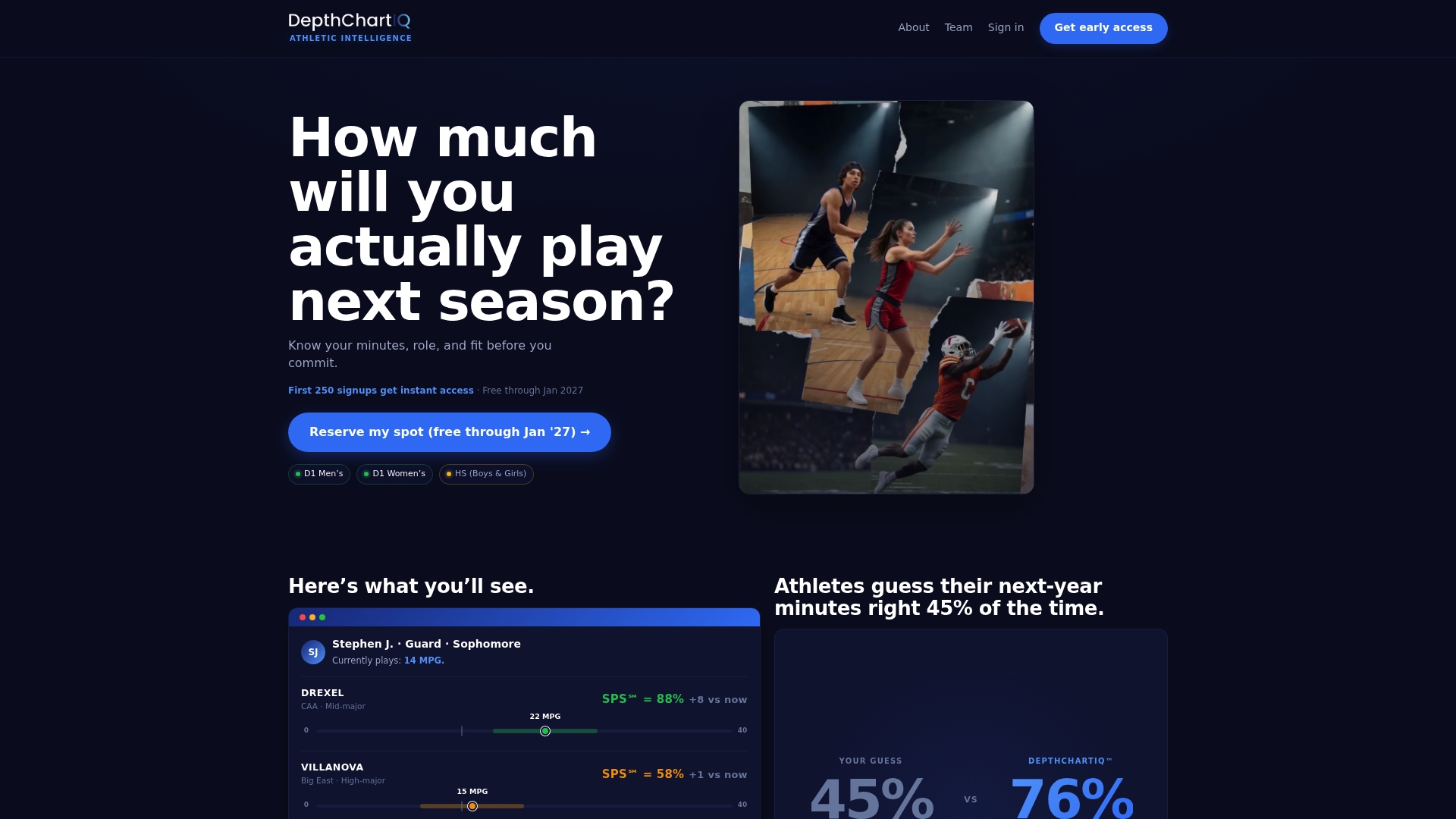
With a 76% accuracy rate in predicting player outcomes, Depthchartiq removes the guesswork from career decisions that directly affect longevity. Whether you are a current college athlete evaluating a transfer, a high school recruit assessing program fit, or a coach managing roster depth, the platform’s real-time data updates and success probability scores give you the strategic clarity to make decisions that protect and extend athletic careers. Explore Depthchartiq to see how data-driven career planning works in practice.
FAQ
What is athletic career longevity planning?
Athletic career longevity planning is the coordinated system of training periodization, workload monitoring, recovery management, and career transition support designed to extend peak performance and minimize injury across a competitive career. It treats physical, psychological, and financial dimensions as interconnected rather than separate concerns.
How does the acute:chronic workload ratio prevent injuries?
The ACWR compares an athlete’s recent training load to their four-week fitness base, flagging spikes that exceed the body’s current adaptation capacity. Research confirms that managing these spikes, combined with adequate sleep, significantly reduces injury risk across age groups.
When should athletes start career transition planning?
Athletes should begin transition planning at least three years before anticipated retirement, ideally earlier. The Personal Transition Project framework from iSport structures this process with clear timelines and goals, replacing uncertainty with a concrete roadmap.
What periodization model is best for long-term athletic careers?
The best model depends on age and career stage. Linear periodization suits athletes under 22 building a base, undulating periodization works well for athletes aged 22 to 30, and block periodization is preferred for elite athletes over 26 managing complex competition schedules.
Why does sleep matter so much for athletic longevity?
Sleep is the primary window for tissue repair, hormonal recovery, and motor pattern consolidation. Athletes sleeping fewer than eight hours per night face a 1.7 times greater injury risk, making sleep quality one of the highest-leverage variables in any longevity plan.