
Sports Psychology's Role in Athlete Success
Discover the role of sports psychology in athlete success. Learn how mental skills enhance performance, focus, and resilience under pressure.

DepthChartIQ
Athletic Intelligence

Sports Psychology’s Role in Athlete Success

Sports psychology is defined as the structured development of mental skills that enable athletes to perform consistently under competitive pressure. The role of sports psychology in athlete success goes far beyond motivation. It builds trainable capacities, including focus, confidence, anxiety regulation, and resilience, that directly determine how athletes execute when it counts. Psychological Skills Training (PST), the recognized industry term for applied mental performance work, has been validated across thousands of studies. A meta-analysis of 127 studies with over 24,000 participants found PST produces a large effect size of 0.83 on athletic performance. That number places mental training firmly alongside physical conditioning as a pillar of athlete development.
What are the primary mental skills developed through sports psychology?
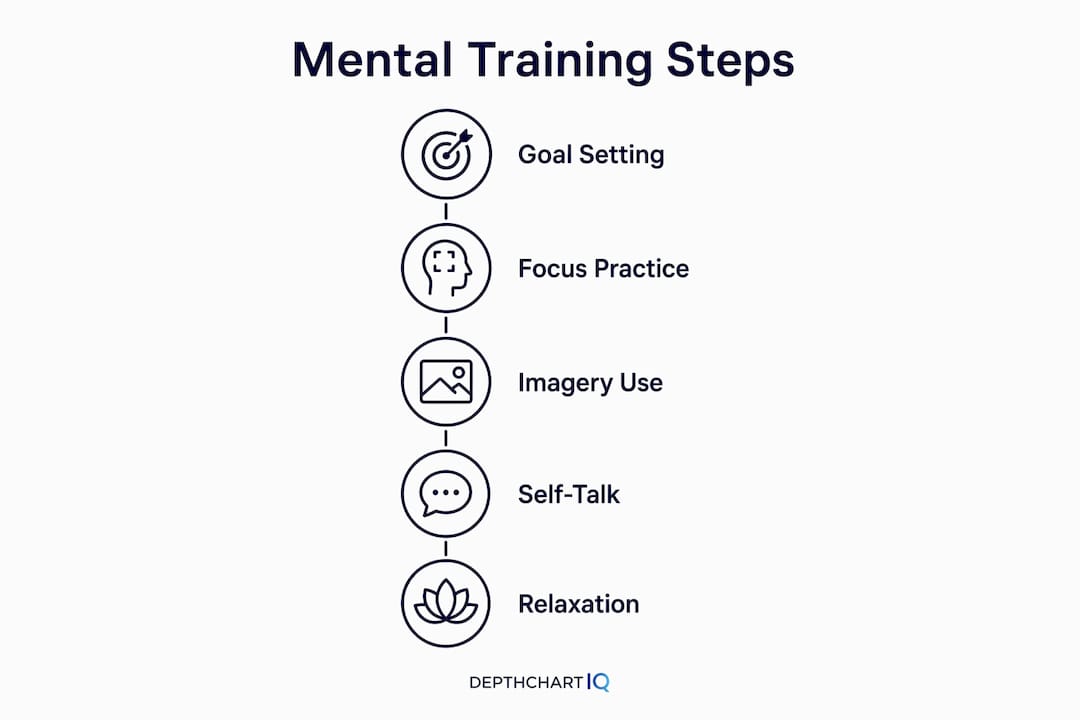
Mental training for athletes targets five core performance mediators. Research confirms these are confidence, attentional control, arousal regulation, anxiety management, and recovery after mistakes. Each one directly shapes how an athlete executes under pressure.
Here is how each skill connects to real performance outcomes:
- Focus and attentional control. Athletes who train attention can block out crowd noise, a missed call, or a rival’s trash talk. Attentional control reduces the cognitive interference that causes errors at critical moments.
- Self-confidence. Confidence built through mental training is not bravado. It is a stable belief in one’s preparation that allows athletes to commit fully to technique without second-guessing mid-execution.
- Anxiety and arousal regulation. Unmanaged arousal causes choking. Breathing protocols, progressive muscle relaxation, and pre-performance routines bring arousal into the optimal zone for each athlete’s sport and position.
- Imagery and visualization. Mental imagery activates the same neural pathways as physical practice. This means a sprinter visualizing a clean start is literally conditioning the nervous system without physical fatigue.
- Goal setting and self-talk. The Association for Applied Sport Psychology confirms that motivational self-talk improves effort, persistence, and skill execution. Goal setting channels motivation into training quality rather than vague ambition.
Pro Tip: Pick one mental skill to develop first. Athletes who try to build focus, imagery, and self-talk simultaneously rarely master any of them. Depth beats breadth in mental training.
What does research reveal about sports psychology’s effectiveness?

The scientific case for psychological factors in sports performance is no longer debatable. The same meta-analysis that validated PST also found imagery produces an effect size of 0.75 and mindfulness produces 0.67. These are not marginal gains. They represent the difference between an athlete who holds their technique in the final quarter and one who falls apart.
A 2026 Bayesian network meta-analysis of 46 trials covering 2,049 participants added important nuance. Mindfulness-Acceptance-Commitment (MAC) interventions reduced competitive anxiety with a standardized mean difference of negative 1.33. That is a clinically large reduction. The same analysis showed elite, semi-elite, and junior athletes respond differently to imagery, MAC protocols, and biofeedback, which means the technique matters less than the fit between technique and athlete.
| Mental Technique | Effect Size / Outcome | Best Suited For |
|---|---|---|
| Psychological Skills Training (PST) | 0.83 effect size | Broad performance gains across sports |
| Imagery / Visualization | 0.75 effect size | Motor skill refinement, pre-competition prep |
| Mindfulness (MAC) | 0.67 effect size | Anxiety reduction, present-moment focus |
| Biofeedback | Varies by athlete level | Arousal regulation, physiological awareness |
The long-term picture is equally compelling. Managing anxiety builds consistency, which increases confidence, which fuels motivation. This compounding cycle reinforces itself at every competition level. An athlete who starts mental training in high school carries those skills into college and beyond, making psychological development one of the highest-return investments in an athletic career.
“Sports psychology is not primarily about increasing motivation. It is about enabling consistent execution under pressure through repeatable mental skills.” — M1 Performance Group
How can athletes and coaches integrate mental training into daily routines?
Knowing the techniques is not enough. The impact of sports psychology depends entirely on consistent application. Hundreds of peer-reviewed studies in The Journal of Applied Sport Psychology document that structured mental training routines over 6–12 weeks produce measurable gains in performance consistency. The key word is structured.
Here is a practical framework for building mental training into existing routines:
- Start with 5–10 minutes of mindfulness each morning. This is not meditation for relaxation. It is attention training. Sit, breathe, and practice returning your focus to one point every time it drifts. That skill transfers directly to competition.
- Add self-talk cues to your warm-up. Tie a two or three word phrase to a specific physical action, such as “stay low” when you drop into your athletic stance. Repetition during practice makes the cue automatic under pressure.
- Run imagery sessions before sleep. Spend five minutes visualizing your next competition in first-person, including the sounds, the pressure, and your ideal execution. Pre-sleep imagery consolidates the mental rehearsal during rest.
- Stack mental drills onto physical habits. Athletes benefit most from tying mental cues to existing routines, such as repeating a focus phrase when putting on gear. This removes the need for extra time and builds automaticity.
- Journal one mental challenge after each practice or game. Write down what happened, what you felt, and one adjustment for next time. This builds a process-focused mindset and prevents fixation on outcomes you cannot control.
Pro Tip: Coaches: build a two-minute mental reset into the end of every practice. Have athletes close their eyes, breathe, and visualize one thing they executed well. This anchors positive patterns before the session ends.
The most common failure in mental training is not lack of effort. Most athletes fail because they try too many techniques at once instead of mastering one. Choose imagery or self-talk, practice it daily for at least three months, and then add a second skill. Consistency over variety is the rule.
What are the most advanced approaches in sports psychology today?
The frontier of how psychology enhances athletic success has moved beyond single-technique interventions. A 2026 review in Frontiers in Sports and Active Living found that integrative psychological interventions targeting cognitive, emotional, and physiological stress processes simultaneously outperform isolated approaches. This means combining cognitive-behavioral techniques with mindfulness and biofeedback in one coordinated program, not picking one and ignoring the others.
Context sensitivity is the other major advance. The same review emphasizes that stress regulation skills must be embedded as trainable, context-sensitive routines rather than generic protocols. A basketball player managing fourth-quarter pressure needs different cues than a golfer managing a two-foot putt. Effective sports psychology now accounts for the sport, the position, the competition level, and the individual athlete’s psychological profile.
Current leading-edge approaches include:
- Cognitive-behavioral techniques that identify and reframe negative thought patterns before and during competition.
- Mindfulness-based stress reduction adapted for sport, focusing on non-judgmental awareness of physical sensations and thoughts during performance.
- Biofeedback training using heart rate variability data to teach athletes to recognize and control their physiological arousal in real time.
- Ecological validity design, meaning mental training scenarios that mirror actual competition conditions as closely as possible, rather than generic relaxation exercises done in a quiet room.
The direction of the field is clear. Personalized, multi-method mental training programs that integrate into daily physical training will produce the largest gains. Athletes and coaches who understand athlete mental health as part of this picture will build programs that last.
Key takeaways
Mental training for athletes is most effective when it targets multiple psychological skills simultaneously, practiced consistently over 6–12 weeks within existing physical routines.
| Point | Details |
|---|---|
| PST produces large gains | Psychological Skills Training shows an effect size of 0.83, making it as impactful as most physical interventions. |
| Technique fit matters | Elite, junior, and semi-elite athletes respond differently to imagery, MAC, and biofeedback. Match the method to the athlete. |
| Consistency beats variety | Mastering one mental skill over three months outperforms dabbling in five techniques at once. |
| Habit stacking works | Tying mental drills to physical routines removes barriers and builds automaticity faster than isolated sessions. |
| Compounding returns | Managing anxiety builds confidence, which fuels motivation, creating a positive cycle across an athlete’s entire career. |
Why mental training is the real separator at the elite level
I have watched physically gifted athletes stall at the college level while less naturally talented teammates climbed the depth chart. The difference was almost never physical. It was the ability to execute a skill they had done a thousand times in practice when the game was on the line and the crowd was loud.
Sports psychology is not a soft add-on. It is the system that makes physical preparation pay off. An athlete who cannot manage arousal will choke. An athlete without attentional control will make mental errors at the worst moments. Physical talent sets the ceiling. Mental training determines how close athletes get to it.
The misconception I see most often is that mental training is about getting fired up or staying positive. That framing misses the point entirely. The goal is repeatable execution, not emotion management. The best mental training programs I have seen treat psychological skills exactly like physical skills: they are drilled, measured, and refined over months, not weeks.
My strongest advice for coaches is to integrate mental skills training into the weekly schedule the same way you schedule film review or strength work. Give it a time slot. Hold athletes accountable for it. The athletes who do this consistently are the ones still performing at their best in the fourth quarter, the final set, and the last mile.
— John
DepthchartIQ and the mental side of athlete development

DepthchartIQ was built on the understanding that athlete success depends on more than physical output. The platform’s methodology integrates advanced metrics and prediction algorithms to give college athletes and high school prospects a clear picture of where they stand and what they need to do to move up. Success Probability Scores and Roster Pressure insights give athletes the kind of objective feedback that supports the process-focused mindset sports psychology demands. When you know exactly where you fit in a program, you can direct your mental and physical preparation with precision. Explore DepthchartIQ’s platform to see how data-driven athlete development and mental performance work together.
FAQ
What is the role of sports psychology in athlete success?
Sports psychology develops trainable mental skills including focus, confidence, and anxiety regulation that enable consistent performance under pressure. Psychological Skills Training produces a large effect size of 0.83 across studies with over 24,000 participants.
How long does mental training take to show results?
Structured mental training routines practiced over 6–12 weeks produce measurable gains in performance consistency, according to peer-reviewed research in The Journal of Applied Sport Psychology.
What mental technique works best for reducing competitive anxiety?
Mindfulness-Acceptance-Commitment (MAC) interventions show the strongest evidence for anxiety reduction, with a standardized mean difference of negative 1.33 in a 2026 Bayesian network meta-analysis of 46 trials.
Can mental training benefit youth and high school athletes?
Mental performance training at youth and school levels increases sport retention, lowers dropout rates, and builds healthier attitudes toward competition, making early adoption one of the highest-return investments in athlete development.
How should coaches introduce sports psychology into practice?
Coaches should tie mental drills to existing physical routines, such as focus cues during warm-up, and schedule consistent mental training time the same way they schedule film review or strength sessions.