
Role of Enrollment Management in Athletics: 2026
Discover the role of enrollment management in athletics and how it drives growth in colleges. Learn strategies for success in 2026!

DepthChartIQ
Athletic Intelligence

Role of Enrollment Management in Athletics: 2026

Enrollment management in collegiate athletics is defined as the coordinated strategy that aligns athletic recruitment, roster planning, and scholarship governance with an institution’s broader student enrollment goals. Athletic administrators and admissions professionals increasingly treat this function not as a back-office process but as a primary driver of institutional growth. NCAA roster limits, Title IX compliance requirements, and the rise of emerging sports have made the connection between athletics and enrollment more direct than ever. Programs like Ole Miss have demonstrated that treating a football bowl season as a recruitment campaign cycle produces measurable results in applications and yield. Understanding this connection is the foundation of every effective athletic enrollment strategy in 2026.
How does the role of enrollment management in athletics work?
Athletics serves as a direct enrollment lever, not just a brand asset. When a program wins, visibility rises. When visibility rises, prospective students take notice. The mechanism is well documented: coordinated outreach during high-visibility sports events like bowl games gives enrollment teams a warm, engaged audience that no traditional recruitment campaign can replicate.
Ole Miss operationalized this insight by scheduling targeted outreach in away cities during bowl game travel. The university engaged prospective students, parents, guidance counselors, and alumni simultaneously. That multi-audience approach turns a single sports event into a segmented recruitment campaign with multiple conversion points.
The enrollment impact of athletics extends well beyond football. Consider what drives a student’s sense of fit at a school:
- Brand visibility: Media coverage of athletic programs increases name recognition among prospective students who have never visited campus.
- Community identity: Students who see themselves as part of an athletic culture are more likely to enroll and persist.
- Parent confidence: Families watching a program compete on national television form impressions about institutional quality. Understanding how parents evaluate programs is critical for enrollment teams building outreach strategies.
- Counselor relationships: High school counselors who attend bowl game events become informed advocates for the institution.
Athletics enrollment impact depends on coordinated timing and event-to-lead conversion tracking. Sports seasons must be treated as campaign cycles with segmented follow-up, not as passive drivers of awareness.
The practical implication is clear. Enrollment managers who schedule outreach around athletic visibility windows extract more value from the same marketing budget. Programs that ignore this timing leave recruitment opportunities on the table.
How do NCAA roster limits affect athletic recruitment?
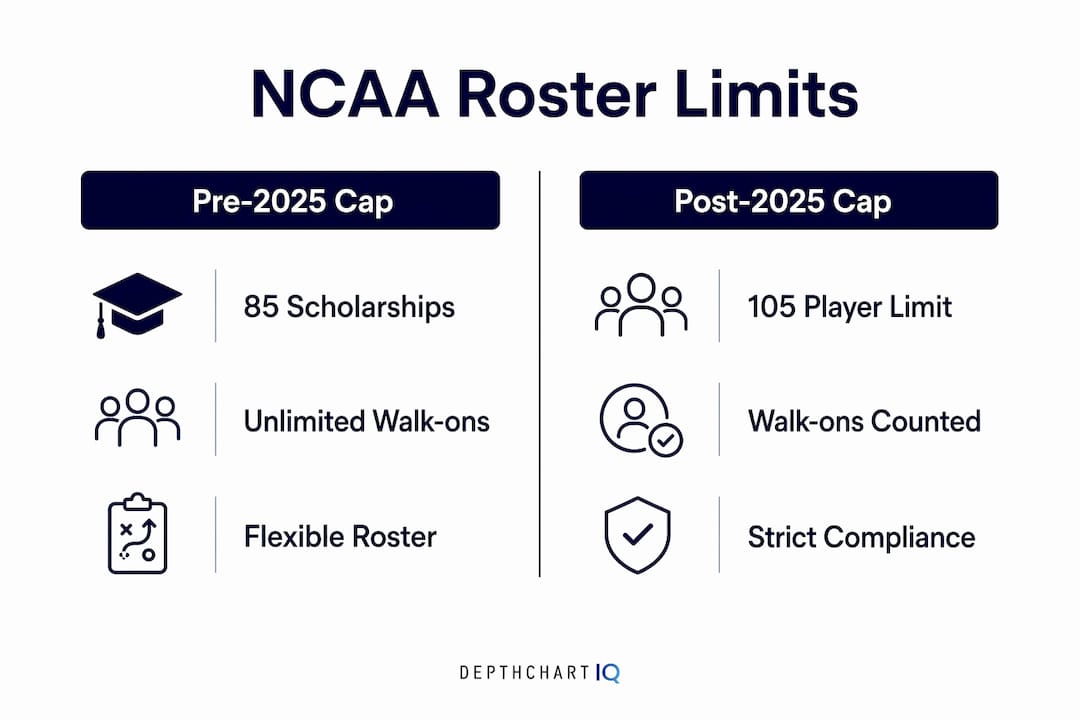
The 2025–26 academic year introduced a structural shift in how NCAA programs manage rosters. The governing body moved from scholarship caps to fixed roster size limits. Football programs now face a 105-player roster limit, replacing the previous 85-scholarship model. That change forces coaches and enrollment teams to make trade-offs they never had to consider before.
Under the old scholarship model, a coach could carry walk-ons freely. Under the new roster limit, every player on the roster counts against the cap regardless of scholarship status. This means recruitment decisions now carry direct enrollment consequences. Signing a marginal prospect consumes a roster slot that could go to a higher-value recruit.
Title IX compliance adds another layer of complexity. The shift to roster limits requires institutions to track athletes using both duplicated and unduplicated counting methods. Duplicated counts include athletes who participate in multiple sports. Unduplicated counts reflect unique individuals. The difference matters for participation equity reporting and financial aid distribution. Getting this wrong creates compliance risk and distorts enrollment projections.
| Governance Model | Key Constraint | Enrollment Impact |
|---|---|---|
| Pre-2025 Scholarship Cap | 85 scholarships (football) | Walk-ons unrestricted; roster size flexible |
| 2025–26 Roster Limit | 105 total players (football) | Every roster slot carries strategic weight |
| Title IX Reporting | Duplicated vs. unduplicated counts | Requires synchronized data between athletics and admissions |
Shared data coordination between athletics and enrollment teams is no longer optional. Synchronized roster and funding data prevents compliance blind spots and keeps enrollment projections accurate. Without it, an institution can unknowingly violate Title IX participation ratios or misreport financial aid figures.
Pro Tip: Build a shared data contract between your athletics compliance office and enrollment management team. Define exactly which roster fields sync to admissions records, how often they update, and who owns discrepancy resolution. This single agreement prevents the majority of compliance reporting errors.
Can emerging sports drive measurable enrollment growth?
Emerging sports are not a consolation prize for programs that cannot compete in revenue sports. They are a proven enrollment tool, particularly for small and mid-sized institutions. NAIA women’s wrestling participation has grown by more than 300%, creating new recruitment pipelines that did not exist a decade ago. That growth translates directly into new students who chose a school specifically because of that sport.
Club sports produce a similar effect. A study of 151 U.S. club-sport athletes found that club sports availability significantly influences college selection and persistence, rivaling academics and coach relationships as a decision factor. That finding reframes how enrollment managers should think about club sport investment. It is not a student life expense. It is a recruitment and retention mechanism.
| Sport Type | Primary Enrollment Function | Cost Profile |
|---|---|---|
| Revenue sports (football, basketball) | Brand visibility, large-scale yield events | High operating cost |
| Emerging varsity sports | New recruitment pipelines, niche athlete pools | Moderate cost, scholarship savings possible |
| Club sports | Retention, sense of belonging, broad participation | Low cost, high retention ROI |
The financial case for emerging sports requires a specific lens. Enrollment leaders should evaluate net tuition revenue against operating costs and scholarship savings rather than treating new programs as pure expenses. A women’s wrestling program that brings in 20 new students per year, each paying net tuition, generates revenue that far exceeds its operating budget at most institutions.
Emerging sports also address a retention problem that admissions offices rarely connect to athletics. Students who participate in a sport, even at the club level, report stronger campus belonging and higher persistence rates. That means the enrollment impact compounds over four years, not just at the point of initial recruitment.
Pro Tip: When evaluating a new sport for your institution, model the four-year net tuition revenue from projected roster size before comparing it to year-one operating costs. The return on investment looks very different over a full enrollment cohort.
What role does data play in roster and enrollment alignment?
Data-driven roster management is the operational backbone of modern athletic enrollment strategy. Kentucky Athletics built BLUEprint, a front office database that centralizes performance metrics, financial data, and recruitment scenarios in one platform. The system supports decision-making from signing day through spring practice by modeling the downstream effects of each roster move.

The value of a tool like BLUEprint is not just internal efficiency. It creates a shared language between coaches and enrollment managers. When both teams work from the same data, scholarship allocation decisions align with admissions forecasting. Roster churn from the transfer portal no longer blindsides enrollment projections.
Effective data integration in athletic enrollment management covers several functions:
- Player valuation modeling: Quantifying each recruit’s athletic and academic profile against roster needs and scholarship budget.
- Scenario simulation: Testing the enrollment impact of different recruiting classes before commitments are made.
- Transfer portal tracking: Monitoring roster changes and transfer decisions in real time to update enrollment forecasts.
- Compliance monitoring: Flagging Title IX participation ratios and scholarship distribution thresholds before they become violations.
Front-office tools that synthesize performance and financial data are increasingly essential for aligning roster decisions with enrollment strategy. The institutions that build this infrastructure now will have a structural advantage in recruitment efficiency and compliance management for years ahead.
Key takeaways
Effective enrollment management in athletics requires coordinated data, strategic outreach timing, and a clear financial framework for every roster and program decision.
| Point | Details |
|---|---|
| Athletics as a recruitment lever | Treat sports seasons as campaign cycles with targeted outreach to prospective students, parents, and counselors. |
| Roster limits demand shared data | The 2025–26 shift to a 105-player football roster limit requires synchronized data between athletics and enrollment teams. |
| Emerging sports grow enrollment | NAIA women’s wrestling grew over 300%; evaluate new sports by four-year net tuition revenue, not year-one cost alone. |
| Club sports drive retention | Club sport availability rivals academics in college selection decisions, making it a measurable retention investment. |
| Data tools align strategy | Platforms like Kentucky’s BLUEprint connect roster decisions to enrollment forecasts, reducing compliance risk and improving yield. |
Where most athletic enrollment strategies break down
I have spent years watching athletic programs and enrollment offices operate in parallel universes. Coaches recruit. Admissions processes applications. Compliance files reports. Nobody is reading from the same document.
The problem is not a lack of effort. It is a lack of shared metrics. When athletics defines success as wins and enrollment defines success as headcount, the two teams will never coordinate effectively. The institutions that get this right have one thing in common: a shared dashboard that forces both teams to look at the same numbers every week.
The Ole Miss bowl game outreach model is instructive precisely because it required someone to say, “We are going to be in Dallas for a game. Let us bring the enrollment team.” That decision did not come from a policy. It came from a leader who understood that athletic visibility is a time-limited asset. You either activate it or you waste it.
My honest recommendation for any enrollment leader reading this: stop treating athletics as a separate department and start treating it as your highest-visibility recruitment channel. Build the data infrastructure. Schedule the outreach. Model the financial return on every new sport you consider. The programs doing this in 2026 are pulling ahead of those that are not.
— John
How DepthchartIQ supports athletic enrollment strategy
Athletic administrators and coaches who want to align roster decisions with enrollment outcomes need more than spreadsheets. DepthchartIQ provides the analytics infrastructure to model roster scenarios, track player valuation, and anticipate the enrollment impact of every recruitment decision.
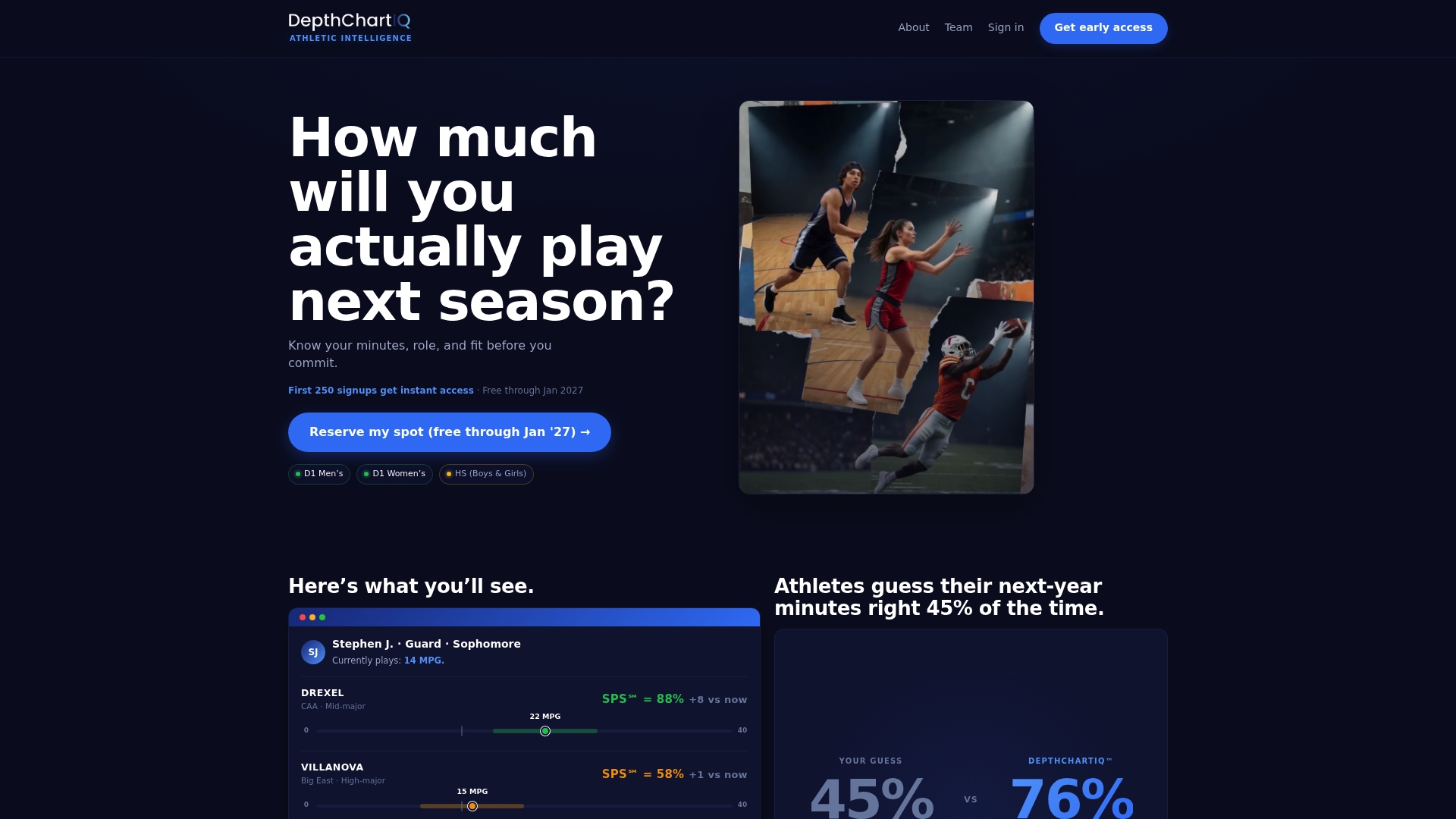
The platform’s Success Probability Scores and Roster Pressure insights give enrollment teams a real-time view of how roster changes affect recruitment pipelines and scholarship allocation. With a 76% accuracy rate in predicting player outcomes, DepthchartIQ gives athletic administrators the confidence to make roster decisions that support both competitive and enrollment goals. Explore the platform and see how data-driven roster management translates directly into enrollment results at DepthchartIQ.
FAQ
What is enrollment management in college athletics?
Enrollment management in college athletics is the coordinated process of aligning athletic recruitment, roster planning, and scholarship governance with an institution’s overall student enrollment goals. It connects admissions, compliance, and athletics into a unified strategy.
How do NCAA roster limits affect enrollment planning?
The 2025–26 NCAA shift to a 105-player football roster limit means every roster slot carries strategic weight. Enrollment teams must synchronize roster data with admissions forecasts to avoid compliance errors and inaccurate enrollment projections.
Can club sports improve student retention?
Research on 151 U.S. club-sport athletes confirms that club sports availability significantly influences both college selection and persistence. Institutions that invest in club sports see measurable retention benefits beyond initial enrollment.
Why are emerging sports valuable for small colleges?
Emerging sports create new recruitment pipelines at lower cost than revenue sports. NAIA women’s wrestling grew by more than 300%, demonstrating that niche sports can generate net tuition revenue that exceeds program operating costs over a full enrollment cohort.
How does data integration improve athletic enrollment outcomes?
Tools like Kentucky’s BLUEprint centralize performance, financial, and roster data to support scenario modeling and compliance monitoring. Shared data between athletics and enrollment teams reduces transfer portal surprises and keeps scholarship allocation aligned with admissions forecasting.