
Positional Size and Playing Time in College Basketball
How much do height and position size decide minutes in college basketball? See typical size ranges, what the research says, and how to judge your fit.
 DepthChartIQ12 min read
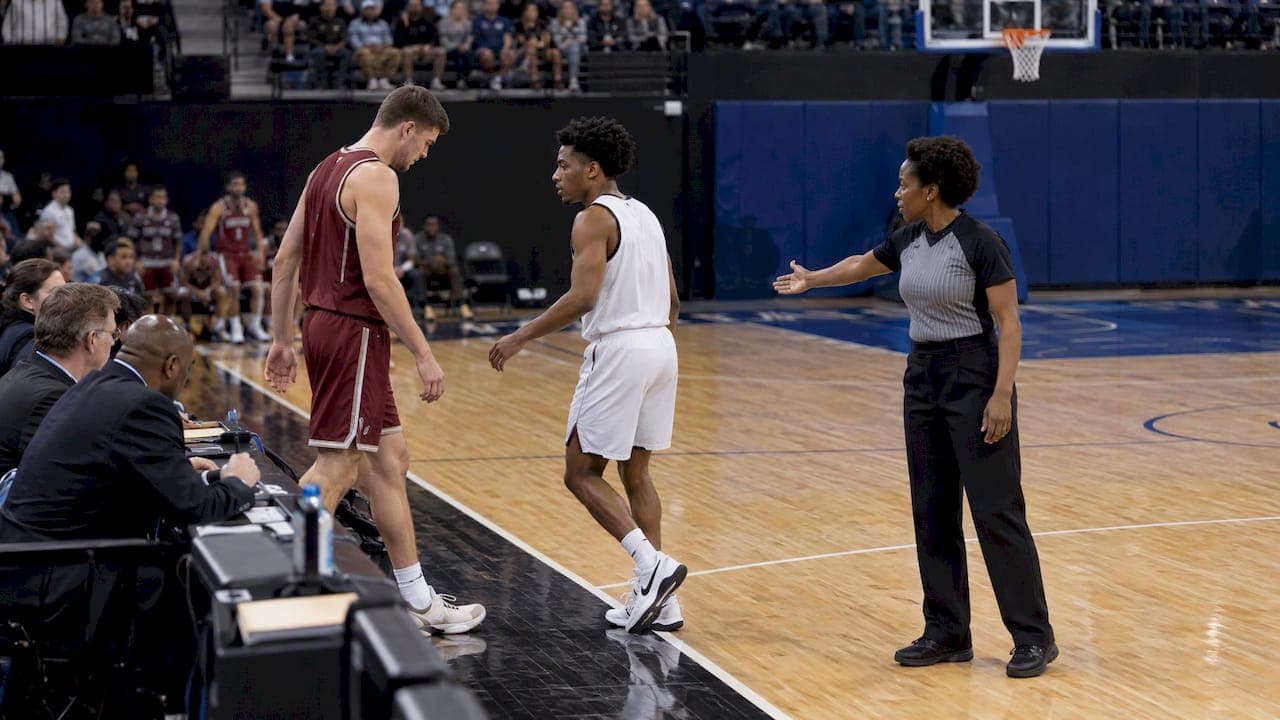

Size matters in college basketball, but it is a weaker predictor of minutes than most recruits and parents assume. Guards are smaller and forwards and centers are bigger, that part is simple. What actually earns playing time is whether your skills fit a role your coach needs filled, and whether the players ahead of you at that spot are leaving. This guide covers typical size ranges by position, what the research says about height and minutes, and how to judge your own fit at a program before you commit or transfer.
TL;DR
- Division I guards run roughly 6’2" for men and 5’8" for women, while forwards run about 6’7" for men and 6’ for women, based on one peer-reviewed study. Individual players fall well outside those averages.
- In one Division I men’s team study, height, standing reach and wingspan did not significantly track minutes. Skill and role appeared to matter more.
- Position labels increasingly describe roles, not body size. Tall forwards with guard skills and 6’2" to 6’5" starters on title teams are now normal.
- Roster crowding at your position, not your height alone, is the number to check before you transfer, stay or sign.
Table of Contents
- Typical size by position in college basketball
- Do height and wingspan decide who plays?
- Why position labels mean less every year
- What really sets minutes at each position
- Perspective: stop asking if you are big enough
- A simple framework to judge your fit
- For transfers: weigh roster pressure before you move
- For high school and junior college recruits
- See your own playing-time range
- FAQ
- Sources
Typical size by position in college basketball
Start with the numbers, because most size charts online are NBA averages. The NBA is not your market. A peer-reviewed study of 127 men and 196 women at the NCAA Division I level put a ruler on college positions:
| Group | Guards (avg. height) | Forwards (avg. height) |
|---|---|---|
| Division I men | 187.4 cm (about 6’2") | 201.7 cm (about 6’7") |
| Division I women | 171.6 cm (about 5’8") | 183.5 cm (about 6’0") |
The same study measured body mass. Men’s guards averaged 85.2 kg against 105.3 kg for forwards. Women’s guards averaged 68.0 kg against 82.2 kg for forwards. Inch conversions here are ours and approximate.
These are group averages from a research sample, with standard deviations of several centimeters for guards. A 6’4" guard and a 6’0" guard can both be ordinary at the same level. An older sample of 437 Division I men averaged 195.3 cm overall (about 6’5") and found guards smallest and centers largest, which is the same pattern thirty years earlier.
Team size varies more than position size
Where you play changes the size picture too. NCAA.com’s analysis of Power Five and Big East men’s rosters found team-average heights from 76.43 inches at Ohio State to 79.07 inches at Duke. Listed heights in that analysis ran from 5’7" to 7’4". So a 6’6" wing might be a rotation-sized forward at one school and a big guard at another.
What this means for you
Use position averages as a rough map, not a gate. If you are 6’3" and play point guard, you are not undersized. If you are 6’6" and every one of your skills is on the perimeter, you may be a guard in one system and a forward in another. Ask each staff how they label you, because that label determines who you compete with for minutes.
Do height and wingspan decide who plays?
Less than you would think. A study of a Division I mid-major men’s team looked at height, standing reach and wingspan against total minutes, games played and minutes per game. It found no significant correlations. The authors suggested basketball-specific skill may have a larger effect on playing time on that team.
Two cautions. It is one team, so do not treat it as a law. And it does not say size is worthless: every player on a college roster already cleared a size and athleticism filter to get recruited. Within that filtered group, an extra inch rarely separates the starter from the backup.
The NBA side shows the filter at work. A 2019 study of 3,610 NBA draft-combine participants found drafted players at all five positions were taller, had longer wingspans and tested better in jumping, agility and sprinting than undrafted players. That is pro draft data, not college playing time, so read it as a statement about reaching the very top of the sport. It tells you little about whether you will play at a given Division I school.

Why position labels mean less every year
Basketball has blurred its own categories. NCAA.com’s history of every men’s championship starter found seven of the ten starters in the 2021 title game stood between 6’2" and 6’5". It also describes modern forwards of 6’10" to 6’11" who bring guard-like skills.
For a recruit, that creates two practical effects:
- Skill can substitute for size. A 6’3" guard who defends, shoots and decides quickly does not need to be 6’6".
- Size does not guarantee a role. A 6’10" player who cannot space the floor or defend in space may find a modern lineup has no spot for him.
That is why a chart of average heights by position, like the NBA versions that dominate search results, answers the wrong question for you. The useful question is who else on that roster does what you do.
What really sets minutes at each position
Size gets you in the door. These factors decide who plays once you are inside.
Role fit
Coaches build rotations around needs: a rim protector, a lead ball handler, a floor spacer, a switchable defender. If you duplicate someone ahead of you, your size will not save you. If you fill a hole, you can play above your class standing.

Roster crowding
Count the players at your spot who return next season, who is coming in through the portal or the recruiting class, and how many are on the roster overall. A school can carry only so many players. Under rules the NCAA adopted for schools in the House settlement framework, sport-specific scholarship limits are removed and schools may offer aid to any or all rostered athletes, but rosters are capped instead. Our guide to scholarship limits in basketball walks through what that means for your offer.
Once a roster is submitted, a player generally must be on the submitted roster to take part in athletically related activities, subject to exceptions. If you are deciding whether you will be one of the players a staff keeps through a roster crunch, roster management analytics from the football side show how programs think about it: they weigh position by position, not player by player.
Schedule and competition level
A tougher schedule changes who a coach trusts and how deep the rotation goes. We cover this in how tough schedules can change college minutes.
Year-to-year volatility
Minutes swing even for players who stay put. Injuries, a new transfer or a coaching change can shift a role in a month. See college basketball minutes swings for what to expect and how to read last year’s numbers.
Perspective: stop asking if you are big enough
We built DepthChartIQ around a different question. Most athletes make transfer and commitment decisions on gut feel and a coach’s pitch. Height shows up in those conversations because it is easy to see. But “you are the right size for our system” tells you nothing about how many players are in front of you.
When you look at a school, we think three things matter more than your height against the position average. First, how crowded is your position next season? Second, what role does the staff actually have in mind, and is it in writing or just in the pitch? Third, what is a realistic minutes range, not a single number a recruiter hands you? A range is honest because every season has injuries, transfers and surprises.
Treat any projection, ours included, as an estimate, not a promise. It is one input next to a candid conversation with the coach and your own sense of the fit.
— Max
A simple framework to judge your fit
Use this before you take an official visit or enter the portal.
- Write your profile honestly. Height, weight, wingspan if measured, and the three skills you win with. Add what a coach has called you: guard, wing, forward, big.
- Compare yourself to the room, not the league. Look at each school’s roster for players at your spot. Note their class, their size and their skills. Your closest match is your real competition.
- Count the exits. Who graduates or is likely to leave? A crowded position with two seniors is a different situation than one with five returners.
- Check the height group, not the exact inch. Public data sets often bucket players: Malter Analytics’ 2025-26 Division I men’s data groups players as under 6’4", 6’4" to 6’7" and over 6’7". Comparing yourself against that kind of group is more meaningful than comparing yourself to a single average.
- Ask specific questions. “Where do you see me in the rotation?” is weak. “Which of your current players do I overlap with, and what would make me play over him?” is strong.
- Get the role in your own notes. After each call, write down what was promised. Our piece on why one promise is not enough explains what to ask beyond the first conversation.
If you are undersized for your position
Name it early. Ask whether the staff has played smaller players there, and what they did to compensate. Often the answer is a system fit: a team that switches everything or plays small values a 6’6" forward differently than a team built on post defense.
If you are oversized for your position
Watch for a team that wants your size but plays a style that does not use your skills. You may be recruited to fill a hole in the roster that is closing as you read.
For transfers: weigh roster pressure before you move
If you are already on a roster, size should barely enter your stay-or-go decision. Compare the crowding at your current school to the crowding at each target. A transfer who lands at a position with several returning players often pays for the move in minutes. The NCAA also states that athletics aid cannot be revoked for roster management or performance reasons unless the student chooses to transfer, so know that before you decide to leave. For eligibility timing, see our explainer on the one-time transfer rule.
For high school and junior college recruits
If you are a recruit, a coach may promise a role that depends on the freshmen and transfers still to come. Before you sign, check how the incoming class changes the picture. We break that down in our guide to checking your impact as an incoming recruit. Know the paperwork too: National Letter of Intent rules and the NCAA eligibility process affect when and how you can commit.
Not offered yet? Size is not the only route. Players who walk on and earn a scholarship usually do it by owning a role the staff values.
See your own playing-time range
DepthChartIQ is built for athletes and their families. You enter your profile, and for each program you are considering you see a projected minutes-per-game range for next season, a Success Probability Score (the chance of gaining minutes) and a Roster Pressure Score (how crowded your position is at that school). It also shows best-fit programs. Projections are estimates with ranges, not guarantees.
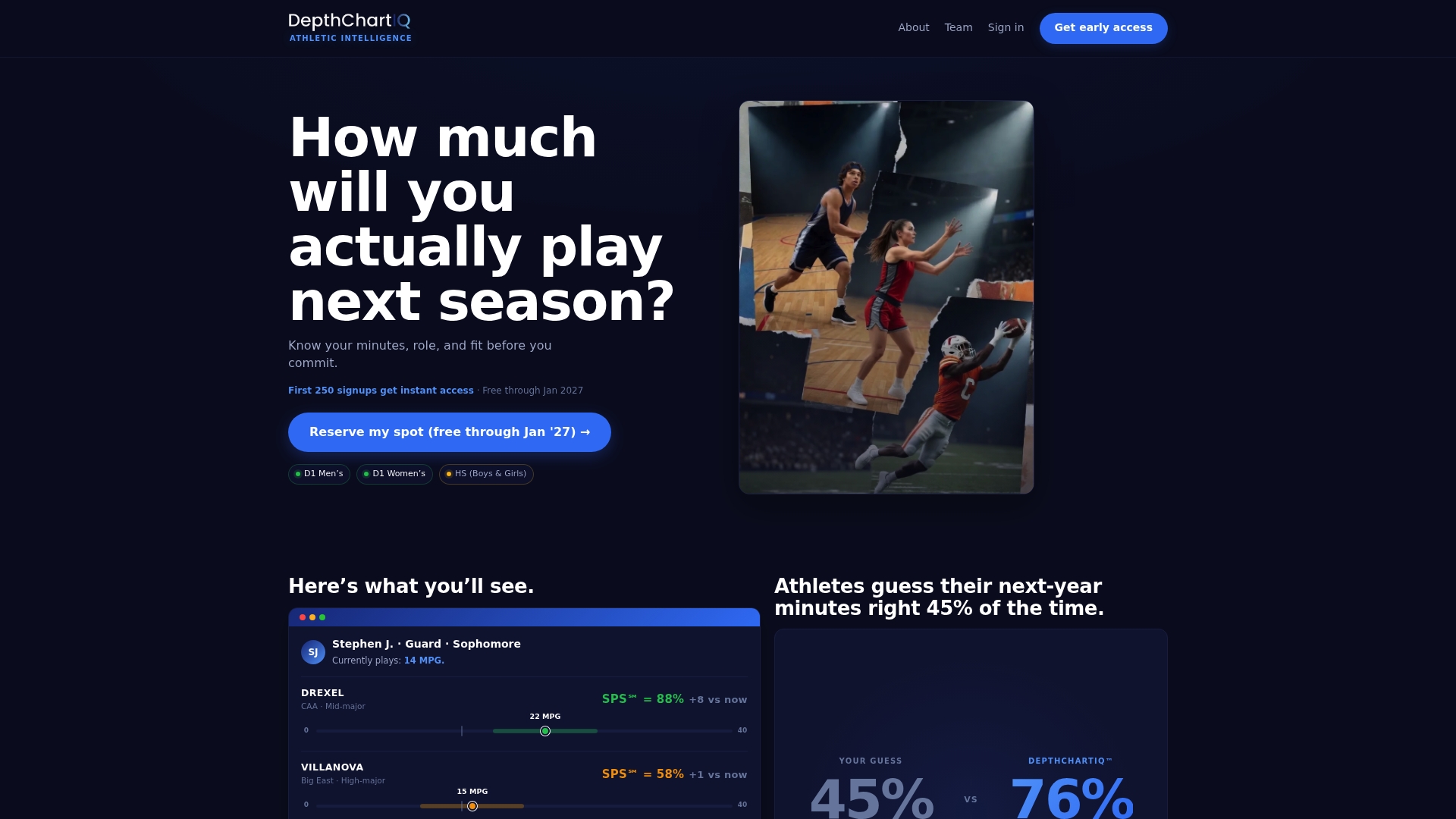
DepthChartIQ is free during Early Access, with DepthChartIQ Pro as the paid plan afterward. You can start with DepthChartIQ and compare the schools on your list side by side. If you want help researching schools and drafting messages to coaches, Spotter is available now.
FAQ
What is the average height of a Division I college basketball guard?
In one peer-reviewed Division I study, men’s guards averaged 187.4 cm (about 6’2") and women’s guards averaged 171.6 cm (about 5’8"). Individual players vary widely around those averages. Team averages differ too, so a guard who is tall at one school can be typical at another.
Does being taller mean more playing time in college?
Not by itself. A study of one Division I mid-major men’s team found no significant link between height, reach or wingspan and minutes per game. Skill, role fit and how many players compete at your position carry more weight.
Can a 6’3" player play forward in college?
Sometimes, but it depends on the system and the roster. Modern lineups use smaller players in many roles, and NCAA.com’s history of title-game starters shows most of the 2021 final’s starters were 6’2" to 6’5". Ask each staff how they would label and use you.
Is size more important for women’s or men’s basketball recruiting?
Size separates positions in both. In the Division I study above, guards were smaller and leaner than forwards for men and women. The gap in height was about 14 cm for men and about 12 cm for women, by our math from the study’s averages. Playing time still comes down to role and roster fit in both.
Sources
- Seasonal and Longitudinal Changes in Body Composition by Position (Sports, 2018)
- Physical and Performance Characteristics of NCAA Division I Male Basketball Players
- NCAA.com: Breaking down the power conferences by height and weight
- NCAA.com: We analyzed the height of every starter ever in the men’s championship
- Relationships between Playing Time and Selected NBA Combine Measures
- Key Anthropometric and Physical Determinants of NBA Draft Combine Participants (Frontiers)
- NCAA: DI Board of Directors formally adopts changes to roster limits
- NCAA Legislative Services Database: roster submission proposal
- Malter Analytics: College Basketball Stats by Height 2025-26