
One Promise Isn't Enough: College Players' Postseason Minutes Outlook
Use a postseason minutes outlook to compare projected minutes, success probability, and roster pressure at each program before deciding whether to...
 DepthChartIQUpdated 9 min read

A postseason minutes outlook gives you a projected minutes-per-game range, a Success Probability Score, and a Roster Pressure Score for a program you’re considering, and the single best use of it is comparing those numbers across every school on your list before you make a transfer, commit, or stay decision. Relying on a coach’s verbal promise alone leaves you guessing. DepthChartIQ builds these outputs specifically for athletes and families weighing that choice.
TL;DR:
- High projected minutes, strong success probability, and low roster pressure point toward a starter role; low probability and high pressure suggest developmental minutes.
- Set a personal minutes threshold and compare every program; prioritize probability for immediate court time, but favor upside if you accept a longer development timeline.
- The transfer window lasts 15 days after the championship, and early roster moves can leave late entrants facing fewer openings.
- Before committing, ask who occupies your position, request comparable players’ minute histories, and get the expected role in writing rather than trusting verbal assurances.
- Division I men’s transfer research found that underperformers often gained minutes after moving, while players already exceeding team averages frequently lost roles at stronger programs.
Table of Contents
- How to Read Minutes Ranges and Roster Pressure Scores
- What Changes Your Projected Minutes During the Portal Era
- Turning the Outlook Into a Transfer, Commit, or Stay Decision
- Questions to Ask Coaches Before You Trust a Minutes Promise
- DepthChartIQ: Comparing Program Outlooks Before You Commit
- FAQ
- Sources
How to Read Minutes Ranges and Roster Pressure Scores
A minutes-per-game range exists because no projection can pin down an exact number months before the season starts. The low end reflects what happens if roster competition goes against you: a strong transfer class arrives, or a coaching change shifts the rotation. The high end reflects a favorable break: an injury ahead of you, a graduation, or a system that rewards your skill set. Treat the range as the realistic band your role will likely fall into, not a promise.
A Success Probability Score estimates how likely you are to earn meaningful minutes at that program, given the current roster and depth chart. A high score paired with a wide minutes range tells you the opportunity is real but the size of the role is still unsettled. A low score paired with a narrow, low range tells you the path to the court is crowded.
A Roster Pressure Score measures how many other players are competing for your position and role. High pressure means several scholarship players or incoming transfers occupy your spot. Low pressure means the depth chart has room.
Putting the three together turns raw numbers into a role label:
- A high minutes range with high probability and low pressure usually points to a starter role.
- A moderate range with moderate probability and moderate pressure usually points to a rotation role.
- A low range with low probability and high pressure usually points to spot minutes or a developmental year.
Pro Tip: Favor programs where your high-case minutes and mid-case probability overlap enough to clear your personal minimum, rather than chasing the single highest ceiling number on the page.
What Changes Your Projected Minutes During the Portal Era
Several forces move a projection up or down between the day you commit and the day the season tips off.
- Roster churn from transfers and recruiting signings opens or closes minutes fast; a program that loses two guards to the portal suddenly has room, while one that lands a top transfer class tightens it, as discussed in the analysis of the transfer portal impact.
- Coaching changes alter system fit overnight; a new staff may value a different skill set than the one that recruited you.
- Program strength itself shifts outcomes. Research on Division I men’s transfers finds that players who were underperforming relative to their team’s average minutes often gain minutes and starts after transferring, while overperformers who move to stronger programs frequently see their roles shrink, a pattern researchers documented across years of transfer data. A separate conference-level analysis of transfer portal movements found similar swings when players moved between tiers of competition, with some conferences absorbing transfers who already carried heavy minutes and experience.
- Timing matters because the transfer window itself has compressed. The NCAA now runs a 15-day transfer window after the national championship, which means early movers shape a roster before late entrants finalize anything.
- Scholarship and roster-limit rule changes can add or remove open spots league-wide in a single offseason.
Transfer rates in Division I men’s basketball have risen significantly since the 2018-19 season, reaching more than double the initial rate by the 2023-24 season, according to the national transfer research. That pace of movement means the roster you’re evaluating today can look different by the time practice starts.
Turning the Outlook Into a Transfer, Commit, or Stay Decision
A workable decision process starts with a number, not a feeling. Set a minimum minutes threshold you need to justify the move, whether that’s 15 minutes a game or a clear path to a starting role within a year. Then line up the Success Probability and Roster Pressure Scores for every program on your list side by side. A program with a slightly lower mid-case minutes number but a much higher probability score often beats a high-ceiling, low-probability option, because the expected outcome weighs both.

Weight probability over upside if your priority is immediate, reliable court time. Weight upside over probability if you have a longer runway and a development timeline you can live with.
Validate the numbers with real conversations. Ask staff directly about your position’s depth chart, request names of past players with a similar profile and what happened to their minutes, and document every answer in writing or by email. Verbal assurances made in a living room rarely hold up once a staff signs three more players at your spot, something reporting on aggressive transfer-class building has shown happens quickly once a program commits to buying proven production.
A program with a 12 to 18 minute range, a high Success Probability Score, and low Roster Pressure is often a safer bet than a 20 to 30 minute range with a low probability score and high pressure at a position already stacked with returning starters.
Compare two programs this way before you rank your list, not after you’ve already made a verbal commitment.
Questions to Ask Coaches Before You Trust a Minutes Promise
Use this checklist in every call with a coaching staff or roster manager.
- Who else is committed, signed, or in the portal at my exact position, and when will the staff finalize the rotation?
- Can you name two or three past players with a similar role or skill set, and what did their minutes look like across their time here?
- What’s the redshirt policy, and how does practice-rep allocation work for incoming transfers versus returning players?
- What’s the typical return-to-play timeline if the player ahead of me is injured, and has that happened before?
- Can you put the expected role in writing, even as a range, rather than a verbal-only assurance?
Phrase follow-ups to ask for specifics, not reassurance. “Who’s ahead of me on the depth chart right now” gets a more useful answer than “will I play.”
DepthChartIQ: Comparing Program Outlooks Before You Commit
We built DepthChartIQ for the exact comparison this article walks through: a projected minutes-per-game range, a Success Probability Score, and a Roster Pressure Score for each program you’re considering, plus a list of best-fit programs based on those outputs.
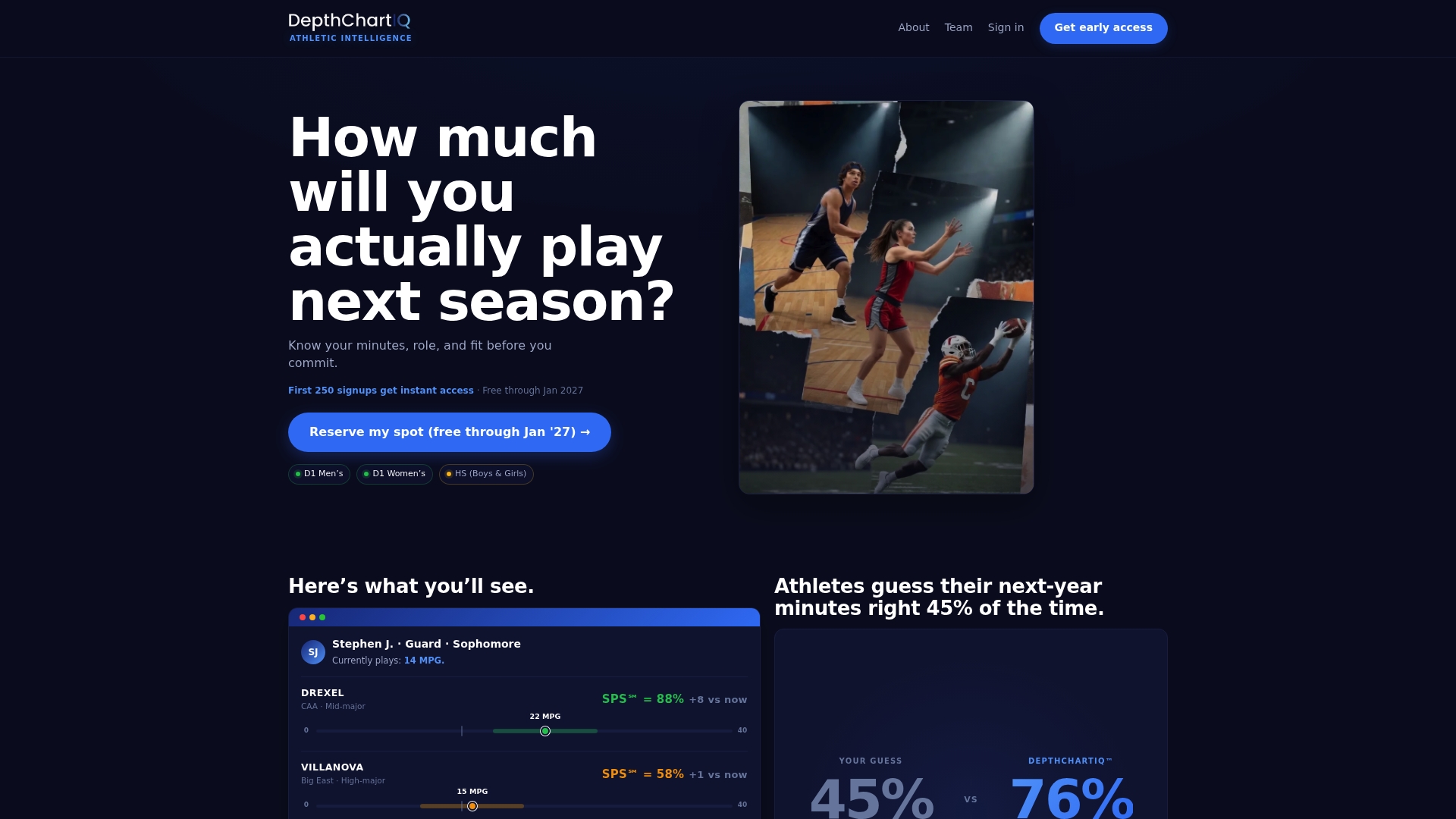
- Enter your profile once and pull outlooks for every school on your list instead of relying on one coach’s pitch.
- Compare Roster Pressure across programs to see where your position is already crowded.
- Use best-fit program suggestions as a starting point for your own research and outreach.
We offer full access free during Early Access through December 31, 2026. After that, DepthChartIQ Pro continues the same comparison tools at current prices listed on the website.
| Plan | Price | Access period |
|---|---|---|
| Early Access | Free | Through December 31, 2026 |
| DepthChartIQ Pro | See the website for current pricing | After Early Access ends |
Start comparing programs now at DepthChartIQ Pro before your transfer window closes.
FAQ
What does a postseason minutes outlook actually measure?
It measures your realistic projected playing time at a specific program through a minutes-per-game range, a Success Probability Score, and a Roster Pressure Score. These outputs come from DepthChartIQ Pro and are built to compare programs side by side, not to guarantee an exact role.
How reliable are minutes projections compared to a coach’s promise?
Projections are estimates with ranges, not guarantees, and they account for roster factors a single conversation often misses. Research on Division I transfers shows roles can shift sharply once a transfer class or new coaching staff arrives, which is why documenting staff answers in writing matters alongside any projection.
Does transferring to a stronger program usually increase or decrease minutes?
It frequently decreases minutes for players who were already above their team’s average production, while players who were underperforming often gain minutes after moving to a better fit, according to national transfer research. Outcomes vary by player and by the specific program, so a minutes outlook should be checked against your personal production level.
How does the transfer window’s timing affect my minutes outlook?
The NCAA’s compressed 15-day transfer window after the national championship means rosters fill quickly, so late movers face a more settled depth chart and higher Roster Pressure. Researching and shortlisting programs before the window opens gives you a clearer, earlier read on realistic minutes.
What should I do if a program’s roster changes after I commit?
Recheck your minutes outlook whenever a program signs a new transfer or recruiting class, since Roster Pressure can shift fast once a staff adds players at your position, a pattern reporting on aggressive transfer-class building has shown repeatedly. Ask the staff directly how the new additions affect your projected role rather than assuming your original conversation still holds.
Sources
- Big Fish or Little Pond? National Evidence on the Relationship Between Transferring and Athletic Performance Within Division I Men’s College Basketball
- An analysis of transfer portal movements and their effects on the athletic performances
- NCAA basketball transfer portal shifts, but tampering concerns remain
- Curt Cignetti bets big on Indiana’s 17-man transfer class in repeat title quest - CBS Sports