
Offensive Scheme Fit in College Basketball: A Guide for Recruits
What offensive scheme fit means in college basketball, how to read a program's system, and how to judge whether it gives you real minutes before you commit or transfer.
 DepthChartIQ13 min read
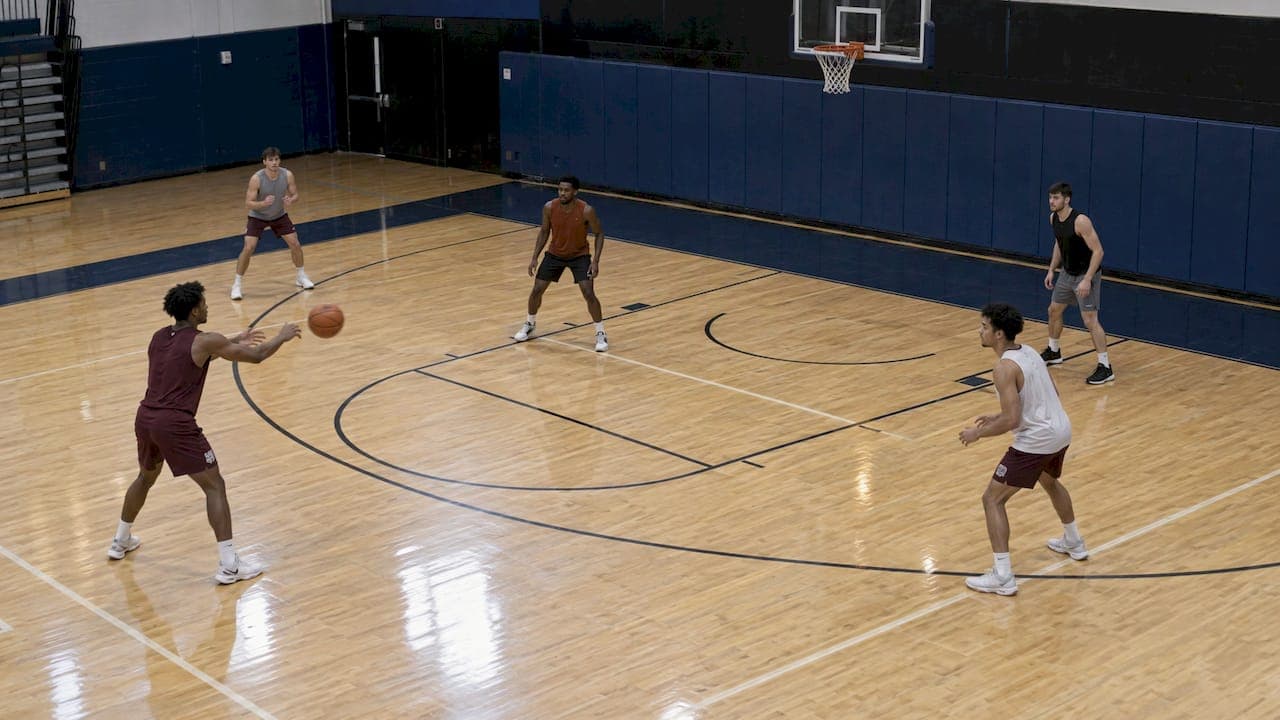

Offensive scheme fit is how well your skills match what a program’s offense asks your position to do, and it often decides whether you play. A great shooter in a system built around post touches can sit. A big who needs the ball inside can disappear in a five-out offense. Judge fit by the role the system gives your position, then test it against how crowded that position is. DepthChartIQ shows athletes a projected minutes-per-game range and a Roster Pressure Score for each program they are considering, so that fit comes with numbers attached.
This guide is for basketball players and their families: high school recruits, junior college players, and college athletes weighing a transfer or a stay-or-go decision.
TL;DR
- Scheme fit means the match between your skills and the job your position has in a program’s offense, not the program’s prestige or its pitch.
- Labels like “motion” or “pace and space” are starting points. What matters is who gets shots, who handles the ball, and where bigs play.
- Fit gets you minutes only if the roster leaves room. Always check who plays your spot and how long they will be there.
- Ask coaches specific questions about your role, then compare the answers with how the team plays on film.
- DepthChartIQ gives you a projected minutes range, a Success Probability Score and a Roster Pressure Score for each school on your list.
Table of Contents
- What offensive scheme fit means in basketball
- Systems, actions and sets: the vocabulary to know
- How fit changes by position
- Fit is not the same as playing time
- How to read a program’s offense before you talk to the coach
- Questions to ask a coach about your role
- Why a range of minutes beats a gut feeling
- Scheme fit for parents: what to watch for
- Stay or go: scheme fit for current college players
- See fit and playing time side by side
- Our perspective
- FAQ
- Sources
What offensive scheme fit means in basketball
In recruiting, “fit” gets used loosely. Coaches say a player “fits what we do.” Families hear it as a compliment. It is really a claim about a specific job: what you will do on the floor, how often, and with what freedom.
A useful way to break it down is into three questions:
- What does the offense ask of my position? Does the point guard run pick-and-roll all night or initiate a motion set and move away? Do the wings catch and shoot, or attack off the dribble? Do bigs screen and roll, pop to the arc, or post up?
- Do my strengths match those demands? A guard who is best in the open court and in pick-and-roll is in a different spot in a slow, half-court, set-play offense.
- Is there a place for me on this roster? Fit on paper does not help if three players ahead of you do the same job and all return.
The third question is the one families skip most. A coach can honestly say you fit and still have no minutes to give you in year one.
The same term shows up in football recruiting, where it is well known. This guide stays with basketball, where the roster is small, five players are on the floor, and one role change can move your minutes a lot.
Systems, actions and sets: the vocabulary to know
A program’s offense has layers. One basketball breakdown separates them into systems, actions and sets: a system is the whole philosophy of spacing, the post player and who gets developed; an action is a reusable piece such as a ball screen or a dribble handoff; a set is a named play called for a specific look.
That matters because most college teams do not run one pure system. They borrow actions from several. The label on a program’s offense tells you less than what its players do possession after possession.
Here are common system families and what they usually ask of a player:
| System family | What it usually asks | Who tends to thrive |
|---|---|---|
| Motion offense | Players read the defense, cut and screen without a script | Smart, unselfish players who pass, cut and shoot |
| Five-out motion | All five start outside the arc, bigs must space and handle | Bigs who shoot and pass, guards who cut and screen |
| Dribble-drive and pace and space | Quick decisions, wide spacing, downhill attacks | Athletic guards and wings who attack and kick out |
| Ball-screen heavy | Pick-and-roll is the main action | Guards who read screens, bigs who roll, pop or dive |
| Post-centered or high-low | Touches go inside first | Skilled, physical bigs who score and pass from the block |
| Set-play, slower pace | Scripted actions, fewer possessions | Disciplined players who execute roles |
The table is a map, not a verdict. Two teams that both call themselves “motion” can give a wing completely different jobs.
How fit changes by position
Guards
Guards feel scheme most in who controls the ball. In a ball-screen offense, the lead guard usually handles it for a large share of possessions and needs to read the screen and make decisions. In a motion offense, the ball moves more and guards may spend long stretches as spacers and cutters.
If you are a pass-first point guard, a system that spreads touches across five players can be great. If you are a scoring guard who creates your own shot, look for a program where you are allowed to initiate and shoot off the dribble.
Wings
Wings are the position most affected by spacing. In five-out and dribble-drive offenses, a wing who shoots, drives closeouts and makes the next pass has a clear role. A wing who needs the ball in isolation to be effective may find fewer chances. Watch how many of a program’s wing shots come off the catch versus off the dribble. That tells you the job.
Bigs
Bigs have the widest swings. In a post-centered offense, a back-to-the-basket scorer is valuable. In a five-out offense, the same player may be asked to screen, pass from the elbow and stay away from the lane. Ask where the five is on the floor on a typical possession, and whether the offense calls for a big who rolls, pops or posts. Size matters too, and our look at positional size and playing time goes deeper on how it connects to minutes.
Fit is not the same as playing time
This is the point most recruiting conversations miss. Fit is about the role. Playing time depends on the role plus the people already in it.
Imagine two programs that both run a ball-screen offense and both want a pick-and-pop big like you:
- Program A returns two upperclassmen at your spot and has signed another big in your class.
- Program B loses its starting big and has no one who shoots from the perimeter behind him.
The scheme fit is identical. The path to minutes is very different. This is what a Roster Pressure Score is for: it shows how crowded your position is at a school. A strong fit at a crowded position is a different bet from a good-enough fit at an open one.
The transfer window adds urgency. The men’s basketball portal window has been shortened in recent years, with the 2026 window cut to two weeks, so you often have days, not weeks, to decide where to go. Do the fit work before the window opens, and check the official NCAA and school pages for the current schedule.
How to read a program’s offense before you talk to the coach
You do not need a coaching degree. You need to watch with a purpose.
- Watch three or four full games, not highlights. Highlights show the best plays. Full games show what the offense is on a normal possession.
- Follow only your position. Track the player who has your role for 20 possessions. Does he or she catch and shoot, attack, screen, post or pass? How many touches per possession?
- Note how the team scores. Count how often points come in transition, from pick-and-roll, off the catch, or from post-ups. The mix tells you what the system is built to do.
- Look at pace. A team that pushes the ball creates more possessions and different roles from a team that works the clock.
- Watch who comes off the bench. If the same five play most of the game, there are fewer minutes to win. If the coach rotates nine or ten, there may be more room.
- Check what changes year to year. If a coach has changed staff, or if the starters at your position are graduating, last year’s film may not describe next year’s offense.
When you have this picture, you will ask better questions and you will know if the coach’s answers match the film.
Questions to ask a coach about your role
A coach’s pitch is meant to be positive. Specific questions get specific answers.
- Where would you see me on the floor on a typical possession?
- Which current or former player had the role you picture for me?
- What do you want me to do more of, and what would you want me to change?
- How many players are you bringing in at my position, and who is expected to return?
- How do you handle minutes when two players at the same spot are close?
- Do you expect to change how you play next season, and why?
- If I play well early, how does that change my role?
Take notes. A strong answer names a player, a role and a plan. A vague answer (“we’ll find a spot for you”) is information too. Our guides on how to choose a college basketball program that fits and on comparing program fit before committing walk through more of the decision.
Why a range of minutes beats a gut feeling
Most players make this call on how a visit felt and what a coach promised. Those are real inputs, but they are hard to compare across five schools. You are left asking which pitch sounded best.
A projected minutes-per-game range gives you something else to weigh. It does not say you will play 24 minutes. It gives a spread of outcomes for next season at each school, so you can see which programs offer a realistic route to the floor and which depend on things going your way. Projections are estimates with ranges, not guarantees, and they work best next to your own film study and honest conversations with coaches.
If you are comparing the way a player’s style matches a program, our piece on the Play Style Fit Score is a good companion read.

Scheme fit for parents: what to watch for
If you are the parent, your job is not to out-scout the staff. It is to keep the family’s eyes on the questions that decide a season.
- Separate the program from the role. A famous program can be the wrong place if your child’s role is unclear.
- Ask what happens if the coach leaves. The system your child is recruited for may leave with the coach.
- Think in seasons, not one year. A fit that grows into a bigger role as seniors leave can be better than a fit that starts well and stalls.
- Keep your child’s confidence in mind. A season of limited minutes can be hard on a player. A realistic read before a decision helps the whole family prepare.
Our basketball family guide to recruiting covers more on running the process as a parent.
Stay or go: scheme fit for current college players
If you are already on a roster, scheme fit is a stay-or-go question. Ask yourself:
- Has my role matched what I was told when I signed?
- Is the offense changing next year, through a new coach, new transfers or a new style?
- Who is coming in at my position, and who is leaving?
- Would a different system use my strengths more?
If the answers point toward a smaller role, look at programs where your skills match the system and the position is less crowded. Run the same checks on each. A transfer that swaps one crowded position for another is a lateral move.
See fit and playing time side by side
DepthChartIQ is built for athletes and families making these calls. You enter your profile, and for each program you are considering, you see a projected minutes-per-game range for next season, a Success Probability Score (the chance of gaining minutes), a Roster Pressure Score (how crowded your position is at that school), and best-fit programs. It covers transfers, athletes deciding whether to stay, and incoming high school and junior college players. It is free during Early Access.

When you are ready to compare schools, start with DepthChartIQ. Spotter, an assistant that helps you research schools and draft messages to coaches, is also available now at Spotter.
Our perspective
Fit is the word recruiting uses when it wants to sound certain. In our experience of the problem, athletes get told they fit and then have no way to check what that means for next season.
We built DepthChartIQ because the decision is a playing-time decision. A player can love a system, admire a coach and still have no path to the floor. The number that matters is minutes, and it should be weighed next to how crowded your position is.
That is why each program on your list gets a projected minutes range, a Success Probability Score and a Roster Pressure Score. They give you a range to weigh against what you hear on a visit, instead of leaving you with gut feel and a pitch. They are estimates, not promises, and they are made for athletes and families, not coaching staffs.
Use scheme fit to ask better questions, and use the numbers to compare schools on equal terms. Then decide with your eyes open.
Max
FAQ
What does scheme fit mean in college basketball recruiting?
It means how well your skills match the job your position has in a program’s offense. That includes who handles the ball, where shots come from, and how bigs are used. It is a different question from whether the roster has room for you.
Is a program’s offense label enough to judge fit?
No. Labels like motion or pace and space describe a general idea, and most teams mix actions from several systems. Watch full games and follow your position to see what the role looks like on a normal possession.
Can a good fit still mean little playing time?
Yes. If several players at your position return or are signed, a good fit can still lead to limited minutes. Check roster pressure at your spot alongside the scheme before you commit or transfer.
When should I check scheme fit if I want to transfer?
Before the portal opens. The window has been short in recent years, so build your list, watch film and ask coaches your questions early. Check the NCAA and your school’s compliance office for current dates and rules.
Sources
- Basketball Offense: Systems, Actions and Sets Explained
- 2026 College Basketball Transfer Portal Primer: Key dates, new rules, what to expect