
Best Motionsports.io Alternatives in 2026: Full Guide
Discover the top motionsports.io alternatives for 2026. Explore sports-specific and project management tools to enhance your athletic program.

DepthChartIQ
Athletic Intelligence

Best Motionsports.io Alternatives in 2026: Full Guide

What are the top motionsports.io alternatives right now?
Motionsports.io (officially Motion Sports Inc.) launched in 2024 as an all-in-one operating system for US college athletic departments, covering roster management, NCAA compliance workflows, NIL payment reporting, academic travel letters, and team communication. It was built by former IU athletes and coaches who knew firsthand how fragmented athletic department tech had become. But it’s early-stage, and many programs need proven alternatives right now.
The strongest motionsports.io alternatives split into two clear categories: general project and client management platforms (ClickUp, Monday.com, Rocketlane, Bitrix24, and similar tools) and sports-specific facility and compliance platforms (Jackrabbit Gymnastics, iClassPro, WellnessLiving, Zen Planner, and others). Which category fits you depends almost entirely on whether your priority is NCAA compliance and roster workflows or day-to-day facility and member management.
| Tool | Best For | Key Features | Pricing |
|---|---|---|---|
| Rocketlane | Client onboarding, service teams | Structured project delivery, client portals | Paid plans; free trial available |
| Assembly | Customer project visibility | Task management, team communication | Freemium |
| Dock | Compliance-focused teams | Custom workflow automation, compliance tracking | Paid plans |
| Agency Handy | Marketing and service agencies | Client communication, task management | Paid plans; free trial |
| GUIDEcx | Client onboarding projects | Milestone tracking, client engagement | Paid plans |
| Bitrix24 | All-in-one CRM and project management | CRM, communication, project tools | Freemium; paid tiers |
| Reclaim.ai | Time management optimization | AI calendar and task automation | Freemium |
| ClickUp | Flexible project and task management | Custom workflows, extensive integrations | Freemium; paid tiers |
| Sunsama | Daily personal productivity | Daily planning, task prioritization | Paid; free trial |
| Morgen | Centralized calendar management | Multi-platform calendar integration | Freemium |
| FlowSavvy | Workflow automation | App connections, process automation | Paid plans |
| Clockwise | Focused work time optimization | AI meeting scheduling, work blocks | Freemium |
| Todoist | Simple task management | Cross-platform to-do tracking | Freemium |
| Notion Calendar | Flexible data and calendar organization | Calendar, database, workspace tools | Freemium |
| Jackrabbit Gymnastics | Gymnastics academies | Member management, class scheduling | Paid plans |
| iClassPro | Dance and gymnastics studios | Billing, scheduling, performance tracking | Paid plans |
| WellnessLiving | Fitness and wellness studios | Client scheduling, marketing tools | Paid plans |
| ABC Glofox | Boutique gyms and fitness chains | Member app, booking management | Paid plans |
| Zen Planner | Large athletic academies | Financial analytics, retention reporting | Paid plans |
| Spark Member | Boutique fitness studios | Onboarding, member management | Paid plans |
| OnRamp | Automated client onboarding | Workflow automation, project tracking | Paid plans |
| Moxo | Secure client collaboration | Communication, task management | Paid plans |
| SuiteDash | Small to mid-size business management | CRM, client portal, billing | Paid plans |
| Clinked | Client collaboration and transparency | Document sharing, project tools | Paid plans |
| Softr | Custom client portals, no-code | No-code web app builder | Freemium |
| HoneyBook | Freelancers and small agencies | Invoicing, contract management | Paid plans; free trial |
| Dubsado | Small business workflow automation | Client workflows, custom forms | Paid plans; free trial |
| Monday.com | Adaptable project tracking | Visual workflows, wide integrations | Freemium; paid tiers |

Detailed profiles of the best motionsports.io alternatives
The 28 platforms above cover a wide range of use cases. Here’s what each one actually does well, and where it falls short.

Rocketlane is built for service teams that need to deliver client projects in a structured, repeatable way. Its onboarding workflows are purpose-built, with shared project spaces where clients and internal teams work side by side. The tradeoff is that it’s not designed for athletic compliance or NIL tracking.
Assembly centers on giving customers visibility into project progress. It combines task management with communication in one workspace, which works well for project-driven service businesses. Thin on sports-specific features.
Dock stands out for teams that need to enforce process compliance, not just track tasks. Its custom workflow automation can be configured for approval chains and documentation requirements. Worth a look for athletic departments that need structured sign-off workflows without the full Motion feature set.
Agency Handy targets marketing and service agencies with integrated client communication and task management. It’s a practical choice for sports marketing agencies or athletic media teams managing multiple client accounts. G2 and Trustpilot both carry verified user reviews for it.
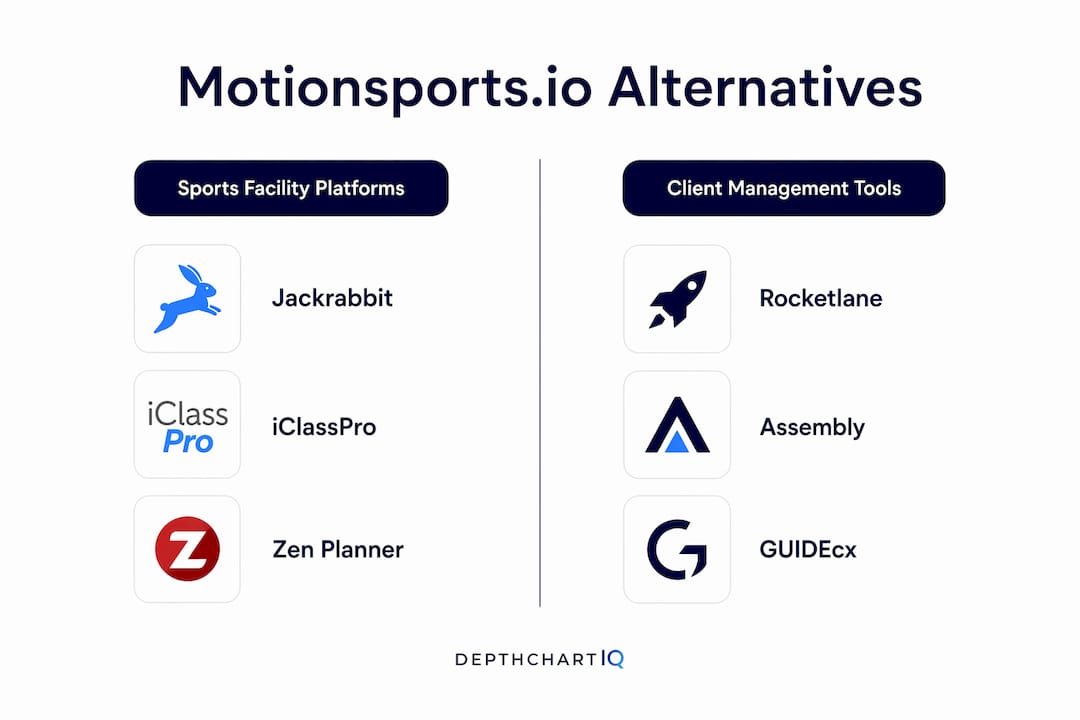
GUIDEcx focuses specifically on client onboarding projects, with milestone tracking and client engagement tools that keep external stakeholders in the loop. GUIDEcx reviews on G2 highlight its visibility features as a primary differentiator.
Bitrix24 is the most feature-dense option on this list. CRM, project management, internal communication, and HR tools all live under one roof. The free tier is genuinely functional, though the interface has a learning curve. Bitrix24 on G2 reflects that tradeoff clearly.
Reclaim.ai is a calendar and task automation tool, not a project management platform. It uses AI to protect focus time and schedule tasks around meetings. Useful for athletic administrators drowning in scheduling conflicts, but it won’t touch compliance or roster data.
ClickUp is the most flexible general-purpose option here. Its custom workflows, views, and integration library make it adaptable to almost any team structure. The downside is that flexibility requires configuration time. ClickUp suits athletic departments willing to build their own workflows from scratch.
Sunsama is a daily planner, not a team platform. It pulls tasks from other tools and helps individuals prioritize their day. Coaches and administrators who need personal task focus alongside a heavier team platform might find it useful as a companion app.
Morgen unifies multiple calendars and task lists into one view. It’s a good fit for athletic staff juggling Google Calendar, Outlook, and other scheduling tools simultaneously.
FlowSavvy automates repetitive workflows by connecting apps and services. It’s a process automation tool rather than a project management platform, best suited for teams that have already mapped their workflows and want to reduce manual steps.
Clockwise optimizes meeting schedules using AI to carve out blocks of focused work time. Like Reclaim.ai, it’s a scheduling layer rather than a full management platform.
Todoist is the simplest task manager on this list. Cross-platform, clean, and reliable. It’s the right pick for individuals who need a personal task system without team collaboration features.
Notion Calendar extends Notion’s database and workspace tools into calendar management. Teams already using Notion for documentation and project tracking will find the calendar integration natural. It’s not built for athletic compliance.
Sports facility and gym management platforms
These tools address a different problem entirely: running a physical sports facility, managing members, and handling class scheduling and billing.
Jackrabbit Gymnastics is purpose-built for gymnastics academies. It handles class enrollment, member management, billing, and parent communication in one place. It’s the category leader for gymnastics-specific programs.
iClassPro covers gymnastics and dance studios with comprehensive scheduling, billing, and performance tracking. Studios that run multiple class types across different age groups tend to find its reporting tools particularly useful.
WellnessLiving targets fitness and wellness studios with client scheduling, automated marketing, and member engagement features. It’s a strong option for yoga studios, personal training facilities, and multi-discipline wellness centers.
ABC Glofox focuses on boutique gyms and fitness chains, with a member-facing app and booking management that reduces front-desk workload. It suits operators who want members to self-serve on scheduling and payments.
Zen Planner is built for large-scale athletic and wellness academies. Its financial analytics and retention reporting go deeper than most gym management tools, making it the right fit when data-driven decisions matter. Zen Planner and Spark Member are both popular for specialized athletic studios, with Zen Planner suited for large academies and Spark Member chosen by boutique studios for its cleaner interface.
Spark Member prioritizes user experience for boutique fitness studios. Its onboarding process is straightforward, and member management stays simple enough that small teams can run it without dedicated admin staff.
Client portal and business management platforms
OnRamp automates client onboarding and recurring operational tasks. It’s a good fit for teams that run the same project type repeatedly and want to reduce manual setup each time.
Moxo provides secure client communication alongside project and task tools. Service providers handling sensitive client data, including sports agents or compliance officers, may find its security focus relevant.
SuiteDash combines CRM, project management, and a customizable client portal in one platform. It targets small to mid-size businesses that want to consolidate tools without enterprise pricing.
Clinked centers on secure document sharing and client collaboration. Firms that need clients to review, sign, and comment on documents will find it more focused than a general project tool.
Softr lets teams build custom client portals and web apps without writing code. It’s the right choice when off-the-shelf portals don’t match your workflow and you need something custom-built quickly.
HoneyBook is built for freelancers and small agencies managing projects, invoices, and contracts. Its contract management and payment features are its strongest suit.
Dubsado focuses on workflow automation and client onboarding for small businesses. Its customizable forms and automated sequences reduce the manual back-and-forth that slows down client intake.
Monday.com is a visual work operating system with wide integration support and adaptable project tracking. Monday.com reviews on G2 consistently highlight its flexibility and visual clarity as top strengths.
Why users look for alternatives to motionsports.io
Motion Sports Inc. is a genuinely promising platform, but it’s still early. Founded in September 2024 by former IU athletes and coaches, the company had secured deals with three college athletic departments by early 2025. That’s a small footprint, and large institutions often can’t wait for a platform to mature.
Several specific factors push users toward alternatives:
- Legacy contracts. Large athletic departments at Power 4 schools often have multi-year agreements with existing vendors. Switching takes time, and landing deals at large conference schools can take a couple of years due to those existing contracts.
- Platform maturity. Motion’s founders acknowledged that full development was still in progress as of early 2025. Programs that need a fully built compliance workflow today can’t wait.
- Feature gaps for niche sports. Gymnastics academies, martial arts studios, and boutique fitness facilities need member billing, rank tracking, and class scheduling. Motion is built for college athletic departments, not facility operators.
- Pricing uncertainty. Smaller programs and independent facilities may not know whether Motion’s pricing fits their budget, especially without a public pricing page.
- Search confusion. Searching “MotionSports” without the “.io” frequently surfaces the 2010 Xbox 360 game published by Ubisoft, reviewed on Common Sense Media as a Kinect sports collection. That’s a completely unrelated product, and it clutters research for anyone evaluating B2B software.
- Patchwork tool fatigue. Large departments often manage multiple software vendors simultaneously, creating bloated costs and fragmented data. Some teams switch to alternatives that solve one specific problem better than a generalist platform.
How to choose the right alternative to motionsports.io
The right platform depends on what you’re actually trying to fix. A gymnastics academy and a Division I football program have almost nothing in common operationally, so the evaluation criteria differ significantly.
Start with your primary use case:
- NCAA compliance, NIL tracking, and roster management: look at Motion, ClickUp with custom workflows, or Monday.com configured for athletic operations.
- Class scheduling, member billing, and facility management: Jackrabbit Gymnastics, iClassPro, WellnessLiving, or ABC Glofox.
- Client project delivery and communication: Rocketlane, Agency Handy, GUIDEcx, or Moxo.
- Personal and team productivity: ClickUp, Todoist, Sunsama, or Reclaim.ai.
Key criteria to evaluate:
- Ease of use. Coaches and athletes aren’t software administrators. A platform that requires IT support to configure basic workflows will face adoption resistance.
- Pricing transparency. If a vendor won’t publish pricing, ask for a written quote before a demo. Vague pricing is a red flag for budget-constrained programs.
- Compliance feature depth. For college athletics, ask specifically whether the platform handles NCAA eligibility workflows, conference-specific reporting, and NIL payment documentation. General project tools rarely do.
- Integration capabilities. Check whether the platform connects to your existing tools, including your student information system, payment processor, and communication apps.
- Customer support quality. Read recent reviews on G2 or Trustpilot, not just the vendor’s own testimonials. Look for patterns in support response times and issue resolution.
- Data migration support. Switching platforms means moving years of roster, compliance, and financial data. Ask vendors directly what migration assistance they provide.
Questions to ask vendors before signing:
- Can you demo the compliance workflow specifically, not just the general project view?
- What does data migration look like, and who handles it?
- How does the platform scale if our department adds sports or staff?
- What’s the contract length, and are there exit clauses?
Pro Tip: Request a compliance workflow demo as a standalone session, separate from the general product demo. Vendors who can’t show you a live compliance workflow in your sport’s context are likely selling a general tool with compliance features bolted on as an afterthought. That distinction matters most for NCAA compliance needs.
Red flags to watch for:
- A vendor that leads with feature count rather than use-case fit.
- No public case studies from programs similar to yours in size and sport.
- A demo that can’t show NIL payment tracking or eligibility monitoring in a live environment.
- A platform that surfaces gaming software results when you search its name (a sign of poor brand clarity).
Special considerations for US athletic departments and sports facilities
College athletics management in 2026 operates under a different set of pressures than general business software. NCAA compliance, NIL payment tracking, revenue sharing, and academic eligibility monitoring are not features you can approximate with a generic project tool. They require purpose-built workflows with audit trails.
Large athletic departments routinely manage multiple software vendors, creating what the industry calls “shadow IT”: unofficial tools that teams adopt because the official stack doesn’t meet their needs. Centralizing onto one platform reduces that risk, but it requires upfront configuration work and data migration that can take months.
Key considerations by institution type:
- Power 4 programs: Need full NCAA compliance workflows, conference reporting, NIL and revenue sharing documentation, and academic monitoring. General tools like ClickUp or Monday.com can be configured for some of this, but they require significant setup and ongoing maintenance. Purpose-built platforms like Motion are designed for this environment.
- Mid-major and Division II programs: Often have smaller budgets and fewer staff. A platform with a lower price point and simpler onboarding, like HoneyBook or SuiteDash, may cover administrative needs without the compliance depth of a full athletic management system.
- Gymnastics and dance academies: Need member management, class scheduling, billing, and parent communication. Jackrabbit Gymnastics and iClassPro are the category leaders here. Gym management platforms prioritize member experience, automated billing, and rank tracking, which are useful for niche sports but often inadequate for NCAA compliance-heavy environments.
- Boutique fitness studios: ABC Glofox, Spark Member, and WellnessLiving all target this segment. The choice between them usually comes down to whether you prioritize member self-service (Glofox), interface simplicity (Spark Member), or marketing automation (WellnessLiving).
- Martial arts and specialty studios: Scheduling, rank tracking, and automatic billing are the core needs. Specialized management software for these disciplines prioritizes user experience over compliance depth, which is the right tradeoff for a studio that has no NCAA obligations.
One practical note: when researching alternatives, always include “.io” or “Sports Inc.” in your search terms. The 2010 Ubisoft Xbox game “MotionSports” still dominates some search results and has nothing to do with athletic department software. Filtering for B2B software specifically, or using terms like “college athletics management platform,” keeps results relevant.
DepthchartIQ’s 76% prediction accuracy for player outcomes represents a different kind of tool entirely, one focused on athlete career analytics rather than administrative management. For athletic departments evaluating the full software picture, it’s worth understanding where analytics tools fit alongside operational platforms.
DepthchartIQ offers a different lens on athlete career decisions
The platforms compared above handle operations: scheduling, billing, compliance, and project management. DepthchartIQ addresses a different question entirely. Where will an athlete actually play, and how much?
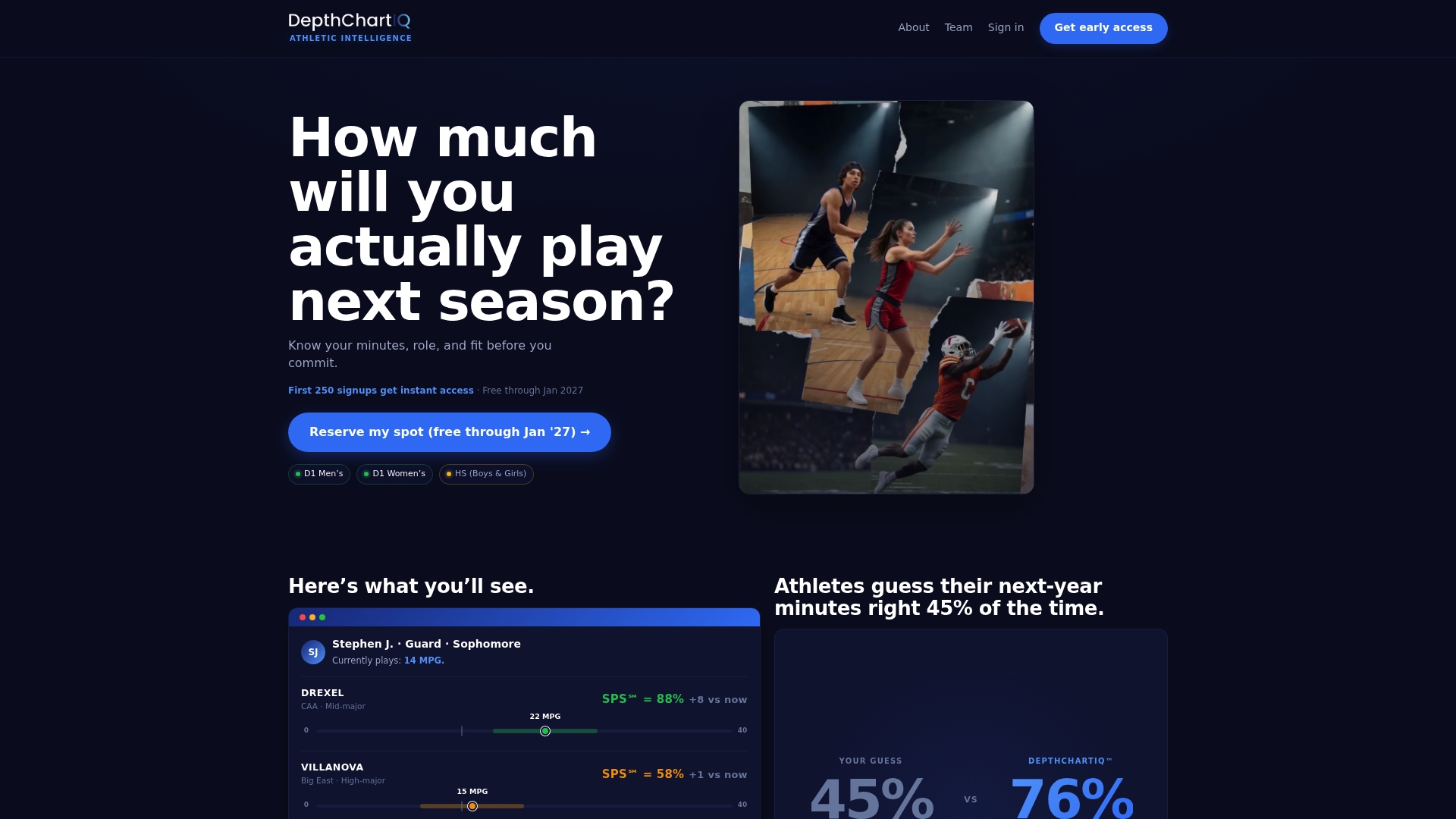
For college athletes weighing a transfer or high school recruits evaluating program fit, administrative software doesn’t answer that. DepthchartIQ does, using advanced metrics, Success Probability Scores, and Roster Pressure insights to predict playing time based on real roster dynamics. Its 76% accuracy rate in predicting player outcomes is the core differentiator. That’s not a feature you’ll find in ClickUp or Monday.com.
Athletic departments and recruiting staff who already use an operational platform can add DepthchartIQ as an analytics layer. It provides real-time data updates as rosters change, which means predictions stay current through transfer windows and signing periods. For programs that want to support athlete decision-making alongside their administrative workflows, it’s a credible addition to the NIL income tracking and compliance tools already in use.
Key Takeaways
The strongest motionsports.io alternatives split by use case: sports-specific platforms for facility management and general project tools for administrative workflows, and the right choice depends on your institution’s size, compliance needs, and budget.
| Point | Details |
|---|---|
| Two distinct categories | Sports facility platforms (Jackrabbit, iClassPro, Zen Planner) and project management tools (ClickUp, Monday.com, Rocketlane) serve fundamentally different needs. |
| Compliance depth matters most | For NCAA programs, ask vendors to demo compliance workflows specifically; general tools rarely handle eligibility and NIL reporting natively. |
| Legacy contracts slow switching | Large Power 4 programs may take years to transition due to existing vendor agreements, making phased adoption a realistic strategy. |
| Search confusion is real | Searching “MotionSports” without “.io” surfaces the 2010 Ubisoft Xbox game; use precise terms like “college athletics management platform” to filter results. |
| DepthchartIQ adds analytics | DepthchartIQ’s 76% prediction accuracy for player outcomes makes it a useful analytics layer alongside any operational platform for athlete career decisions. |
FAQ
What is motionsports.io, and why do users seek alternatives?
Motionsports.io is a college athletic department management platform covering roster management, NCAA compliance, NIL payments, and team communication, launched in 2024. Users seek alternatives because the platform is still early-stage, and many programs need proven tools with full compliance workflows available today.
Which motionsports.io alternative is best for NCAA compliance?
Purpose-built athletic platforms handle NCAA compliance most reliably; for general project tools, ClickUp and Monday.com can be configured for compliance workflows but require significant setup. Always request a live compliance workflow demo before committing to any platform.
What’s the best alternative for a gymnastics or fitness studio?
Jackrabbit Gymnastics and iClassPro lead for gymnastics academies, while WellnessLiving and ABC Glofox are stronger fits for general fitness and wellness studios. Zen Planner suits large-scale academies that need financial analytics and retention reporting.
How is DepthchartIQ different from these alternatives?
DepthchartIQ is an athlete career analytics platform, not an administrative management tool. It predicts playing time and program fit using Success Probability Scores and Roster Pressure insights, with a reported 76% accuracy rate, making it a complement to operational platforms rather than a replacement.
What red flags should I watch for when choosing a platform?
Watch for vendors who can’t demo compliance workflows live, lack case studies from programs similar to yours, or use vague pricing without written quotes. Platforms that surface gaming software results when searched by name are also a sign of poor brand clarity worth noting.