
Will I Lose Minutes If I Transfer? What 5,500 Real Moves Reveal
Most transferring players assume their minutes will look like last season. Across 5,541 real D1 moves, that assumption is directionally wrong 55% of the time. Here's what the data actually shows.

DepthChartIQ
Athletic Intelligence
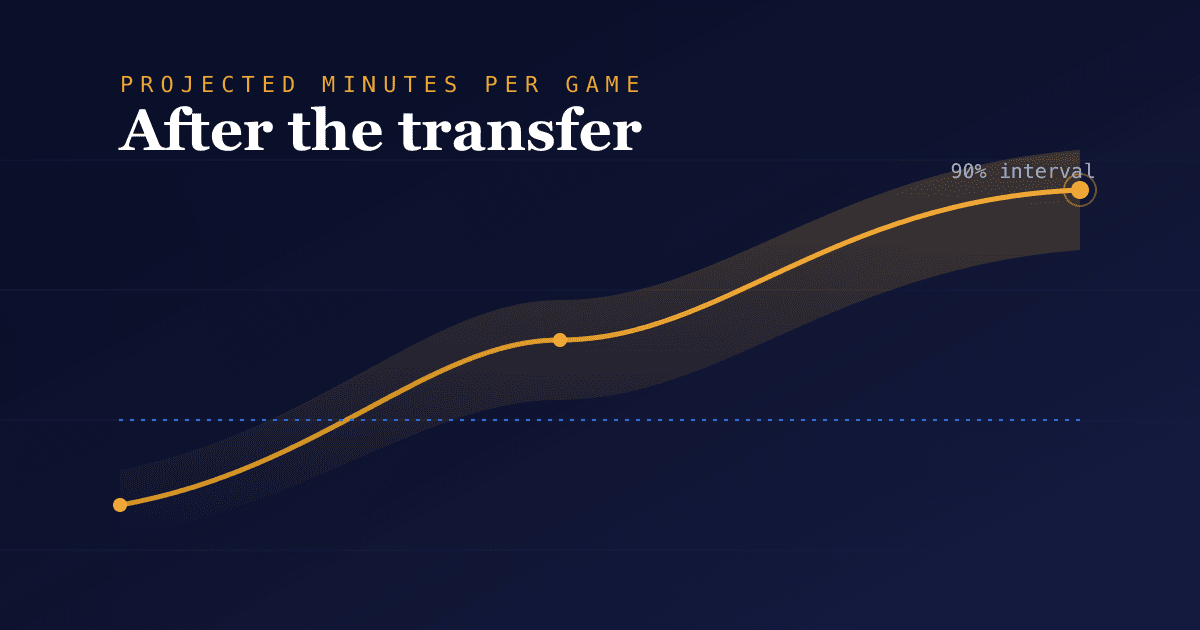
Every spring, thousands of college basketball players enter the transfer portal believing the same thing: that their minutes will look roughly like last season. The data says otherwise — and it says so loudly.
We studied 5,541 Division I transfer events with realized outcomes from 2021 through 2026. The pattern is stark, and it runs in the opposite direction of player intuition.
The naïve assumption is wrong more than half the time
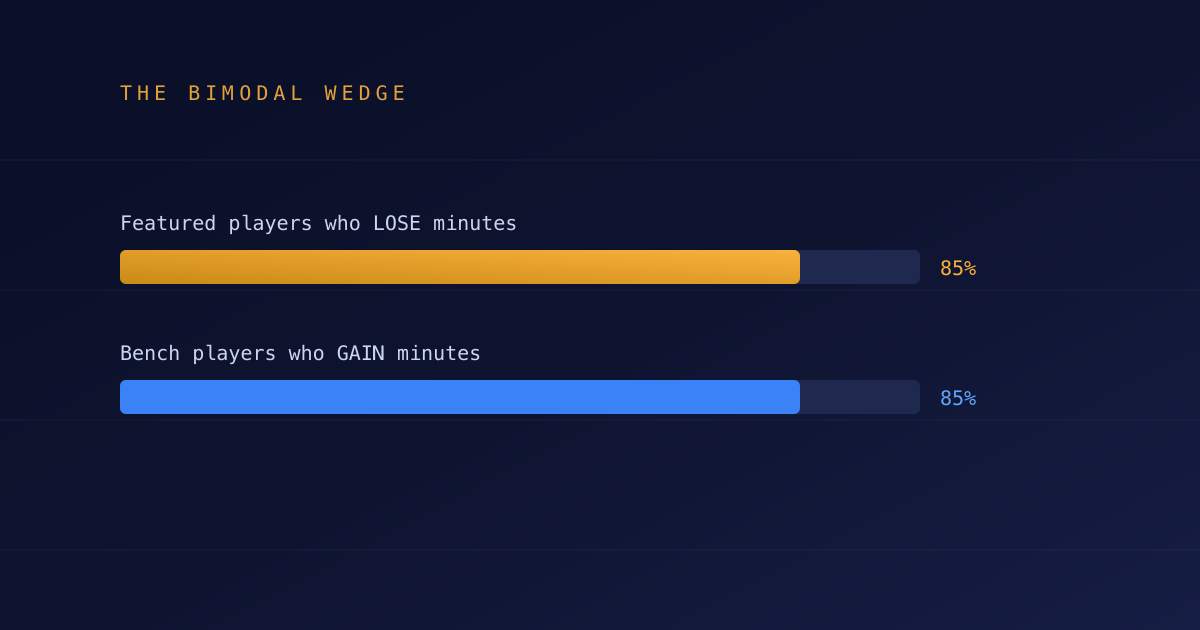
If you assume your minutes per game will resemble your prior season, you'll be directionally wrong about 55% of the time. That's worse than a coin flip. The reason is that the transfer population is bimodal:
- Featured players (heavy minutes at their old school) lose minutes after a transfer in roughly 85% of cases.
- Bench players (limited minutes) gain minutes in roughly 85% of cases.
Why the direction flips
A program that recruits a transfer is, by definition, adding talent at a position. The incoming player competes with returners and other additions for a fixed pool of minutes. Strength-of-schedule, pace, and the destination coach's rotation tendencies all reshape the role.
The question isn't "how many minutes did you play?" It's "how will this specific situation change them?"
What actually predicts the change
The strongest signals aren't the obvious ones. Position vacancy at the destination, the strength gap between programs, and — newly — intra-season role momentum (how your minutes trended over your final ten games) carry real predictive weight.
| Approach | Directional accuracy |
|---|---|
| Naïve "same as last year" | 45.4% |
| DepthChartIQ model | 76.5% |
That's a 31-point swing in getting the direction right — the difference between a guess and a grounded decision. For the full methodology, see how the model works.
The takeaway for athletes
Don't anchor on last year. Anchor on the situation you're walking into. A bench player betting on a breakout and a featured player assuming continuity are often both miscalibrated — in opposite directions.