
What Does an Athletic Scholarship Offer Mean for You?
Discover what does athletic scholarship offer mean for your financial future. Learn about coverage and benefits to maximize your potential!

DepthChartIQ
Athletic Intelligence

What Does an Athletic Scholarship Offer Mean for You?

An athletic scholarship offer is financial aid awarded by a college to a student-athlete based on athletic ability, designed to reduce education costs including tuition, fees, housing, and books. Understanding what does athletic scholarship offer mean is the first step every family must take before committing to a program, because the word “scholarship” does not automatically mean a full ride. Offers range from partial tuition-only awards to full grant-in-aid packages covering every major college expense. The amount, coverage, and renewal terms depend entirely on the sport, the NCAA or NAIA division, and the program’s budget.
What does an athletic scholarship offer actually cover?
The meaning of athletic scholarship coverage is more specific than most families expect. A standard full grant-in-aid covers four categories: tuition and required fees, room and board, course-related books, and a personal expense stipend. That stipend, called the Cost of Attendance allowance, was added after a 2015 NCAA Board action and typically ranges from $3,000 to $6,000 annually. It exists to cover transportation, personal supplies, and other living costs that tuition alone does not address.
Partial scholarships are far more common than full awards. A partial scholarship covering tuition and fees may leave room and board entirely out of pocket, which can add $12,000 to $18,000 per year at many universities. Families often fill that gap with academic aid, need-based grants, or personal funds. This is why treating an athletic scholarship as one piece of a broader financial aid package is the correct approach from day one.
Here is what athletic scholarships typically include and exclude:
- Covered: Tuition, mandatory fees, on-campus room and board, required textbooks, and COA stipend (where applicable)
- Often not covered: Summer school tuition, graduate coursework, off-campus housing above the school’s standard rate, travel to and from home, and elective equipment
Pro Tip: Ask the financial aid office for the school’s official Cost of Attendance figure before comparing offers. Two schools offering “50% scholarships” can differ by thousands of dollars in actual dollar value.
How do athletic scholarship offers vary by division and sport?
The division a program competes in determines the scholarship model more than any other single factor. The table below shows how college sports scholarships differ across the major governing bodies.

| Division / Association | Scholarship model | Athletic aid allowed |
|---|---|---|
| NCAA Division I | Headcount or equivalency | Full or partial; varies by sport |
| NCAA Division II | Equivalency only | Partial; combined with academic aid |
| NCAA Division III | No athletic scholarships | Merit and need-based aid only |
| NAIA | Equivalency | Partial to full; program-dependent |
| NJCAA | Varies by division | None to full grant-in-aid |
Division I uses a roster limit model allowing full scholarships in headcount sports like football and women’s basketball, where every scholarship athlete receives a full grant-in-aid. Equivalency sports, such as baseball and swimming, divide a fixed aid pool across the roster. A Division I baseball program with 11.7 scholarship equivalencies might spread that aid across 27 athletes, meaning most players receive a fraction of full coverage.
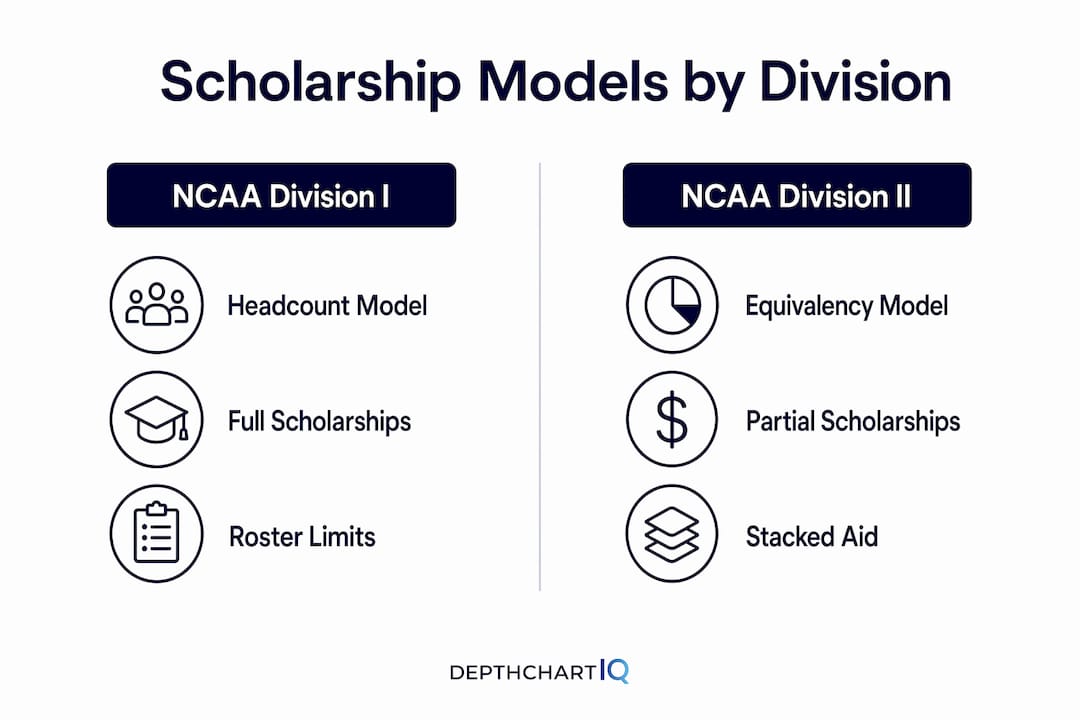
Division II programs use equivalency scholarships exclusively, and coaches routinely stack athletic aid with academic and need-based awards to build competitive packages. Division III cannot offer athletic scholarships, but coaches at those schools can advocate for merit scholarships and influence admissions decisions. NAIA and NJCAA programs follow their own rulebooks, and the variation within those associations is significant enough that you must research each school individually.
Post-2025 NCAA roster limit changes increased flexibility for programs to award more full scholarships in some sports, but budget constraints still determine whether a program actually uses that flexibility. A school with the rules to offer full scholarships may not have the budget to do so.
What does it mean when a coach offers an athletic scholarship?
When a coach extends an athletic scholarship offer, the offer is a financial aid proposal tied directly to that program’s roster needs and budget at that moment. Coach discretion plays a major role, and offers can be renewed or revoked on an annual basis. The offer is not a four-year contract. It is a one-year commitment that the program intends to renew, provided the athlete meets performance, academic, and conduct standards.
Here is what you need to clarify before accepting any offer:
- Dollar amount: Ask for the exact dollar value of the scholarship, not just a percentage. A “25% scholarship” means different things at a $30,000-per-year school versus a $60,000-per-year school.
- Line-item breakdown: Request the offer in line-item form showing tuition, fees, room, board, books, and any stipend separately.
- Renewal conditions: Ask what academic GPA, athletic performance standards, and team roster decisions affect renewal each year.
- Stacking rules: Confirm whether you can combine the athletic award with academic scholarships, need-based aid, or outside grants.
- Verbal vs. written: Get every detail in writing before signing a National Letter of Intent or any commitment document.
Pro Tip: Coaches are often willing to clarify or adjust offer details when asked directly and professionally. Asking specific questions signals that you are a serious recruit who understands the process.
Understanding recruiting and team budget factors that influence offers helps you ask better questions. A coach working with a tight budget may offer a smaller initial award with the intent to increase it in year two, but only if you ask whether that is possible.
How should families evaluate and compare athletic scholarship offers?
Comparing athletic scholarship offers requires converting every offer into a net cost number. The gross scholarship amount is meaningless without knowing the school’s total Cost of Attendance. A $20,000 scholarship at a school with a $35,000 COA leaves $15,000 uncovered. The same $20,000 at a school with a $55,000 COA leaves $35,000 uncovered. The scholarship sounds identical. The financial reality is completely different.
Use this checklist when reviewing each offer:
- Get the school’s official COA figure from the financial aid office, not just the admissions website
- Subtract the athletic scholarship from the COA to find your base gap
- Add any academic, need-based, or outside scholarships you qualify for
- Confirm whether those additional awards reduce your athletic scholarship or stack on top of it
- Calculate the out-of-pocket amount you would pay each year
- Multiply by four to estimate total four-year cost, then factor in annual renewal risk
Scholarship offers must be renewed annually, so a four-year estimate carries real uncertainty. Injury, coaching changes, or budget cuts can all affect renewal. Families who plan only for year one and assume stability for years two through four are the ones who face financial surprises mid-degree.
The table below shows how two hypothetical offers compare when broken down by actual coverage:
| Expense category | School A offer | School B offer |
|---|---|---|
| Tuition and fees | Covered | Covered |
| Room and board | Covered | Not covered |
| Books | Covered | Covered |
| COA stipend | $4,000 | $0 |
| Estimated annual gap | $0 | $14,000 |
School A’s offer is worth significantly more even if both schools describe their award as a “full scholarship” in conversation.
What are common misconceptions about athletic scholarship offers?
The most damaging misconception is that an athletic scholarship offer equals a full ride. Only a small percentage of athletes receive full grants-in-aid, and most awards are partial. Families who assume full coverage and skip financial planning often discover the gap only after enrollment, when options are limited.
A second misconception is that scholarship offers are stable for four years. They are not. Scholarships are reviewed annually, and renewal depends on performance, team needs, and program budget. A coaching change alone can shift scholarship priorities across an entire roster.
A third misunderstanding involves the difference between a scholarship offer and a roster spot. In equivalency sports, being on the roster does not guarantee athletic aid. A coach can invite an athlete to join the team as a walk-on while reserving scholarship money for other positions. These are two separate conversations, and families should confirm both in writing.
“The offer is the starting point of a financial negotiation, not the final answer. Every family should treat it that way.”
The athletic scholarship benefits you receive are only as real as the written documentation behind them. Verbal promises from coaches, however sincere, carry no binding weight once a season begins and roster priorities shift.
Key takeaways
Athletic scholarship offers are annual, partial-to-full financial aid awards whose real value only becomes clear when compared against each school’s total Cost of Attendance and confirmed in writing.
| Point | Details |
|---|---|
| Offers vary widely by division | NCAA Division I allows full scholarships; Division II uses partial equivalency; Division III offers none. |
| Most scholarships are partial | Families should plan to cover gaps with academic aid, need-based grants, or personal funds. |
| Renewal is never guaranteed | Scholarships are reviewed each year based on performance, team needs, and program budget. |
| Request line-item breakdowns | Ask for exact dollar amounts per expense category, not just a percentage of tuition. |
| Compare net cost, not award size | Subtract the scholarship from each school’s COA to find your true annual out-of-pocket cost. |
The question families forget to ask
Most families I work with spend weeks comparing scholarship percentages and almost no time asking about renewal terms. That is the wrong priority. A 60% scholarship at a school with transparent renewal criteria and a stable coaching staff is worth more than an 80% offer at a program with a history of roster turnover and budget cuts.
The post-2025 NCAA rule changes around roster limits have made the scholarship conversation more complex, not simpler. Programs now have more flexibility to award full scholarships in some sports, but that flexibility is only meaningful if the budget exists to back it up. I have seen athletes commit to programs based on a verbal promise of increased aid in year two, only to find the coach who made that promise was gone by October.
My strongest advice: treat the written offer letter as the only document that matters. Everything a coach says in a phone call or campus visit is goodwill, not a contract. Ask for offer analysis tools that break down what each program’s scholarship history actually looks like before you sign anything.
The athletes who navigate this process well are the ones who ask uncomfortable questions early. “What happens to my scholarship if I get injured?” and “Has this program ever reduced a scholarship mid-year?” are questions coaches respect, not resent. They signal that you are serious, organized, and unlikely to be caught off guard.
The meaning of an athletic scholarship is ultimately defined by the paperwork, not the pitch.
— John
Make smarter scholarship decisions with Depthchartiq
Understanding an athletic scholarship offer is only half the equation. Knowing how your position fits within a program’s roster determines whether that offer holds its value over four years.

Depthchartiq gives high school recruits and their families data-driven roster analysis showing exactly where you fit within a program’s depth chart and how roster changes affect scholarship stability. With a 76% accuracy rate in predicting player outcomes, the platform turns abstract offer letters into concrete decisions. Use Depthchartiq to compare programs, understand roster pressure, and ask the right questions before you commit. Visit depthchartiq.ai to see how the platform works for your sport and division.
FAQ
What does an athletic scholarship offer mean?
An athletic scholarship offer is a college’s proposal to award financial aid to a student-athlete in exchange for joining the team. Coverage ranges from partial tuition to a full grant-in-aid covering tuition, fees, room, board, books, and a personal expense stipend.
Do athletic scholarships cover all college expenses?
Most athletic scholarships are partial and do not cover every expense. Full grants-in-aid exist primarily in NCAA Division I headcount sports; most athletes in other divisions and sports receive partial awards that leave room, board, or other costs uncovered.
Are athletic scholarships guaranteed for four years?
Athletic scholarships are not guaranteed for four years. They are renewed annually based on athletic performance, academic standing, team roster needs, and program budget, so families should plan for the possibility of changes each year.
How do I compare two athletic scholarship offers?
Subtract each scholarship amount from the school’s official Cost of Attendance to find your annual out-of-pocket cost. Then confirm whether you can stack academic or need-based aid on top of the athletic award, and ask about scholarship renewal conditions at each school.
What is the difference between a headcount and equivalency scholarship?
A headcount scholarship is a full grant-in-aid awarded to individual athletes, common in sports like football and women’s basketball. An equivalency scholarship divides a fixed aid pool across multiple athletes, meaning most players receive a fraction of full coverage rather than a complete award.