
College Players: 5 Roster Checks for Over-Recruited Position Warnings
Five roster checks for college basketball athletes assessing crowded positions, talking to coaches, and weighing whether to stay or transfer.
 DepthChartIQ11 min read
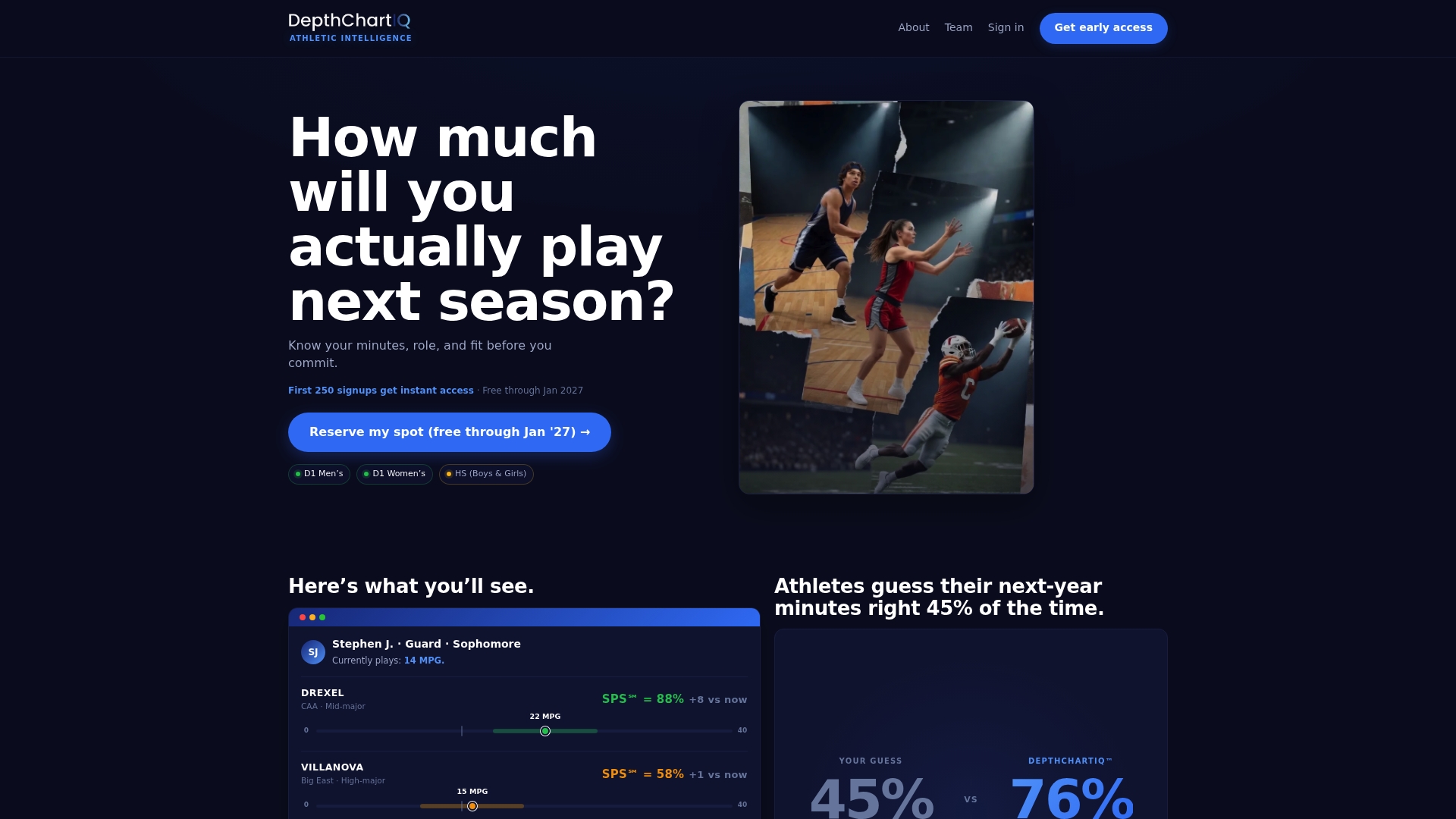
DepthChartIQ gives D1 men’s and women’s basketball athletes a projected minutes-per-game range at each program, a Success Probability Score, a Roster Pressure Score, and best-fit programs. Projections are estimates shown as ranges.
Table of Contents
-
What Does an Over-Recruited Position Warning Actually Look Like?
-
How Predictive Analytics Helps Estimate Your Playing-Time Risk
-
How Do You Communicate With Coaches Without Burning Bridges?
-
Have Players Actually Turned Over-Recruitment Into an Advantage?
-
Author Perspective: Balancing Data and Human Judgment on Roster Decisions
What Does an Over-Recruited Position Warning Actually Look Like?
Coaches and recruiting analysts call this “role compression,” a term borrowed from hiring practices where one job gets stacked with overlapping responsibilities until nobody’s role is clearly defined. In hiring, role compression makes success unlikely when expectations stay vague, and the same logic plays out on a basketball roster: when three or four players are competing for what used to be one clear role, minutes fragment and nobody gets a real runway.
The roster-level tells are usually visible if you know where to look:
-
Recruiting clusters: A program signs two or three players at your exact position in the same class, on top of returners who already play it.
-
Practice idle time: You’re running fewer live reps in practice than last season, even though your effort hasn’t changed.
-
Fragmented minutes: Last season’s box scores show four or five players splitting time at your spot instead of one or two logging heavy minutes.
-
Vague role talk: The coaching staff describes your role in shifting or generic terms (“we’ll see how things shake out”) rather than a specific plan.
-
Repeated recruiting pushes: The staff keeps adding names at your position even after signing what should be enough depth, a pattern similar to what hiring analysts call overhiring, where overlapping roles and idle capacity become the norm.
Any one of these alone isn’t a crisis. Two or three together, especially paired with silence from the coaching staff, is a real warning sign.
How Do You Assess Your Personal Playing-Time Risk?
Treat this like due diligence, not a gut check. Numbers beat vibes here, and the numbers are usually sitting in public rosters, stat archives, and your own memory of practice reps.
-
Count the depth at your position. List every player, by class, who plays your position or an overlapping one.
-
Log incoming eligibility. Note new signees and transfers who are immediately eligible versus those who’ll redshirt or sit a year under transfer rules.
-
Pull last season’s minutes. Compare your per-game average against returners at your spot. A drop of more than a few minutes per game year over year is a flag worth taking seriously.
-
Rate skill overlap. Score yourself honestly against new additions on the two or three skills the coaching staff values most at that position.
-
Track coach language over time. Write down what coaches say about your role in one-on-ones, team meetings, or the media. Contradictions between what you’re told privately and what gets said publicly are a signal, not a coincidence.
A rough rule of thumb: if your position group has grown by two or more bodies since last season without a corresponding graduation or departure, your odds of maintaining your current minutes usually drop, not rise. High-volume recruiting at one spot rarely means more opportunity for everyone in that group. It usually means slower evaluation and worse fit alignment for the staff doing the recruiting, which trickles down as uncertainty for you.
Pro Tip: Ask a coach directly, “What does success look like for me in the next six months?” A specific answer is a good sign. A vague one usually means the staff hasn’t decided your role either, which is its own kind of warning.
Should You Stay, Push for Clarity, or Transfer?
Three paths exist once you’ve run the numbers, and none of them is automatically right. The correct one depends on what your checklist turned up.
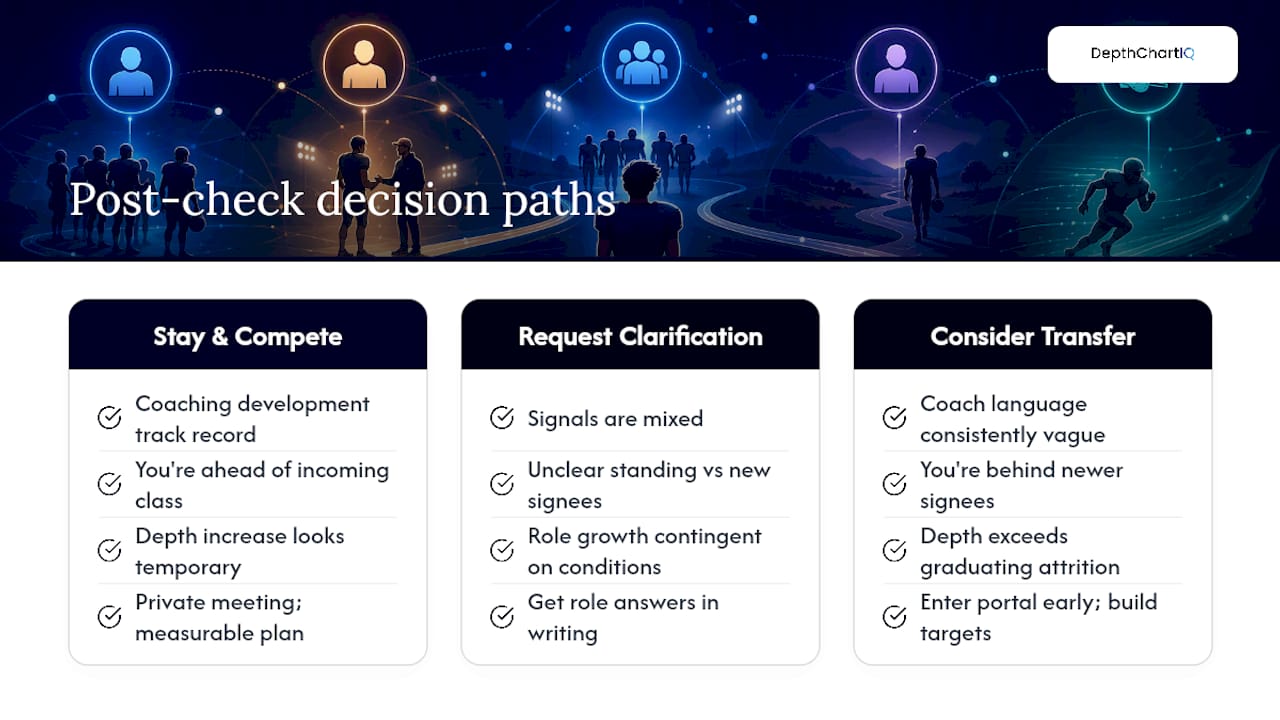
Stay and compete when the coaching staff has a track record of developing players at your position, when your metrics show you’re still ahead of the incoming class on the skills that matter most, and when the depth increase looks temporary (a graduating senior class next year, for example). Concrete steps here: request a private meeting to state your goals, ask for a specific development plan tied to measurable targets, and revisit the conversation every four to six weeks rather than assuming things will sort themselves out.
Request role clarification when the signals are mixed. Ask for a specific answer to three questions: What is my role right now? What would need to happen for that role to grow? Is there a timeline attached to that? Get it in writing if you can, even informally through a follow-up email summarizing the conversation. That documentation matters if the staff’s story changes later.
Consider transferring when the depth chart has grown well beyond graduating attrition, when coach language has been consistently vague across multiple conversations, and when your own metrics show you’re clearly behind newer signees in the skills the staff prioritizes. Timing matters. The NCAA transfer portal windows are tight, and entering early gives you more leverage with receiving programs than waiting until after a season you know is lost. Start building your list of target programs well before you need to make a final call, not after.
What Should You Check Before Targeting a New Program?
A program that looks appealing from the outside can carry the exact same over-recruitment problem you’re trying to escape. Check these before you invest real energy in outreach:
-
Rotation size: How many players actually see meaningful minutes at your position, not just how many are listed on the roster.
-
Minutes distribution: Is playing time concentrated in one or two players, or spread thin across four or five?
-
Incoming class composition: How many new signees are entering at your position for the season you’d actually be eligible to play?
-
Coaching stability: Has the staff turned over recently? New coaches often bring their own recruiting priorities that can reshuffle depth charts fast.
-
Posting patterns: A program that keeps listing an “open” roster spot at your position for multiple cycles, similar to a reposted job listing that signals decisions were already made earlier, may not be as open as it looks.
On calls and visits, ask directly how many players they’re bringing in at your position and what happened to the last two or three players who played your role. Comparing program fit using roster data before you commit time to a visit saves you from repeating the same mistake somewhere new.
Pro Tip: If a staff can’t give you a straight number when you ask how many players they’re recruiting at your position, that’s information too.
How Predictive Analytics Helps Estimate Your Playing-Time Risk
How Does Over-Recruitment Affect You Beyond the Roster?
The psychological toll of watching your position group balloon is real, and it’s rarely talked about in recruiting coverage. Confidence erodes fastest not from losing minutes outright, but from the uncertainty of not knowing if or when it’s coming. Athletes in compressed roles often report a specific kind of anxiety: showing up to practice unsure whether today is the day the staff finally settles the rotation, and carrying that tension into games where every mistake feels magnified.
There’s a career dimension too. Extended stretches in an over-recruited position can quietly erode the tape and stats that future coaches, scouts, or transfer-portal programs will eventually evaluate. A player logging 12 fragmented minutes a game for two seasons has a much thinner résumé than one who logged 25 steady minutes, even if the raw talent is comparable. That gap compounds if you wait too long to act.
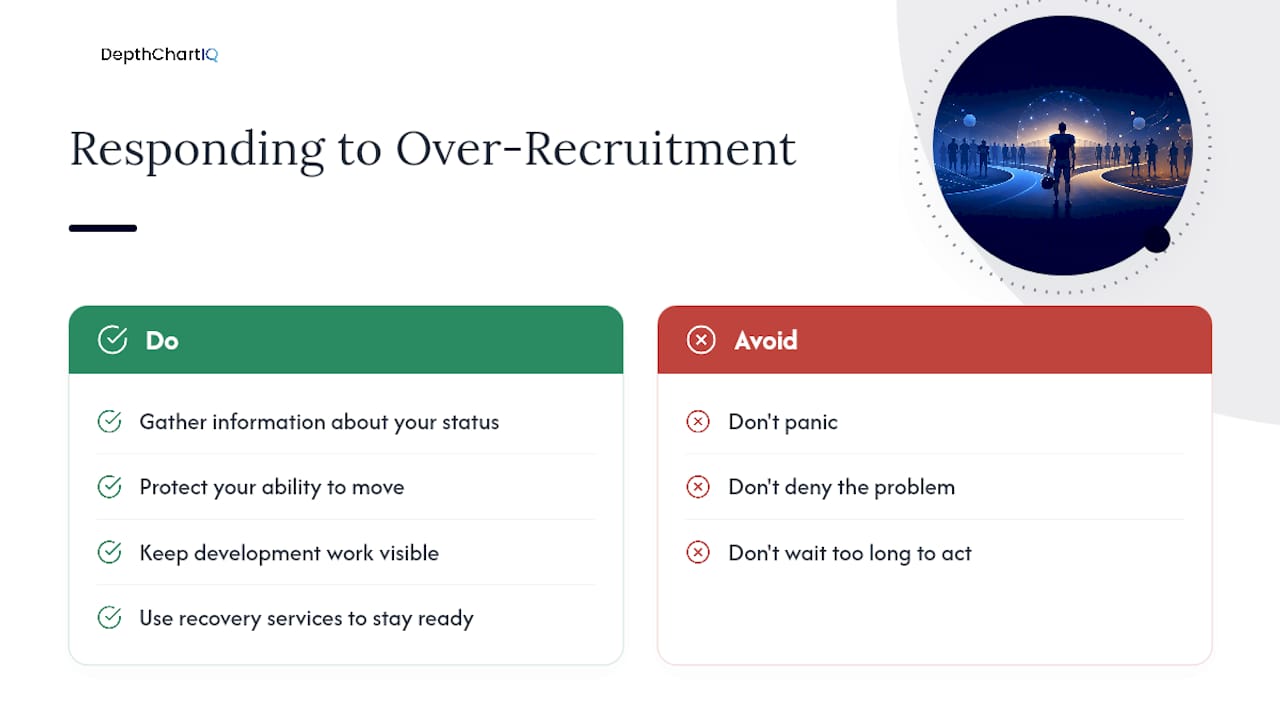
The healthiest response isn’t panic or denial. It’s treating your role the way a professional treats a job that’s becoming redundant: gather information, protect your ability to make a move if needed, and keep your development work visible regardless of how minutes shake out. Staying sharp physically also matters here. Programs like sports recovery services for student-athletes can help you stay ready for whatever opportunity opens, on your current roster or a new one.
How Do You Communicate With Coaches Without Burning Bridges?
Silence rarely improves your standing. Neither does an ultimatum. The middle ground is consistent, low-drama communication that keeps you visible without making every conversation about your playing time.
Schedule check-ins on a set cadence, monthly is reasonable, rather than only reacting after a bad game or a frustrating practice. Come with specific questions (“What’s one thing I should improve this week to earn more reps?”) instead of open-ended complaints. Coaches respond better to players asking for a development target than players asking for reassurance.
Teammates matter here too, more than most players account for. A crowded position group can turn competitive fast, but the players who handle it best treat teammates at their position as measuring sticks, not rivals to undercut. Publicly supporting a teammate who’s playing well, while privately working to close the gap, builds the kind of locker-room reputation that coaches notice and factor into decisions, sometimes more than raw stats do.
Document everything informally. A quick note to yourself after every coach conversation, dated, with the specifics of what was said, gives you a record if promises don’t match outcomes months later. It also gives you clarity when emotions run high after a tough loss or a benching, since you can check what was actually said against what you remember feeling.
Have Players Actually Turned Over-Recruitment Into an Advantage?
The pattern that shows up most often in athletes who navigate a crowded position well isn’t talent separation. It’s decision speed. Players who ran their own version of the checklist early, counting incoming signees, tracking minutes trends, asking direct questions, tended to make their stay-or-go call in weeks, not months. That earlier clarity mattered more than any single skill improvement.
The players who struggled most typically shared one trait: they waited for the coaching staff to resolve the ambiguity for them. In a role compression scenario, that resolution rarely comes on its own. Someone has to force clarity, either by asking pointed questions or by exploring other programs seriously enough that the current staff feels the stakes.
A common thread among the players who transferred successfully out of an over-recruited spot: they didn’t wait for a bad season to prove the point. They started evaluating other programs while still holding value at their current school, using strong practice tape and recent game minutes as leverage rather than negotiating from a position of desperation. Timing the move before the depth chart fully closed in gave them options that a delayed decision would have taken away.
Author Perspective: Balancing Data and Human Judgment on Roster Decisions
Roster depth can change. Keep developing, document conversations with coaches, and protect your academic standing while considering your next move.
Get a Personalized Minutes Forecast With DepthChartIQ Pro
DepthChartIQ is built for athletes and their families. It covers college transfers, stay-or-go decisions, and incoming high-school and JUCO players.
Sources
FAQ
What Is an Over-Recruited Position in College Basketball?
It’s a position where a program has signed or retained more capable players than there are minutes to reasonably distribute among them. This mirrors what hiring analysts call role compression, where too many people are stacked into one lane with unclear expectations.
How Do I Know If My Position Is Over-Recruited?
Check whether your position group has grown without a matching wave of departures, whether minutes fragmented last season across several players, and whether coaches describe your role in vague terms. Two or more of these together are worth taking seriously.
Should I Transfer Immediately If My Position Looks Over-Recruited?
Not immediately. Run your risk assessment first, request role clarification from your coaching staff, and only pursue transfer options if the depth increase looks permanent and the coach conversations stay vague after you’ve asked directly.
Can a Tool Like DepthChartIQ Actually Predict My Playing Time?
DepthChartIQ gives D1 men’s and women’s basketball athletes a projected minutes-per-game range at each program, a Success Probability Score, a Roster Pressure Score, and best-fit programs. Projections are estimates shown as ranges.
What Does DepthChartIQ Pro Cost?
Early Access is free through December 31, 2026. After that, DepthChartIQ Pro costs $19.99 a month or $199.99 a year.