
How to Help Student Athletes Evaluate Program Fit
Discover how to help student athletes evaluate program fit effectively. Ensure they choose a college that aligns with their goals and values.

DepthChartIQ
Athletic Intelligence

How to Help Student Athletes Evaluate Program Fit

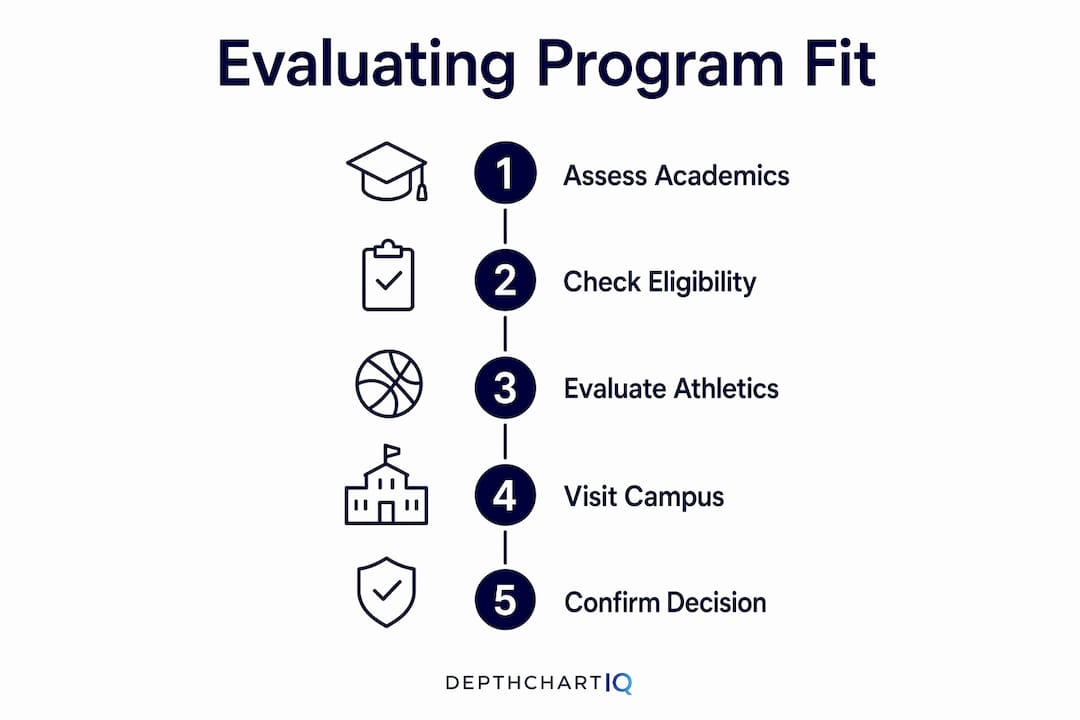
Program fit is the degree to which a college basketball program aligns with your athletic goals, academic needs, eligibility status, and personal values. Most athletes who make poor college choices do not lack talent. They lack a structured framework to help student athlete evaluate program fit before signing. The right program puts you on the floor, keeps you eligible, and supports a degree you can actually finish. The wrong one does one of those three things, if you are lucky. This guide gives you the exact framework to assess every program on your list with the same rigor coaches use to evaluate you.
How to assess academic fit in college basketball programs
Academic fit is the most overlooked factor in student athlete program evaluation, and it is the one most likely to end your career early. The question is not whether a school has good academics. The question is whether you can succeed academically while playing Division I basketball.
Start by verifying whether academic supports are proactive or reactive. Proactive programs monitor your grades before you fall behind and intervene with tutoring, study halls, and advisor check-ins on a scheduled basis. Reactive programs wait for you to ask for help. That distinction matters enormously when you are traveling three weekends a month in January.

Next, map your intended major’s class schedule against a realistic practice and travel calendar. Engineering, nursing, and pre-med programs frequently require labs that conflict with afternoon practices. Ask the academic advisor, not the coach, whether athletes in your intended major graduate on time. Programs that claim all majors are accessible must be verified against actual graduation data for athletes in those fields.
Use two NCAA metrics to benchmark academic performance:
| Metric | What it measures | Benchmark to watch |
|---|---|---|
| Graduation Success Rate (GSR) | Percentage of athletes who graduate within six years | Compare to the school’s overall GSR |
| Academic Progress Rate (APR) | Term-by-term eligibility and retention of scholarship athletes | 930 minimum; 986 is the 2026 national average |
The APR reflects real-time academic success more accurately than graduation rates alone, because it captures eligibility and retention term by term rather than waiting six years for an outcome. A program sitting below 930 faces NCAA penalties. That is a red flag about daily academic culture, not just a number.
Pro Tip: Ask specifically: “What percentage of athletes in my intended major graduate in four years?” A coach who cannot answer that question has not thought about your academic future.
How do you evaluate athletic opportunity realistically?
Athletic opportunity assessment starts with public data, not coach promises. Analyze roster depth by position and class year before your official visit. Count how many players at your position are returning, how many are seniors leaving, and how many recruits are already committed ahead of you. That math tells you more than any recruiting pitch.
Here is a step-by-step process for assessing athletic fit:
- Pull the current roster. Count players at your position by class year. If three sophomores and a junior all play your spot, your path to minutes is narrow regardless of what the coach says.
- Check development history. Look at where players ranked coming in versus where they ended up statistically. Programs that develop players show consistent improvement in minutes and production across years two and three.
- Ask about freshman integration. Specifically ask: “How many freshmen started or played significant minutes last season?” Vague answers signal a program that redshirts or buries newcomers.
- Evaluate coaching stability. A coach who has been at the program fewer than three years carries real roster turnover risk. Check the staff’s tenure and whether the system has changed recently.
- Assess facilities and medical support. Strength and conditioning staff quality, training room access, and sports medicine coverage directly affect your development and injury recovery.
Verify coach answers against public roster data and development history. Coaches are recruiters during the process. Their job is to sell you on the program. Your job is to cross-check everything they say with facts you can find independently.
Pro Tip: Build a simple comparison spreadsheet with columns for each program. Score each factor from 1 to 5: roster opportunity, coaching stability, facilities, development history, and academic support. The scores cut through emotional bias fast.
What does NCAA eligibility certification require?
NCAA eligibility clearance is not automatic, and a delayed or incomplete status at enrollment can cause significant uncertainty during the most critical period of your transition. You need to treat eligibility management as its own project with deadlines.
The core steps for NCAA Eligibility Center registration include:
- Create your account early. Register at the NCAA Eligibility Center as a sophomore or junior in high school, not senior year. Earlier registration gives you time to fix problems.
- Submit all transcripts on time. Your high school counselor must send official transcripts directly to the Eligibility Center. Coordinate this proactively. Do not assume it happens automatically.
- Complete the amateurism questionnaire. Any paid participation in sports, agent contact, or professional tryouts must be disclosed. Incomplete or inaccurate answers delay certification.
- Monitor your status. Log into your Eligibility Center account regularly to check for missing documents or pending items. Waiting for a letter is not a strategy.
- Coordinate with your counselor. Your high school counselor is your most important partner in this process. Give them the Eligibility Center’s requirements in writing and confirm submission dates.
Proactive transcript coordination and amateurism questionnaire completion are the two steps athletes most commonly delay. Both create last-minute clearance problems that can push back your enrollment or practice eligibility. A program that fits you athletically and academically means nothing if you cannot step on the floor in October.
How does team culture reveal itself during a visit?
Team culture is the factor athletes most consistently underestimate and coaches most consistently oversell. Culture reveals itself under pressure, not in highlight videos or official visit dinners.
The most reliable way to assess culture is to talk privately with current players, especially those who play your position. Ask them what the coach is like after a loss. Ask how injured players are treated. Ask whether the coach follows through on what he told them during recruiting. Players who have nothing to hide give you direct answers. Players in a difficult culture give you rehearsed ones.
“The best question I ever heard a recruit ask a current player was: ‘If you could go back, would you choose this program again?’ That one question tells you everything the official visit is designed to hide.”
Beyond player conversations, evaluate these cultural signals:
- How coaches handle adversity. Watch film of their sideline behavior during close losses. Body language and substitution patterns reveal coaching philosophy more clearly than any conversation.
- Academic-athletic balance. Ask players whether they feel supported in pursuing their academic goals or whether basketball always takes priority. The answer should not require hesitation.
- Campus environment. A 40,000-student flagship university and a 4,000-student private college create completely different daily experiences. Neither is wrong, but one fits your personality better.
- Lifestyle compatibility. Consider the city, the social environment, and whether you can see yourself thriving there for four years even if basketball does not go perfectly.
Coaches who give specific, honest answers about player roles and team dynamics demonstrate credibility. Coaches who deflect or generalize are telling you something important about how they communicate when things get hard.
Key takeaways
Evaluating program fit requires combining public academic metrics, roster data, eligibility status, and direct player conversations into a structured decision, not a gut reaction to a great official visit.
| Point | Details |
|---|---|
| Use APR and GSR together | A program’s 2026 national APR of 986 sets the benchmark; scores below 930 signal academic risk. |
| Analyze roster depth independently | Count returning players by position and class year before trusting any coach’s playing time promise. |
| Start eligibility registration early | Register with the NCAA Eligibility Center as a sophomore or junior to avoid last-minute clearance delays. |
| Talk to position peers privately | Ask current players at your position whether they would choose the program again for the most honest read on culture. |
| Score programs on a comparison grid | Assign numerical scores to each fit factor to remove emotional bias from your final decision. |
Why the official visit is the last place to make this decision
I have watched athletes commit to programs after a single official visit and spend four years regretting it. The visit is designed to impress you. The arena looks great, the locker room is spotless, and the coaches are charming. None of that tells you whether you will play, graduate, or be happy.
The athletes who make the best decisions treat the visit as a confirmation step, not a discovery step. They arrive having already analyzed the APR, counted the roster, checked the coach’s tenure, and prepared specific questions for current players. By the time they sit down with the coaching staff, they already know what answers they need to hear and what answers would disqualify the program.
I also want to be direct about something most recruiting guides avoid. Athletic scholarship offers create psychological pressure that distorts judgment. When a Division I program offers you money to play basketball, it feels like validation. It is. But validation and fit are not the same thing. A scholarship to a program where you will not play, cannot finish your major, or will be miserable is a bad deal regardless of the dollar amount.
Use quantitative tools like DepthChartIQ’s roster analysis methodology alongside your own research to ground your decision in data. Then visit, talk to players, and trust what you observe. The combination of structured data and firsthand observation is what separates athletes who thrive from athletes who transfer twice looking for something they could have identified before signing.
— John
See your playing time potential before you commit
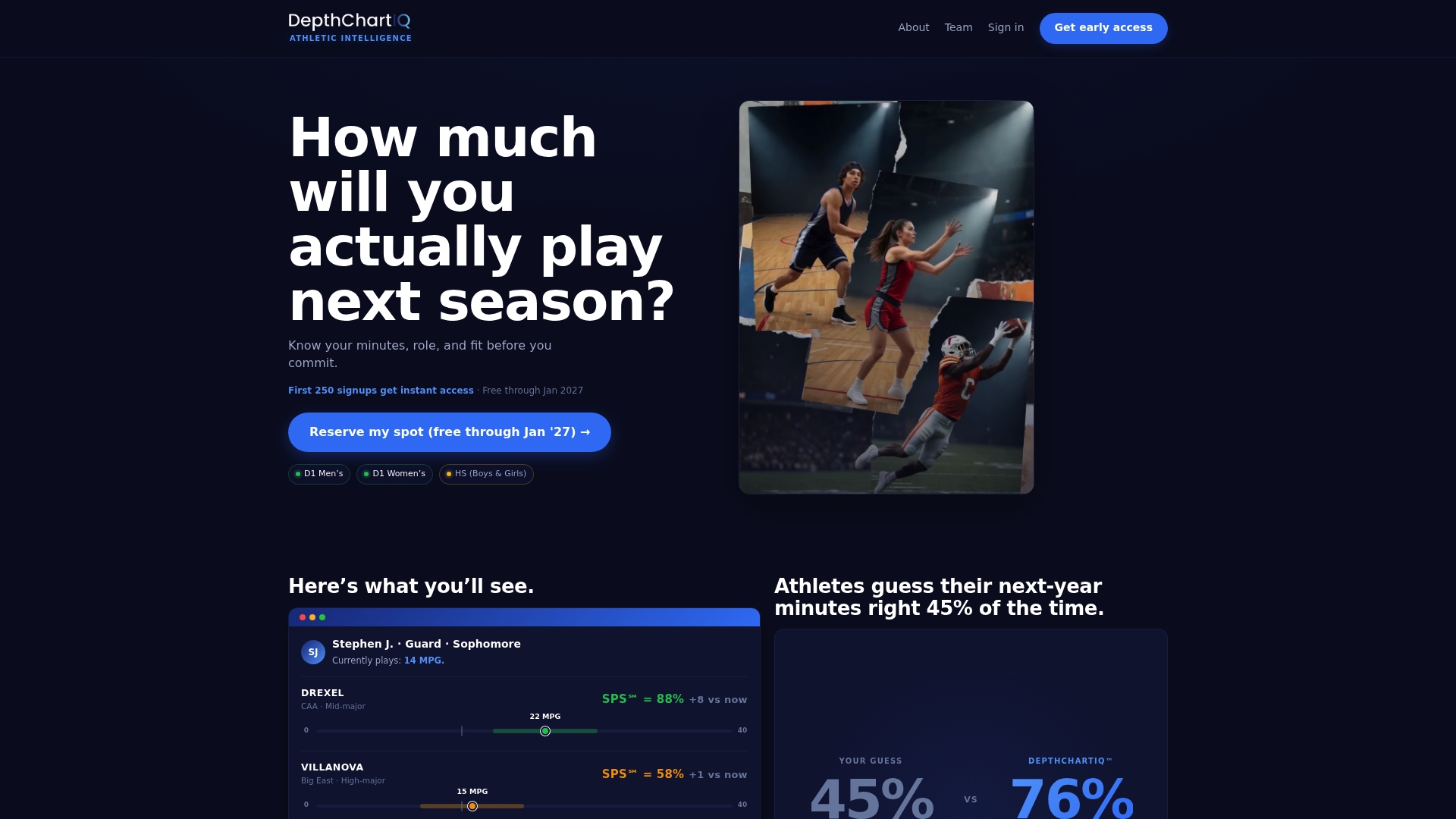
DepthChartIQ gives college basketball players a data-driven view of their realistic playing time potential at any program they are considering. The platform’s roster pressure scores and success probability metrics are built specifically for athletes assessing program fit, whether you are a high school recruit or a current player evaluating a transfer. Instead of guessing whether you will play, you can see exactly where you fit in a program’s depth chart based on real roster data. Explore the DepthChartIQ platform to add objective analysis to your recruitment process before you make one of the most important decisions of your athletic career.
FAQ
What does program fit mean for a college basketball player?
Program fit means the alignment between your athletic ability, academic goals, eligibility status, and personal values with what a specific college program actually offers. A strong fit means you can play, graduate, and thrive at that school.
How do I check a program’s academic quality for athletes?
Use the NCAA Academic Progress Rate and Graduation Success Rate for each program you are considering. An APR below 930 triggers NCAA penalties and signals a weak academic environment for athletes.
When should I register with the NCAA Eligibility Center?
Register with the NCAA Eligibility Center as a sophomore or junior in high school. Early registration gives you time to resolve transcript issues or amateurism questions before they affect your enrollment timeline.
What questions should I ask current players on an official visit?
Ask players at your position whether they would choose the program again, how the coach behaves after a loss, and whether injured athletes receive consistent support. Direct, unprompted answers are the most reliable signal of true team culture.
How do I assess realistic playing time at a program?
Count the number of returning players at your position by class year using the public roster, then compare that against the coach’s recruiting class commitments. That roster math gives you a realistic picture of your opportunity without relying on promises.