
Athletic Department Roster Strategy: A 2026 Guide
Discover what athletic department roster strategy involves and how it shapes college sports in 2026. Learn effective management techniques today!

DepthChartIQ
Athletic Intelligence

Athletic Department Roster Strategy: A 2026 Guide

Athletic department roster strategy is the deliberate management of a college sports program’s player roster within NCAA limits, using recruitment, transfer portal activity, eligibility audits, and financial planning to build competitive, compliant, and sustainable teams. The term most athletic directors and compliance officers use is roster management, though the broader strategic framework now encompasses scholarship allocation, NIL budgeting, and multi-year scenario planning. Under the 2025 NCAA roster reforms, every Division I program faces a fundamentally different operating environment. Platforms like Teamworks Personnel and workflows like Michigan State’s transfer portal process illustrate how the most competitive programs are responding.
What is athletic department roster strategy under 2025 NCAA rules?
The NCAA Division I Board replaced sport-specific scholarship caps with maximum roster-size caps across all sports, effective July 1, 2025. Football moved from 85 scholarships to a 105-player roster limit. That shift is not just arithmetic. It means programs can now distribute scholarship dollars across every rostered athlete rather than being locked into a fixed number of full scholarships, which creates both flexibility and new financial risk.
The flexibility is real but bounded. A program can roster more players than before, but total scholarship spending is still constrained by budget. Athletic directors who treat the new roster limits as an invitation to expand headcount without a corresponding financial plan will find themselves over-committed within two recruiting cycles.
Walk-on management becomes a direct strategic variable under this model. Previously, walk-ons existed largely outside scholarship accounting. Now, non-scholarship roster inflation counts against total roster caps, which forces programs to make deliberate decisions about who earns a roster spot regardless of scholarship status. Title IX compliance adds another layer. Adding roster slots in one sport triggers proportionality obligations in others, so gender equity planning must be integrated into every headcount decision from the start.

Pro Tip: Run a Title IX impact analysis before finalizing any roster expansion decision. Adding five walk-ons to a men’s program may require corresponding additions on the women’s side to maintain proportionality.
| Sport | Previous scholarship cap | 2025 roster limit |
|---|---|---|
| Football | 85 | 105 |
| Men’s basketball | 13 | 15 |
| Women’s basketball | 15 | 15 |
| Baseball | 11.7 (equivalency) | 34 |
The table above illustrates how the shift from scholarship caps to roster limits changes the planning calculus sport by sport. Programs that previously managed to a scholarship number now manage to a headcount, and those are fundamentally different constraints.
How does the transfer portal fit into roster management?
The transfer portal now functions as a free agency market for college programs, and the most effective programs treat it that way. Rather than using the portal to build general depth, competitive programs enter each portal window with specific positional targets tied to identified roster gaps. That discipline separates programs that use the portal well from those that accumulate transfers without a coherent plan.
Most programs maintain roughly a 70-30 split between high school recruits and portal transfers. That ratio reflects a deliberate philosophy. High school recruiting builds program culture, develops players over multiple years, and creates roster continuity. Portal activity fills immediate competitive needs. Tilting too far toward the portal creates a roster that turns over almost entirely every two years, which compounds uncertainty and makes long-term development nearly impossible.
Here is how a well-run portal recruitment cycle typically operates:
- Conduct a post-season roster audit. Identify departing players, expiring eligibility, and positional gaps before the portal window opens.
- Rank needs by competitive priority. Not every gap is equal. A starting point guard vacancy is a different problem than losing a backup forward.
- Run eligibility and academic credit checks early. Michigan State’s compliance team delivers credit transferability results within 24 hours during active transfer windows, which is a direct competitive advantage.
- Align NIL budget to target tier. Know what you can offer before you make contact, not after.
- Move quickly once a target clears eligibility. Time-to-offer gaps cost programs top portal targets more often than compensation gaps do.
Pro Tip: Treat your portal target list like a depth chart. Have a primary target, a secondary target, and a fallback for each position need. Portal windows close fast, and programs without contingency plans often end a window with unresolved gaps.
Over-reliance on the portal carries real costs. Roster discipline reduces long-run regret caused by frequent turnover. Programs that cycle through rosters annually often sacrifice the compounding benefits of player development, team chemistry, and coaching continuity that produce sustained winning records.
What role do data tools and scenario planning play in roster strategy?
Roster strategy increasingly resembles professional sports management, complete with draft-like recruiting, free-agent portal activity, and salary-tier budgeting. That complexity demands tools built for it. Spreadsheets and email chains cannot manage multi-year roster scenarios, NIL contract tracking, and eligibility status simultaneously without introducing errors.
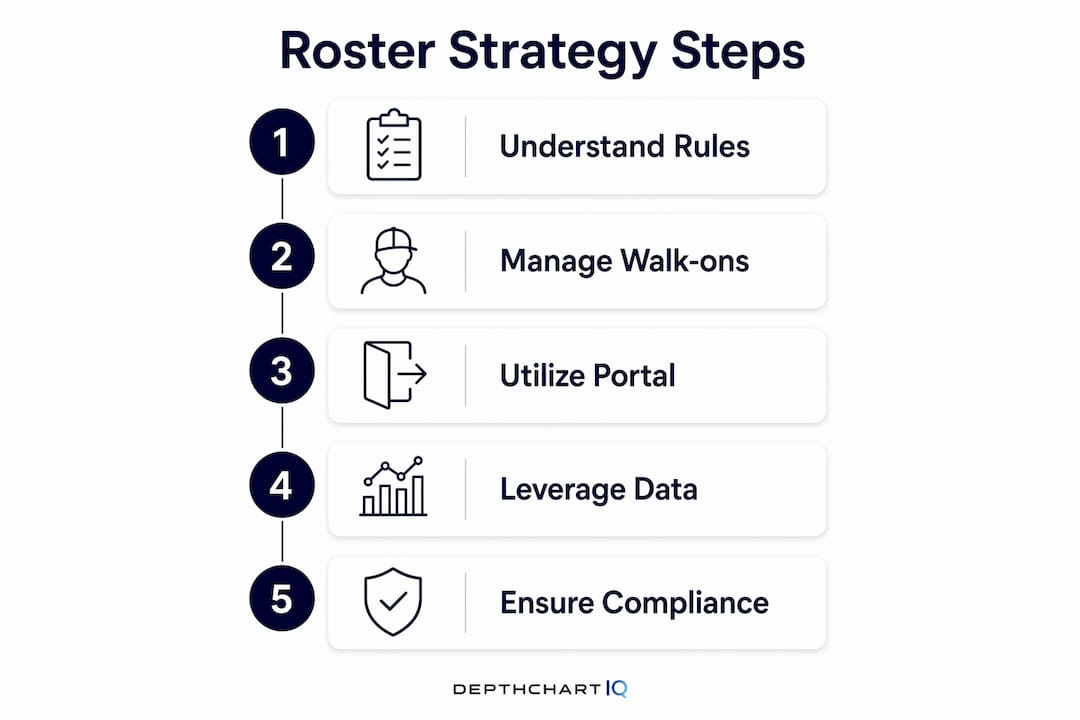
Platforms like Teamworks Personnel provide centralized analytics and contract management tools designed specifically for college athletics. The core value is integration. When budgeting, eligibility status, NIL earnings, and roster headcount live in the same system, scenario planning becomes a practical daily activity rather than a quarterly exercise.
Key capabilities that define a useful roster management platform:
- Scenario modeling. Simulate the roster and financial impact of adding a transfer, losing a player to the portal, or adjusting scholarship distribution before committing.
- NIL contract tracking. Monitor total athlete earnings against budget allocations in real time.
- Eligibility status dashboards. Flag academic or compliance risks before they become roster emergencies.
- Multi-year projections. Map roster composition and scholarship spend two to three years forward to avoid cliff years where multiple starters depart simultaneously.
Virginia’s athletic department formalized this integration by creating a Deputy Athletics Director role that combines roster and cap management with external operations. That structural decision signals how seriously leading programs treat the intersection of finance and roster planning. It is no longer a back-office function. It is a front-office priority.
How do program philosophy and budget shape roster construction?
Roster construction philosophies vary widely across programs, and no single approach dominates. The right strategy depends on budget, coaching style, institutional priorities, and competitive tier. A mid-major program with a $4 million NIL budget constructs its roster differently than a Power Four program with $20 million to deploy.
Three broad philosophies define the current landscape:
- Continuity-first programs prioritize retaining role players and developing talent over multiple years. They use the portal sparingly and invest heavily in athlete development and coaching relationships. This model produces roster stability but can leave programs exposed when key players transfer unexpectedly.
- Portal-heavy programs treat each offseason as a near-complete roster rebuild. They move quickly in transfer windows and allocate the majority of NIL budget to incoming players. This model can produce rapid competitive improvement but creates culture and continuity risks.
- Hybrid programs balance both channels. They recruit high school players for positional depth and long-term development while using the portal to address specific competitive gaps. Most successful programs at the high-major level operate this way.
NIL spending strategy is inseparable from roster philosophy. Tiered NIL allocation models group players into standardized spending brackets, such as all-conference level, starter level, and developmental, which reduces negotiation friction and maintains budget discipline. Programs that negotiate every contract individually without a tier structure often overpay for secondary contributors while underpaying for primary ones.
The influence of team psychological dynamics on roster construction is underappreciated. Coaches who build psychologically safe environments retain players longer and attract transfers who prioritize culture alongside compensation. That retention effect has direct budget implications.
What operational processes make roster audits and compliance work?
A roster audit is the systematic review of every player’s eligibility status, academic standing, scholarship assignment, and contract obligations at a defined point in time. Programs that conduct formal audits at least twice per year, once before the fall semester and once before the portal window opens, catch compliance risks before they become NCAA violations or roster emergencies.
Michigan State’s transfer portal workflow is the clearest public example of cross-functional coordination done well. The process works as follows:
- Coaching staff identifies a portal target and submits the name to compliance.
- The compliance office runs an NCAA eligibility audit, checking transfer rules, years of eligibility remaining, and any previous transfer history.
- The registrar evaluates academic credit transferability against Michigan State’s degree requirements.
- Student-athlete support services assesses academic risk and support needs.
- Results from all three units are consolidated and delivered to the coaching staff, typically within 24 hours.
That speed matters. In a portal window where a sought-after player may receive five offers in 48 hours, a program that takes four days to clear eligibility loses the target before it can make an offer. Speed and accuracy in compliance workflows are competitive advantages, not administrative overhead.
The compliance function also integrates with Title IX monitoring. Every roster addition or subtraction must be evaluated against the program’s gender equity obligations, which means the compliance office needs real-time visibility into headcount across all sports simultaneously.
Key takeaways
Effective athletic department roster strategy requires integrating NCAA compliance, financial planning, and transfer portal discipline into a single coordinated process rather than treating each as a separate function.
| Point | Details |
|---|---|
| NCAA roster limits changed in 2025 | Football expanded to 105 roster slots, requiring headcount planning beyond scholarship counting. |
| Portal strategy requires discipline | A 70-30 high school to portal split maintains stability while addressing competitive gaps efficiently. |
| Compliance speed is a competitive edge | Michigan State delivers eligibility results within 24 hours, enabling faster offers than slower programs. |
| Tiered NIL models reduce budget risk | Predefined spending brackets prevent overpaying secondary contributors and maintain negotiation discipline. |
| Scenario planning tools are now standard | Platforms like Teamworks Personnel centralize budgeting, eligibility, and contract data for multi-year planning. |
The uncomfortable truth about roster strategy most programs ignore
I have spent years watching athletic departments treat roster management as a reactive function rather than a proactive one. The programs that struggle most are not the ones with the smallest budgets. They are the ones that make roster decisions in isolation, where the compliance office learns about a transfer target the same day the coach makes an offer, where the budget office finds out about an NIL commitment after the contract is signed.
The shift from scholarship caps to roster limits in 2025 exposed how many programs were operating without a real roster strategy at all. They had recruiting processes and compliance checklists, but not an integrated framework that connected headcount decisions to financial projections to eligibility timelines. That gap is now expensive.
What I find most telling is the Virginia model. Creating a Deputy Athletics Director role that explicitly combines roster and cap management signals that the most forward-thinking programs have stopped treating roster strategy as a coaching function with administrative support. It is now a front-office discipline with its own leadership, its own data infrastructure, and its own accountability structure.
The programs that will build sustainable competitive advantages over the next five years are the ones that treat every roster decision as a financial and compliance decision simultaneously, not sequentially. That requires cross-functional coordination that most athletic departments have not yet built. The tools exist. The frameworks exist. The gap is organizational will.
— John
How Depthchartiq supports smarter roster decisions
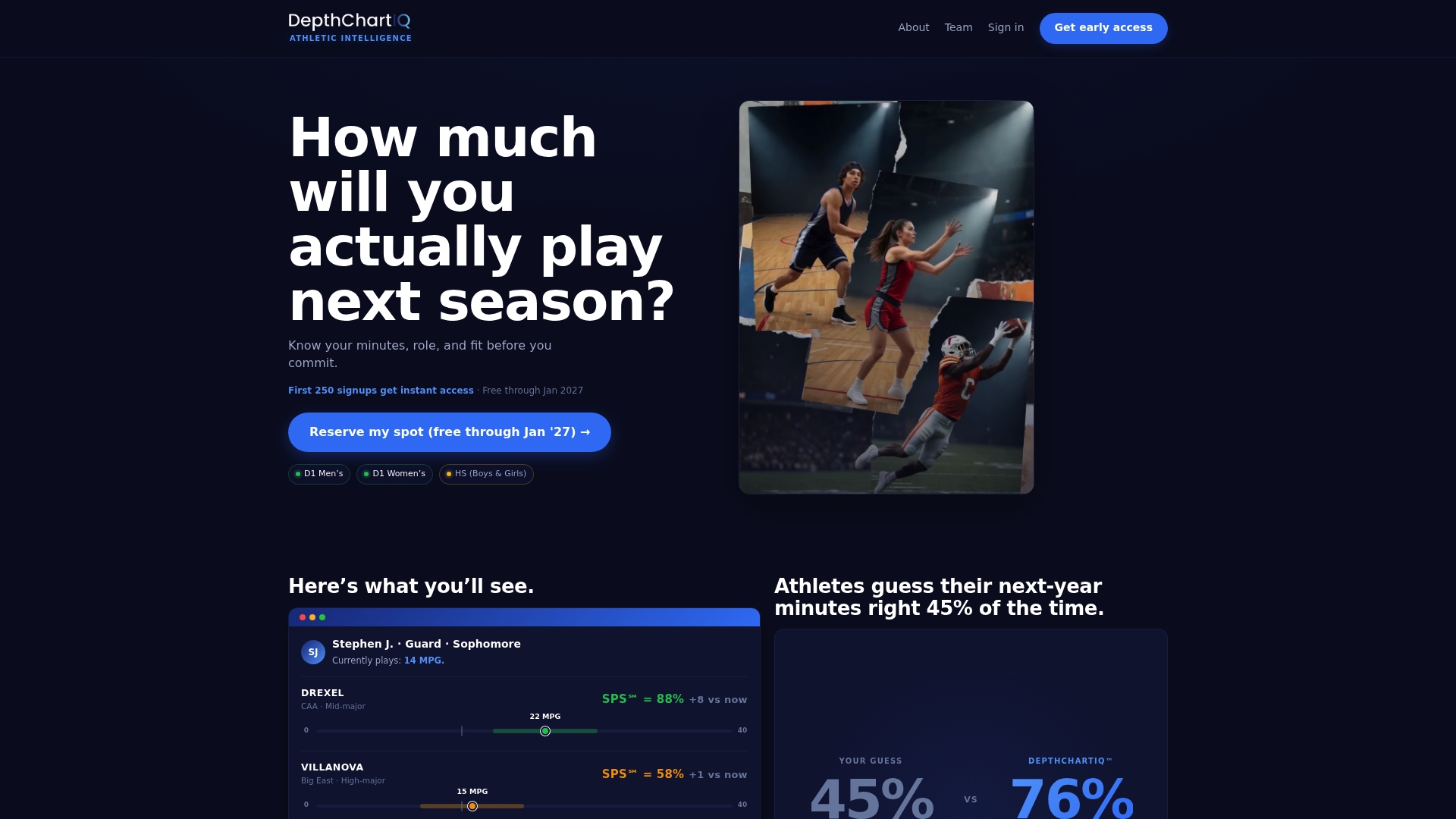
Depthchartiq gives college basketball players and programs a data-driven view of how roster changes affect playing time and competitive fit. The platform’s scenario planning methodology models roster pressure, predicts player outcomes with 76% accuracy, and delivers real-time updates as transfer portal activity shifts the competitive picture. For athletic departments building out their roster management infrastructure, Depthchartiq provides the athlete-level intelligence that connects program-level roster decisions to individual player outcomes. Whether you are evaluating a transfer target’s fit or helping a current player understand their role under a new roster configuration, the platform turns roster complexity into clear, usable data. Explore how Depthchartiq supports your department’s planning process.
FAQ
What is athletic department roster strategy?
Athletic department roster strategy is the coordinated management of a college sports program’s player roster, covering NCAA compliance, scholarship allocation, transfer portal activity, NIL budgeting, and eligibility audits to build competitive and sustainable teams.
How did the 2025 NCAA changes affect roster management?
The NCAA replaced scholarship caps with roster limits effective July 1, 2025, expanding football to 105 roster slots and requiring programs to manage total headcount, including walk-ons, within new caps that also trigger Title IX obligations.
What is a roster audit in college athletics?
A roster audit is a formal review of every player’s eligibility status, academic standing, scholarship assignment, and contract obligations, conducted to identify compliance risks and inform recruiting decisions before portal windows open.
How do programs balance high school recruiting and the transfer portal?
Most competitive programs maintain roughly a 70-30 split between high school recruits and portal transfers, using high school recruiting for long-term development and the portal to fill specific positional gaps identified through post-season roster audits.
Why does compliance speed matter in transfer portal strategy?
Programs that deliver eligibility and academic credit results faster can make offers before competitors, and Michigan State’s cross-functional workflow demonstrates that a 24-hour turnaround on eligibility audits directly improves a program’s ability to secure top portal targets.